
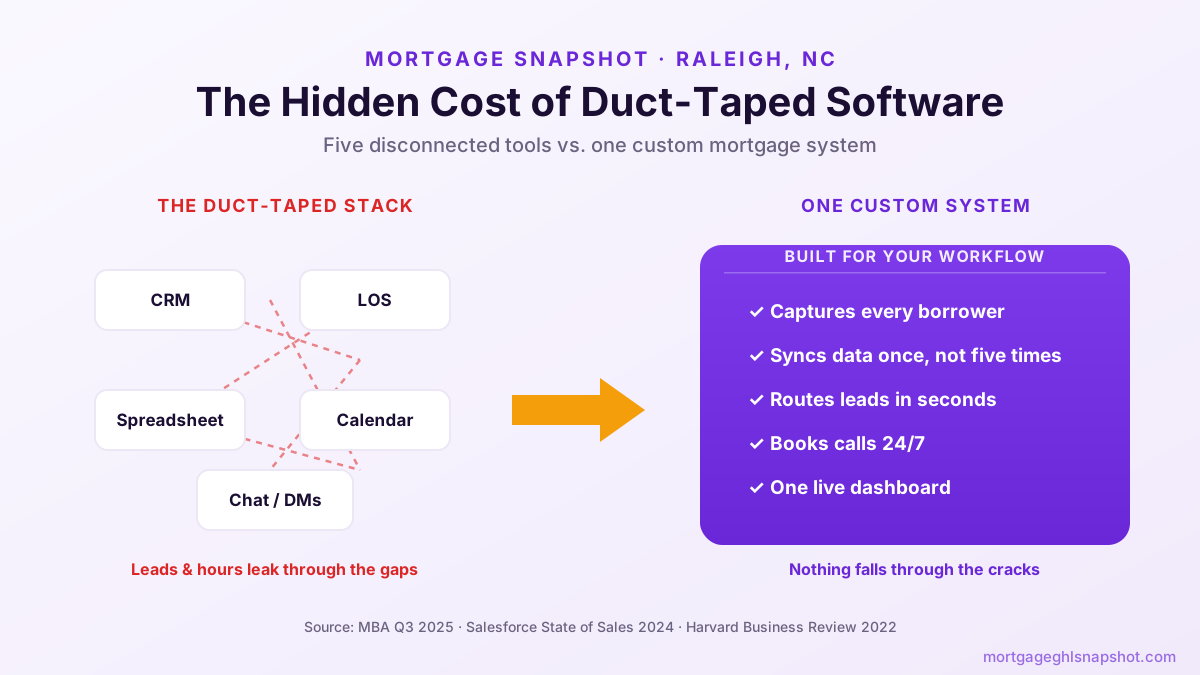
A Raleigh loan officer starts Tuesday with a borrower in the LOS, a follow-up list in a spreadsheet, a calendar that lives in a different tab, a CRM nobody fully trusts, and a phone full of unanswered DMs. Nothing is broken, exactly. It all works. And that is the problem — because the seams between those tools are where borrowers quietly slip away, where the same address gets typed four times, and where an afternoon disappears into copy-paste instead of conversations. In a market where it costs more than eleven thousand dollars to produce a single loan, the software you duct-taped together to save money may be the most expensive thing in your business.
Raleigh mortgage brokers lose deals to duct-taped software because stitched-together tools leak leads in the gaps between apps, force loan officers to re-enter the same borrower data over and over, and hide your pipeline across five dashboards that never agree. Custom-built software fixes it by connecting your LOS, CRM, calculators, portals, and booking into one system shaped around how your firm actually works — so data is entered once, leads are routed in seconds, and your team spends its hours selling instead of swivel-chairing between tabs. This guide breaks down the real, sourced cost of the duct-tape stack, what “custom software” actually means for a mortgage business, and how to decide when it’s worth building.
The short answer: what duct-taped software really costs
“Duct-taped software” is the stack almost every growing mortgage shop ends up with: a loan origination system for the file, a separate CRM for contacts, a spreadsheet for the follow-up list, a scheduling app for appointments, an email tool, a texting tool, and a couple of social inboxes — none of which talk to each other. Each tool is fine on its own. The cost is in the gaps.
Those gaps show up in three places. First, time: someone has to move data between the tools by hand, and that someone is usually your highest-value person. Second, leads: a borrower who fills out a form in one system but doesn’t get routed into the follow-up in another simply goes cold. Third, truth: when the pipeline lives in five places, no dashboard is right, so decisions get made on gut instead of data.
None of this is dramatic. No single dropped lead announces itself. That’s exactly why it’s dangerous — the duct-tape tax is invisible on any given day and enormous over a quarter. The rest of this guide puts real, sourced numbers on it, then shows what replacing the seams with one custom system does to each cost.
The 5 hidden costs of a stitched-together stack
1. Hours lost to swivel-chair data entry
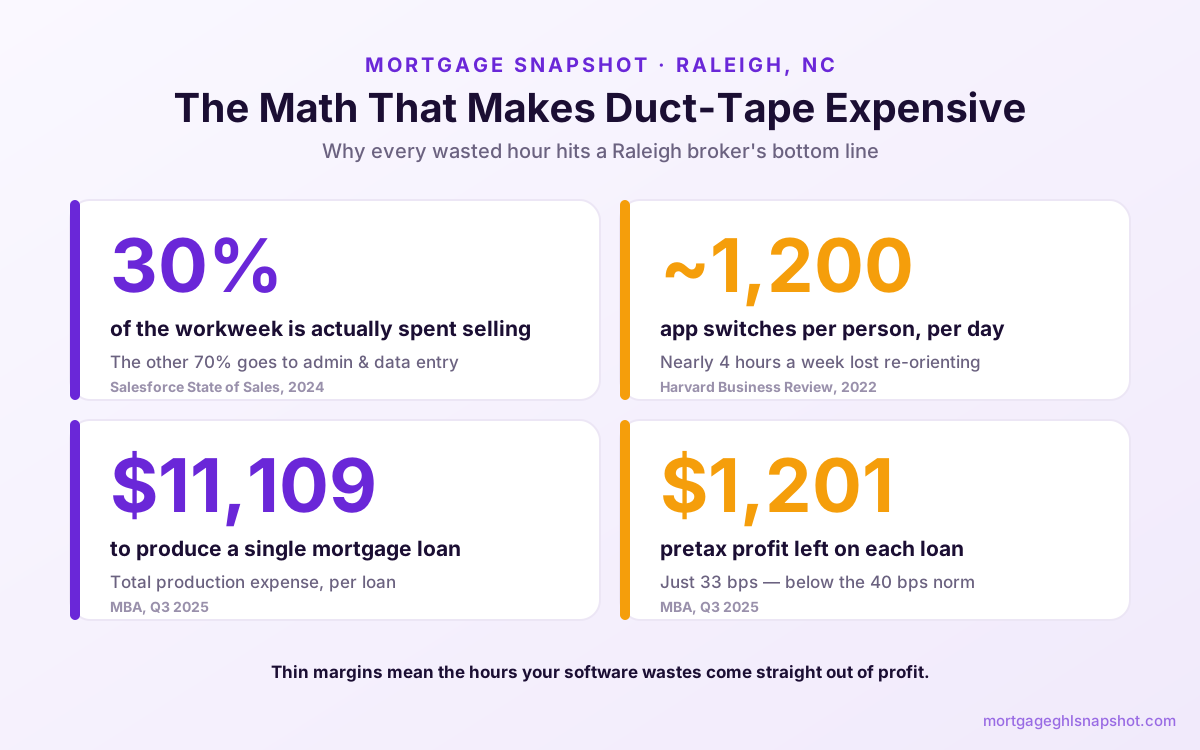
The single biggest hidden cost is a person retyping data a computer should move. When your LOS, CRM, and spreadsheet don’t sync, every new borrower is entered two or three times, and every status change has to be copied by hand. It adds up fast: across industries, sales reps spend less than 30% of their time actually selling, with the rest consumed by admin, internal meetings, and manual data entry (Salesforce, State of Sales).
The tool-switching itself has a measured price. A Harvard Business Review study of workers across three large firms found people toggled between applications about 1,200 times a day, adding up to just under four hours a week — roughly 9% of their time — simply re-orienting after each switch (Harvard Business Review, 2022). For a Raleigh loan officer, four hours a week is a full afternoon that could have gone to borrowers or referral partners.
Where the sales workweek goes. Source: Salesforce, State of Sales.
2. Leads that die in the gaps between tools
A borrower doesn’t care how many apps you run — they care whether anyone answers. When a lead lands in a form, a DM, or a missed call and the routing to your follow-up lives in a different system, the response clock keeps ticking while your team is heads-down in the LOS. That delay is where deals die: a lead contacted within 5 minutes is 21× more likely to qualify than one contacted after 30 minutes (MIT / InsideSales). And most firms are slow — an audit of 2,241 U.S. companies found a median first-response time of 42 hours, with 24% never responding at all (Harvard Business Review, 2011). Every seam in your stack is a place the clock can run out. This is the same speed-to-lead math we break down in our speed-to-lead playbook and lead-conversion guide.
3. Dirty, duplicate data you can’t trust
When the same borrower exists in three systems, they exist three different ways — one has the old phone number, one has the wrong loan type, one is missing the co-borrower. Poor data quality is estimated to cost the average organization about $12.9 million a year (Gartner). In a mortgage shop, that abstract number becomes concrete: duplicate contacts that get texted twice, pre-approvals that expire because the follow-up fired against a stale record, and a database you can’t reactivate because you don’t trust what’s in it. A single system with one record per borrower is the only real fix.
4. A borrower experience stuck in email and phone tag
Buyers now expect to check status, upload documents, and get answers without waiting on a callback. A duct-taped stack can’t deliver that — so borrowers and agents call you for updates instead, and every “where’s my loan?” call is an interruption that pulls a loan officer out of selling. Firms that stand up a borrower document portal or a loan-status portal collect files faster and cut the status-call load — but only when the portal is wired into the same system that holds the file, not bolted on as a sixth disconnected tool.
5. Thin margins that make every wasted hour real money
Here’s why all of the above matters more in 2026 than it did five years ago: the margin cushion is gone. Independent mortgage banks made just $1,201 of pretax profit per loan in Q3 2025 — about 33 basis points, still below the long-run quarterly average of 40 bps — while it cost $11,109 to produce each loan (Mortgage Bankers Association, 2025). Production costs have stayed elevated all year, though they eased from a Q1 2025 peak of $12,579 (MBA, Q1 2025) to $10,965 in Q2 (MBA, Q2 2025). When you keep about $1,200 on an $11,000 cost to produce, an afternoon lost to copy-paste and a handful of leads dropped in the seams aren’t rounding errors — they’re the difference between a profitable month and a flat one.
Total cost to produce a single mortgage loan, per quarter (USD). Source: Mortgage Bankers Association, 2025.
Why off-the-shelf tools hit a ceiling for mortgage
Off-the-shelf tools are how every firm should start — they’re cheap, fast, and good enough at the beginning. The problem is what happens as you grow. Generic software is built for the average business, and a mortgage operation is not average: it has a 1003 intake, program-specific math (FHA UFMIP, VA funding fees, DTI and LTV thresholds), a compliance layer, referral-partner co-marketing, and a borrower who needs to be nurtured for months between “just looking” and “ready to apply.”
So you bolt on a plugin for calculators, another for texting, a spreadsheet for the pipeline the CRM can’t model, and a Zapier zap holding two of them together with a string. Each addition is reasonable. The sum is a stack where you are the integration — the human API moving data between tools that were never designed to meet. That’s the ceiling: not that any one tool is bad, but that no off-the-shelf tool bends to your process, so you end up bending your team to theirs.
A platform like GoHighLevel raises that ceiling a lot, because it collapses the CRM, calendar, texting, email, and pipeline into one place. For most originators that consolidation alone is the win, and it’s exactly what our snapshot installs. But some firms have a workflow, a data model, or an integration that even a great platform can’t cover out of the box — and that’s where custom development starts.
What “custom software” actually means for a mortgage firm
“Custom software” sounds like a two-year, six-figure moonshot. For a mortgage business it usually isn’t. It means building the specific pieces that close the gaps in your stack — and nothing you don’t need. The most common builds:
- LOS-to-CRM connectors. A two-way sync so a loan created or updated in your LOS flows into your CRM automatically — no retyping, no stale records. This is the single highest-ROI build for most shops, and connectors typically start around $3K–$8K (see /ghl-development).
- Borrower & application portals. A branded, secure place where borrowers complete a 1003-lite intake, upload documents, and track status themselves — wired into the same system that holds the file. This is the difference between a real document portal and another inbox.
- Loan-milestone dashboards. One live view of every file’s stage, the whole team’s pipeline, and the follow-ups that are due — instead of five dashboards that disagree.
- AI agents for the repetitive conversations. An AI chatbot or AI caller that answers borrower questions, qualifies interest, and books consultations 24/7, then drops the full context into your CRM.
- A fast, lead-capturing website. A prebuilt or custom mortgage site with calculators that feed the same system, so the top of the funnel isn’t a sixth disconnected tool either.
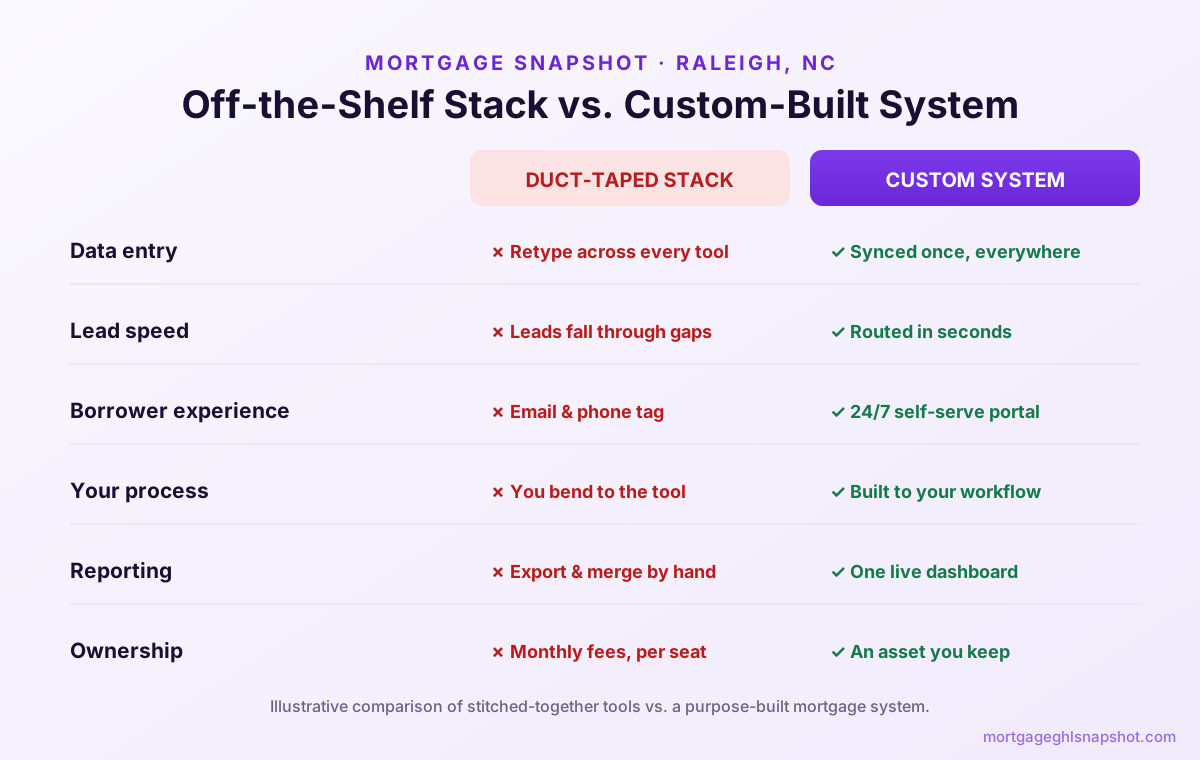
The pattern across all of these is the same: enter data once, let the system move it, and give every borrower one continuous experience. Here’s the before-and-after in plain terms:
| What happens | Duct-taped stack | Custom-built system |
|---|---|---|
| A new borrower comes in | Typed into 2–3 tools by hand | Entered once, synced everywhere |
| A web lead or DM arrives | Waits until someone checks that app | Routed and followed up in seconds |
| Borrower wants a status update | Calls you; you go look it up | Self-serves in a 24/7 portal |
| You need your real pipeline | Export and merge spreadsheets | One live dashboard, always current |
| Your process is unusual | You bend to the software | The software is built to your workflow |
| What you own at the end | A stack of monthly per-seat fees | A system that’s an asset you keep |
Not every firm needs a full custom build, and a good partner will tell you when a configured platform already covers you. If you’re weighing that call, our mortgage CRM buyer’s guide walks through what to buy versus build before you spend a dollar on development.
The Raleigh angle: why the Triangle makes this urgent
Raleigh is one of the worst places in the country to be slow. The Triangle’s relocation boom keeps demand high and competition fierce: the median home in Raleigh sold for around $459,000 in mid-2025, up 1.8% year over year, with homes going under contract in roughly 27 days (Redfin, Raleigh housing market). A market that moves in under a month is a market where the loan officer who answers first wins — and where a lead lost in the seams of your software is a lead your competitor closes.
The borrowers driving that demand — tech workers relocating to RTP, first-time buyers, move-up families — expect a modern, digital experience. They’ll fill out a form at 10 p.m., upload a pay stub from their phone, and DM you a question before they ever pick up a call. A duct-taped stack can’t meet them there. A system built to capture every one of those touchpoints and route them instantly can. That’s the same reason Triangle-area and North Carolina firms invest in GHL integrations and, when they’ve outgrown a generic setup, migrate onto a system built for the mortgage workflow.
Duct tape vs. custom: how to decide
You don’t fix a duct-taped stack by adding a seventh tool. You fix it by deciding, honestly, which of three levels you actually need:
- Consolidate first. If your pain is just too many disconnected apps, the answer usually isn’t custom code — it’s moving onto one platform that already does most of it. Our done-for-you snapshot collapses CRM, calendar, texting, calculators, and pipeline into a single GoHighLevel system, installed in about 24 hours. Start here; it’s the cheapest fix and it’s enough for most originators.
- Configure and connect. If the platform covers 90% but you have one integration or workflow it can’t handle out of the box — say, your specific LOS, or a referral-partner co-marketing flow — a targeted GHL development build closes that last gap without rebuilding everything.
- Build what’s truly yours. If your competitive edge is a workflow, a portal, or a data model no platform offers, that’s when custom software earns its keep — a purpose-built application you own outright.
A simple test: if the thing eating your week is switching between tools, consolidate. If it’s one stubborn gap between otherwise-good tools, connect it. If it’s a process no software models, build it. And if you’re not sure, talk to a real person before you spend — the right answer is often the smallest one. Don’t have the in-house capacity to run any of it? A dedicated GHL specialist can operate the system for you so you stay on the loans.
Keeping borrower data compliant and secure
Custom software touches sensitive borrower data — Social Security numbers, income, bank statements — so the build has to respect the same rules a lender lives by. That means encrypted storage and transit, role-based access so staff see only what they need, an audit trail of who touched what, and consent-aware messaging. Under TCPA, automated texts and calls require prior express consent and a working opt-out, and every borrower record should carry the proof of that consent — which is far easier when consent lives in one system instead of scattered across tools. Mortgage Snapshot is not a lender and doesn’t make loans, quote rates, or pre-approve borrowers; our role is the software and automation layer, built so your team can move fast without skipping the steps that keep you compliant. When you scope a build, put security and consent handling in the requirements from day one — retrofitting them later is where firms get into trouble.
Frequently asked questions
What counts as "custom software" for a mortgage broker?
It's software built to your specific workflow rather than bought off the shelf — most often an LOS-to-CRM connector, a borrower or loan-application portal, a live pipeline/milestone dashboard, or an AI agent that handles borrower conversations. The goal is to close the gaps between your existing tools so borrower data is entered once and moves automatically. Many firms only need one or two of these pieces, not a ground-up platform.
Do I actually need custom software, or is GoHighLevel enough?
For most originators, a well-configured GoHighLevel system is enough — it consolidates CRM, calendar, texting, email, calculators, and pipeline into one place, which solves the tool-sprawl problem on its own. Custom development is worth it when a platform covers 90% but can't handle a specific integration, workflow, or data model your business depends on. Our advice is to consolidate first, then only build the last gap. See our mortgage CRM buyer's guide for the buy-vs-build decision.
How much does custom mortgage software cost?
It depends on scope. LOS-to-CRM connectors typically start around $3,000–$8,000, custom AI borrower chatbots run higher, and full milestone dashboards or marketplace apps are larger builds. Every fixed-price build includes a 30-day bug-fix warranty, and ongoing maintenance is available via a dedicated specialist or an hourly retainer. You can see current ranges on our GHL development and custom software pages, or book a call for a scoped quote.
Why is a duct-taped stack so expensive if each tool is cheap?
The cost isn't in the tools — it's in the gaps between them. Someone has to move data by hand (reps spend under 30% of their time selling), leads die while the response clock runs out in the seams, and duplicate records make your pipeline untrustworthy. With independent mortgage banks earning only about $1,201 of pretax profit per loan in Q3 2025, those invisible losses come straight out of a thin margin.
Will a custom build disrupt my current pipeline while it's built?
It shouldn't. Good builds are phased — the connector or portal is built and tested alongside your live system, then switched on once it's verified, so no active files are put at risk. Data is migrated with one record per borrower to clean up duplicates in the process, and security and TCPA consent handling are scoped in from the start rather than retrofitted later.
Is my custom software available to mortgage firms outside Raleigh?
Yes. We work with mortgage brokers and loan officers across North Carolina — Raleigh, Durham, Cary, Chapel Hill, Apex — and nationwide. The Raleigh examples here are illustrative; the same connectors, portals, dashboards, and AI agents apply to any U.S. mortgage business drowning in disconnected tools.
About the author
Emilio Duarte is a GHL Automation Lead for the mortgage niche, based in Tampa, FL. He builds GoHighLevel snapshots and custom connectors for mortgage brokers and loan officers — wiring LOS, CRM, calculators, portals, and booking into one system so raw leads become booked appointments without anyone touching a keyboard. He writes about the operational side of mortgage marketing and what actually moves the needle on speed-to-lead and conversion.
Related posts
- Mortgage CRM for Loan Officers: The 2026 Buyer’s Guide
- GoHighLevel Migration for Charlotte Mortgage Loan Officers
- Loan Status Portals for Los Angeles Mortgage Brokers
- How to Set Up a Borrower Document Portal for Your Atlanta Mortgage Business
- Mortgage Speed-to-Lead: Why the First 5 Minutes Decide the Loan