
You spent real money to book that appointment. An ad click, a Realtor referral, a late-night call answered — and finally a San Antonio borrower is on your calendar for a 2 p.m. rate review. At 2:15 the Zoom room is still empty. You text them. Nothing. By the time they resurface next week, they’ve already applied with the lender who happened to catch them first. The lead wasn’t bad. The follow-through leaked.
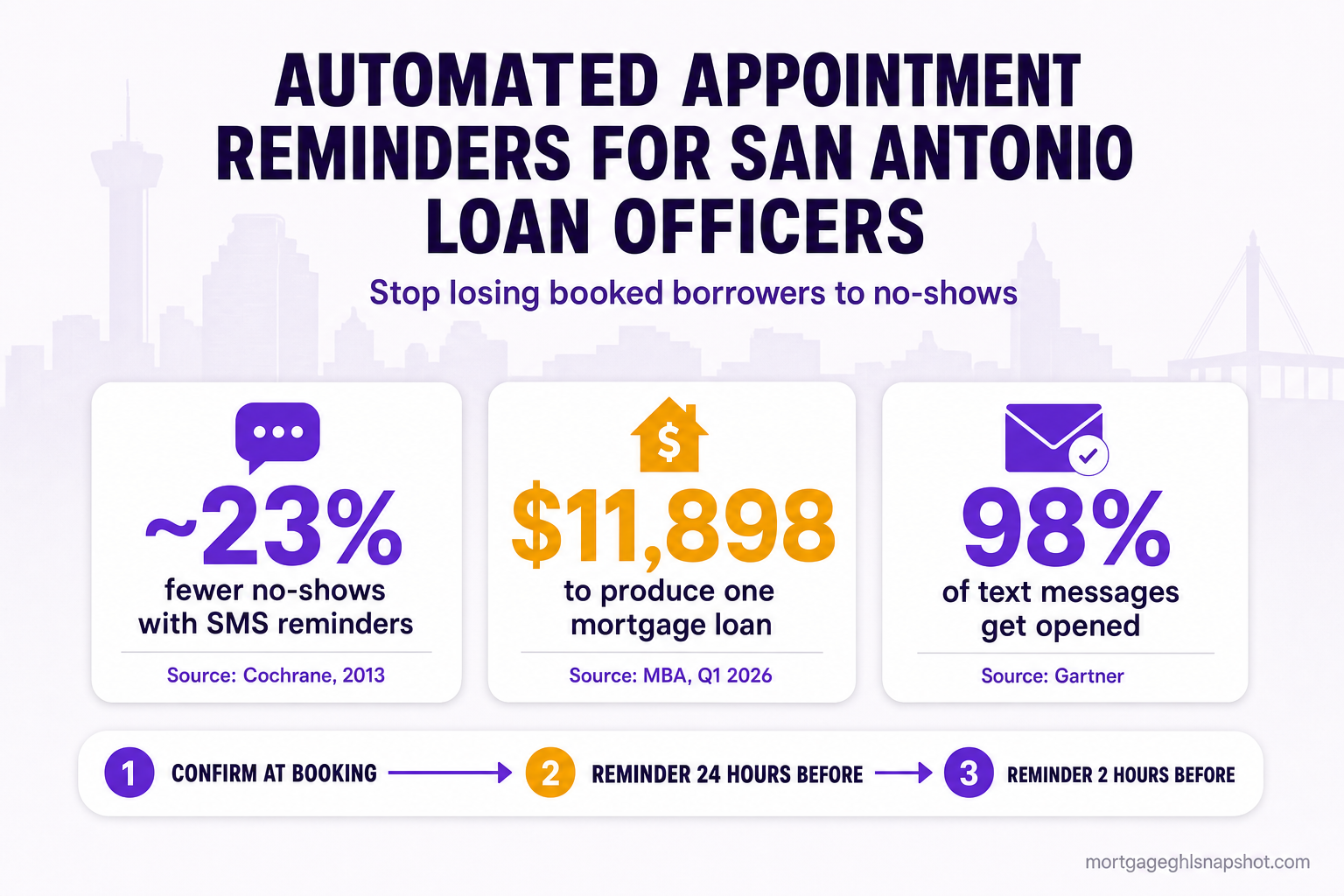
For a San Antonio loan officer, the fastest way to stop losing booked borrowers is an automated reminder sequence: a timed series of texts, emails, and calls that fires the moment a consult is scheduled and keeps firing right up to the appointment — because SMS appointment reminders cut no-shows by roughly 23% versus no reminder at all (Cochrane, 2013). This is the 2026 playbook: what a no-show really costs you, why borrowers ghost their own appointments, the exact reminder cadence that works, and how to wire it inside GoHighLevel so it runs without you.
The short answer: what an automated reminder sequence is
An automated appointment reminder sequence is a set of messages your CRM sends on its own, on a schedule tied to the appointment time. The borrower books a consult; the system immediately confirms it, then sends a reminder the day before, another a couple of hours out, and — if they still don’t show — kicks off a recovery flow that texts them and offers a one-tap re-book. You set it up once, and it runs on every appointment forever.
It’s the opposite of the way most loan officers “remind” people today, which is to say from memory, between calls, when they happen to glance at the calendar. That approach fails not because LOs are careless but because they’re busy originating. Automation removes the human bottleneck: the reminder fires whether you’re in a closing, at your kid’s game, or asleep.
The payoff is measurable. In a Cochrane review of eight randomized controlled trials, patients who got an SMS reminder missed their appointments far less often than those who got none — a risk ratio of 0.77, or roughly a 23% relative reduction in no-shows (Cochrane, 2013). That research is from healthcare, where no-shows are studied heavily, but the mechanism is identical for a mortgage consult: a timely nudge on a channel people actually read turns a forgotten booking into a kept one.
Relative no-show rate, indexed to 100 for “no reminder.” SMS reminders reduced non-attendance to a risk ratio of 0.77. Source: Cochrane Database of Systematic Reviews, 2013.
What a no-show actually costs a San Antonio loan officer
A missed appointment isn’t a scheduling annoyance — it’s a discarded investment. Independent mortgage banks spent $11,898 in total production expense to produce a single loan in Q1 2026, while net production profit was just $727 per loan (MBA, 2026). In an industry with margins that thin and costs that high, every booked borrower who ghosts is money you already spent walking out the door.
San Antonio makes the math especially real. The metro’s typical home value sits around $251,000 (Zillow, 2026) — an affordable, high-volume purchase market full of first-time buyers who are comparison-shopping lenders. It’s also “Military City USA”: Joint Base San Antonio spans Fort Sam Houston, Lackland, and Randolph, making it one of the largest concentrations of service members in the country (Joint Base San Antonio) and one of the busiest VA-loan markets anywhere. Those borrowers book consults with more than one loan officer. The one whose appointment actually happens is usually the one who wins the file.
Independent mortgage bank per-loan production expense vs. net profit, in dollars. Source: Mortgage Bankers Association, Q1 2026.
Put the cost of a reminder system next to the value of a single San Antonio loan and the decision answers itself. Whatever you earn on one funded mortgage dwarfs the flat monthly cost of automation — and the industry is already spending nearly $12,000 just to originate each one. You don’t need reminders to save many appointments a month to come out ahead; in most pipelines, saving one pays for the year. This is the same logic behind reactivating a dormant database: recovering a borrower you already earned is far cheaper than buying a new one.
Why borrowers miss appointments — and why reminders fix it
Most no-shows aren’t rejections — they’re lapses. The borrower got busy, the calendar invite got buried, life happened, and your 2 p.m. quietly fell off their radar. A reminder works because it re-surfaces the appointment at the moment it matters, on the one channel almost everyone checks: their phone. An estimated 98% of text messages get opened, the vast majority within minutes, compared with roughly 20% of marketing email (Gartner, via Sender). An email reminder sitting unread under 40 other emails does nothing; a text gets seen.
That gap is the whole reason SMS is the backbone of a good reminder sequence. Email still has a role — as a second touch with the Zoom link, directions, or a document checklist — but the message that actually saves the appointment is almost always the text.
Estimated share of messages opened, by channel (%). Source: Gartner, via Sender.
The content of the reminder matters too, not just the timing. Randomized research has shown that even small changes — like making the message more specific and concrete — measurably cut missed appointments (PLOS ONE, 2015). For a mortgage consult, that means naming the loan officer, the exact time in the borrower’s zone, what to bring (a rough income figure, the property address if they have one), and a dead-simple way to confirm or reschedule. A vague “reminder: appointment tomorrow” is far weaker than “Hi Maria — this is Emilio at [Firm]. Confirming your VA rate review tomorrow (Thu) at 2:00 PM CT. Reply C to confirm or R to reschedule.”
The reminder cadence that reduces no-shows
The cadence that works is simple and front-loaded: confirm instantly, remind the day before, remind again a couple of hours out, and recover fast if they still miss. Industry best-practice guidance converges on reminders at roughly 7 days, 24 hours, and 2 hours before the appointment, with the 24-hour reminder doing the heaviest lifting — it’s early enough to let someone reschedule but close enough to stay top of mind (Apptoto, 2025). Here’s the sequence we build for mortgage consults:
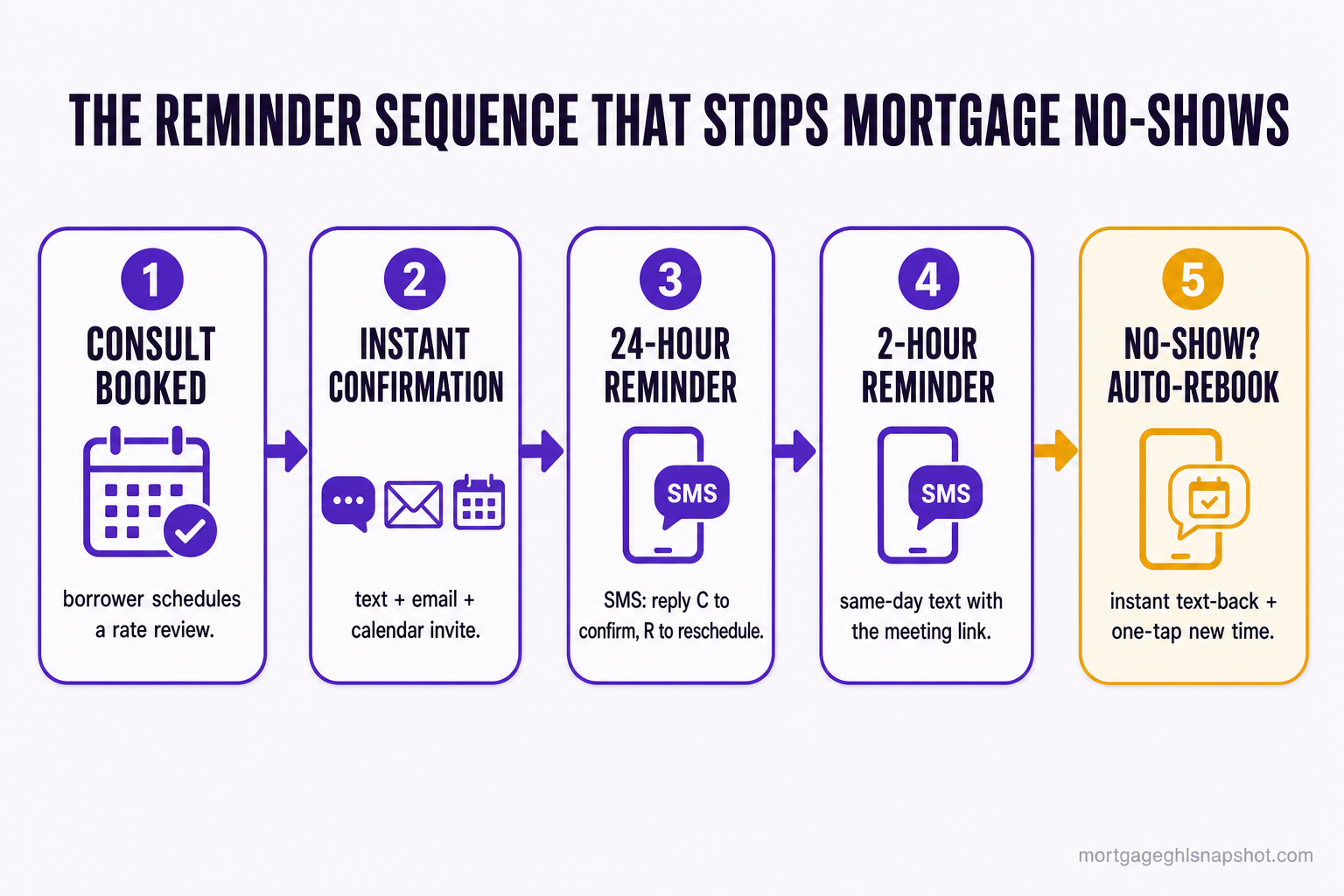
- Instant confirmation (at booking). The second a borrower books, they get a text and email confirming the time, the loan officer’s name, and a calendar invite. This is also where two-way texting starts — they can reply with a question and stay engaged.
- The 7-day heads-up (for consults booked far out). A light touch that keeps a distant appointment from being forgotten and gives early room to reschedule instead of ghost.
- The 24-hour reminder. The workhorse. A specific SMS naming the time, the loan type, and a one-tap “Reply C to confirm / R to reschedule.” Most saved appointments are saved here.
- The 2-hour reminder. A short same-day text with the Zoom or call-in link and your direct line — no hunting for the invite when 2 p.m. arrives.
- The no-show recovery flow. If the appointment time passes with no attendance, the system fires an instant, friendly text-back and a link to grab a new slot — covered in the next section.
Because every step is automated and consistent, it also stays compliant. Consent to text is captured at booking, every message carries a clear opt-out, and the whole thread is logged — the same discipline covered in our mortgage text-message compliance guide. Reminders about an appointment the borrower requested are the cleanest kind of outreach there is, but they still need proper A2P/10DLC setup and STOP handling, which is exactly the part a done-for-you build gets right.
Don’t just remind — recover the no-show
Even a great sequence won’t save 100% of appointments, so the difference between good and elite is what happens the minute someone doesn’t show. The answer is speed. The Lead Response Management study out of MIT Sloan — 15,000+ leads and 100,000+ call attempts — found a lead contacted within 5 minutes is 21× more likely to qualify than one contacted at 30 minutes (MIT / InsideSales, 2007). A no-show is just a warm lead that slipped, and the same clock applies: reach them while your firm is still the one they were thinking about.
Automated recovery closes that gap without you lifting a finger. The moment an appointment goes un-attended, the system sends a no-blame text — “Sorry we missed you, Maria! Grab a new time here 👇” — with a one-tap re-book link, and pings you so you can call while it’s hot. Pair it with an instant missed-call text-back so a borrower who tries to call during your next meeting still gets an immediate reply. This is where automation earns its keep: humans are terrible at reacting in five minutes, and software is perfect at it.
Borrowers today expect that responsiveness. HubSpot found 82% of consumers rate an immediate response as important or very important when they have a sales question (HubSpot, 2025). Persistence matters as much as speed — most conversions take several follow-up touches, and reps who stop after one attempt leave deals on the table (ZoomInfo, 2026). An automated flow simply doesn’t get tired or forget, so it re-books the borrower you’d otherwise write off. From there, they drop back into your pre-qualification follow-up and your mortgage CRM like any other live opportunity.
Manual vs automated: how to build it in GoHighLevel
You can run reminders by hand, but the reason no-shows persist is that manual reminders depend on a busy human remembering to send them. Automation moves that job to your CRM. Here’s the honest comparison of the two approaches for a San Antonio mortgage practice:
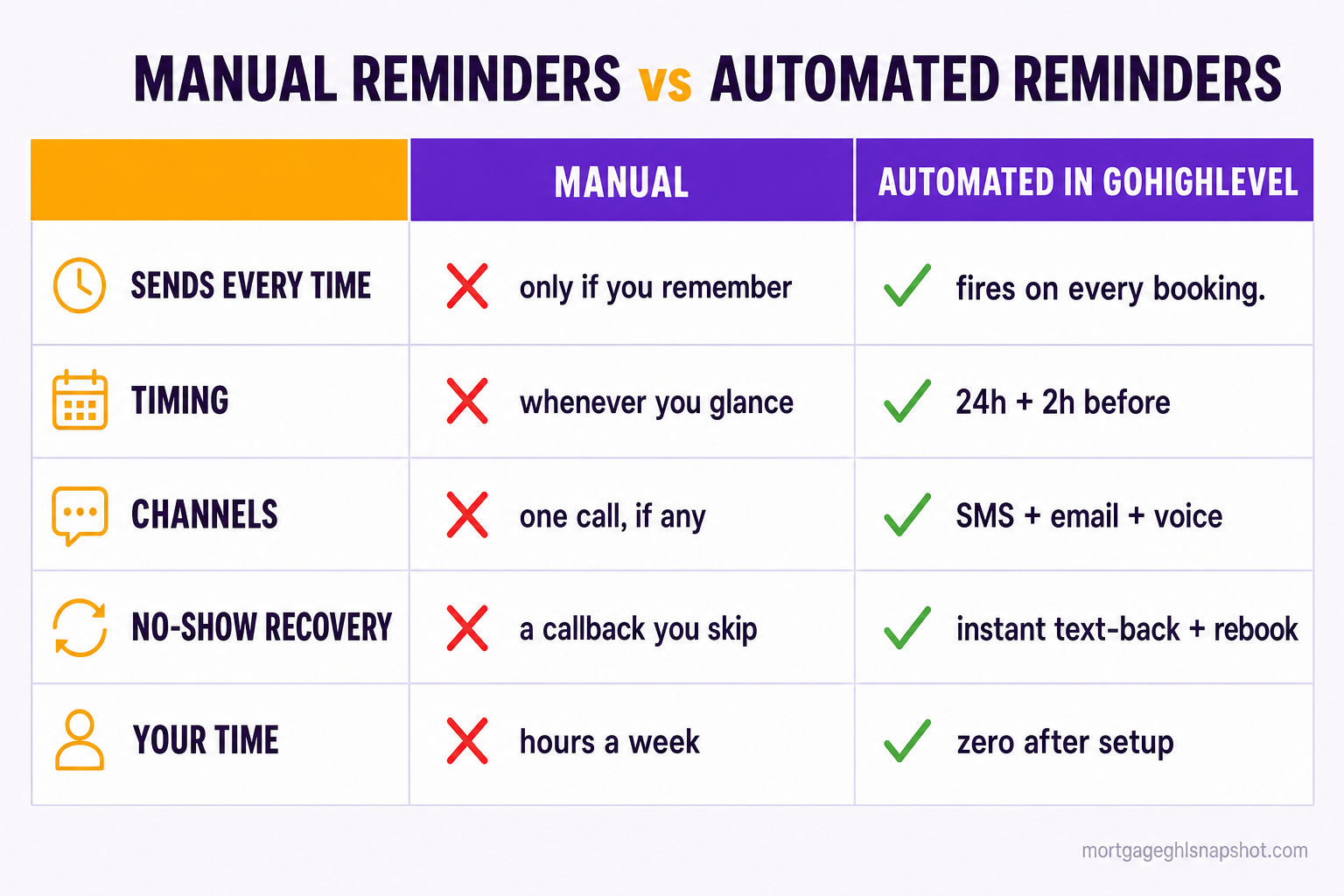
| What matters | Manual reminders | Automated in GoHighLevel |
|---|---|---|
| Sends every time | Only when you remember | Yes — fires on every booking |
| Timing | Whenever you glance at the calendar | 7 days, 24 hours & 2 hours out |
| Channels | One call or text, if any | SMS + email + optional voice |
| No-show recovery | A callback you rarely get to | Instant text-back + rebook link |
| TCPA / opt-out logging | Ad hoc, hard to prove | Consent + STOP logged automatically |
| Your time | Hours a week, error-prone | Zero after setup |
Building it yourself in GoHighLevel means creating a calendar with the right consult types, writing the SMS and email templates, and wiring a workflow triggered by “appointment booked” with wait-steps timed to the appointment, plus a separate workflow triggered by a “no-show” status. It’s very doable — and it’s also exactly the kind of fiddly setup that eats an originating week and half-works until someone debugs the time-zone math. If you’d rather skip that, our appointment automation and SMS automation ship pre-built inside the Mortgage Snapshot: the reminder cadence, the no-show recovery flow, TCPA-aware consent capture, and the borrower pipeline are already wired together and installed in your account.
Frequently asked questions
Appointment reminders for San Antonio loan officers — quick answers
How much do automated reminders actually reduce no-shows?
A Cochrane meta-analysis of eight randomized trials found SMS reminders cut missed appointments to a risk ratio of 0.77 — about a 23% relative reduction versus no reminder (Cochrane, 2013). That research is from healthcare, but the mechanism — a timely nudge on a channel people read — applies directly to mortgage consults.
Text or email for mortgage reminders?
Lead with text. An estimated 98% of SMS messages get opened, most within minutes, versus roughly 20% of marketing email (Gartner, via Sender). Use email as a supporting touch for the meeting link and any document checklist, but make the reminder that saves the appointment a text.
When should each reminder go out?
Industry best-practice guidance points to reminders at about 7 days, 24 hours, and 2 hours before the appointment, with the 24-hour reminder doing the most work (Apptoto, 2025). Add an instant confirmation at booking and a no-show recovery text afterward, and you've covered the full window.
Are appointment reminder texts TCPA-compliant?
They can be, and they're among the cleanest outreach there is because the borrower requested the appointment. You still need consent captured at booking, A2P/10DLC registration, and STOP/opt-out handling — all of which we configure before launch. See our text-message compliance guide for the current rules.
What happens when a borrower no-shows anyway?
Recovery has to be instant — a lead re-contacted within 5 minutes is 21x more likely to qualify than one reached at 30 (MIT / InsideSales, 2007). An automated flow texts the borrower a no-blame message with a one-tap rebook link and pings you to call, so the missed slot turns into a rescheduled one instead of a lost file.
Can I get this without building it myself?
Yes. Our appointment automation and SMS automation ship pre-built inside the Mortgage Snapshot — reminder cadence, no-show recovery, and consent logging installed in your GoHighLevel account. Book a walkthrough and we'll scope it to your San Antonio pipeline.
About the author
Emilio Duarte is a GHL Automation Lead for the mortgage niche, based in Tampa, FL. He builds GoHighLevel systems for brokers and loan officers — borrower capture, pre-qualification flows, reminder cadences, and no-show recovery — with a focus on the operational details that turn booked appointments into funded loans. Emilio is a fictional editorial persona for Mortgage Snapshot; nothing here is individualized legal, financial, or compliance advice. We are not a lender, and any figures cited are drawn from the sources linked.
Related reading
- Mortgage speed-to-lead: why the first 5 minutes decide the deal — the clock that governs no-show recovery.
- Missed-call text-back for loan officers — the instant reply that backs up every reminder.
- Pre-qualification follow-up that actually converts — where a kept appointment goes next.
- Mortgage text-message compliance in 2026 — the TCPA rules behind reminder texts.
- AI receptionist for Houston loan officers — the front door that books the appointment in the first place.