
It’s Tuesday afternoon in your Los Angeles office and your phone buzzes for the fourth time before lunch. Same question every time: “Any update on my loan?” One is the borrower on a $1.1M Sherman Oaks purchase. One is that borrower’s Redfin agent, who has a nervous seller asking the same thing. The appraisal came back yesterday and everything is fine — but you were on a call, then in an application, then answering the last “any update?” text, so nobody knows that yet. Multiply this across the eight files in your pipeline and you’ve spent your best originating hours being a human status page.
A loan status portal fixes this by giving every borrower — and their real estate agent — one secure, branded place to see exactly where their loan is in real time, with automatic milestone updates by text and email, so the “where’s my loan?” calls stop and you get your day back. This guide breaks down why status anxiety quietly costs Los Angeles brokers real money, what a modern portal actually shows, and how to build one as custom software that plugs into the loan origination system (LOS) and CRM you already run.
The short answer: what a loan status portal does for LA loan officers
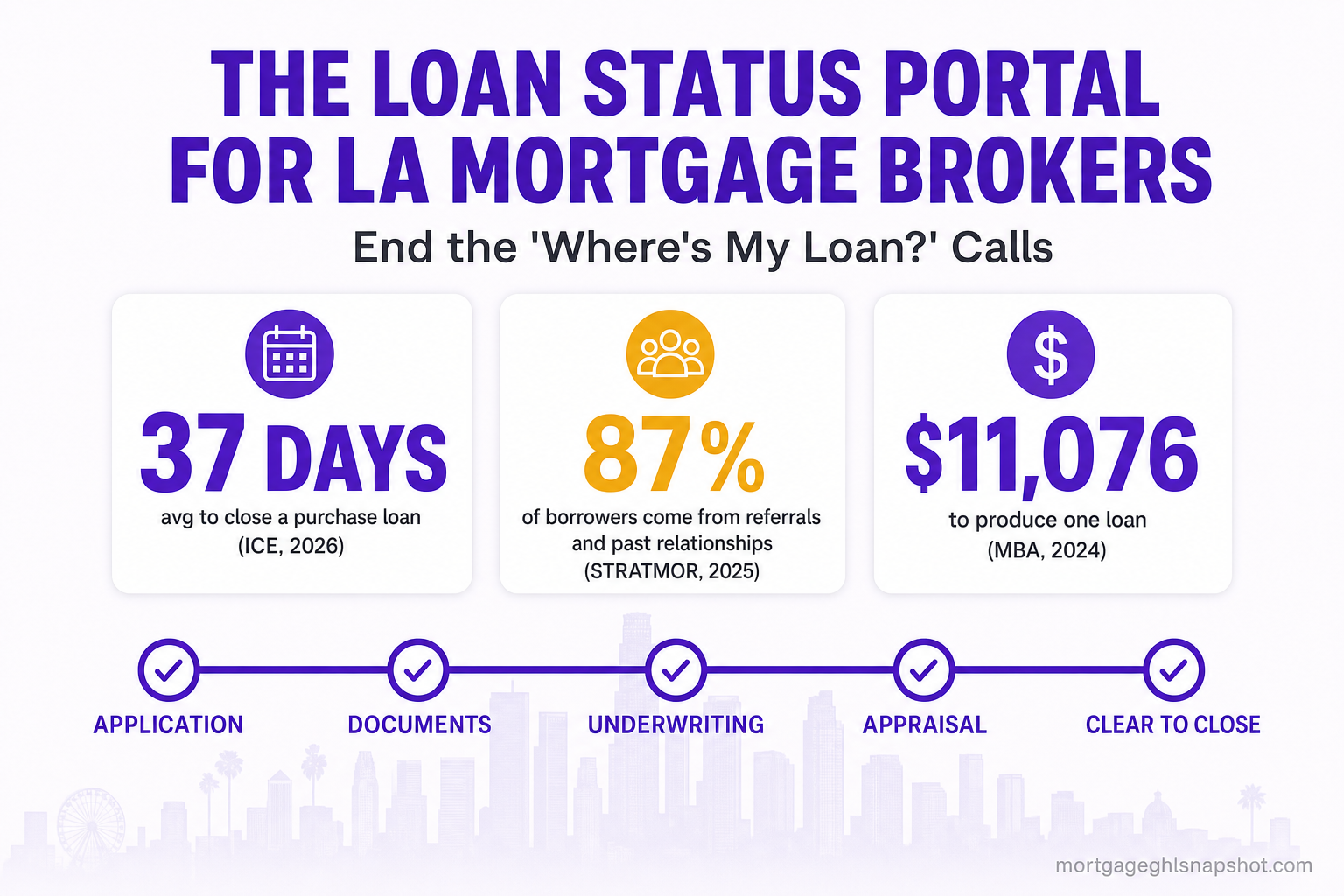
A loan status portal is a secure, branded web page each borrower logs into to see exactly where their loan is — the same way they track a package. Instead of a phone call, they see a live milestone tracker: Application received → Documents in → Submitted to underwriting → Conditional approval → Appraisal ordered → Clear to close → Funded. Each stage flips automatically as your loan origination system moves the file, and each flip fires a short, on-brand text and email: “Good news — your appraisal is in and your file is with underwriting.”
The point isn’t a prettier dashboard. It’s that the borrower’s question is answered before they ask it, and their real estate agent can see the same milestones without calling you either. You stop being the bottleneck between “something happened on the file” and “everyone who’s anxious about it knows.” For a producing Los Angeles loan officer juggling eight to fifteen files across a metro this competitive, that’s the difference between spending your afternoon originating and spending it reciting status.
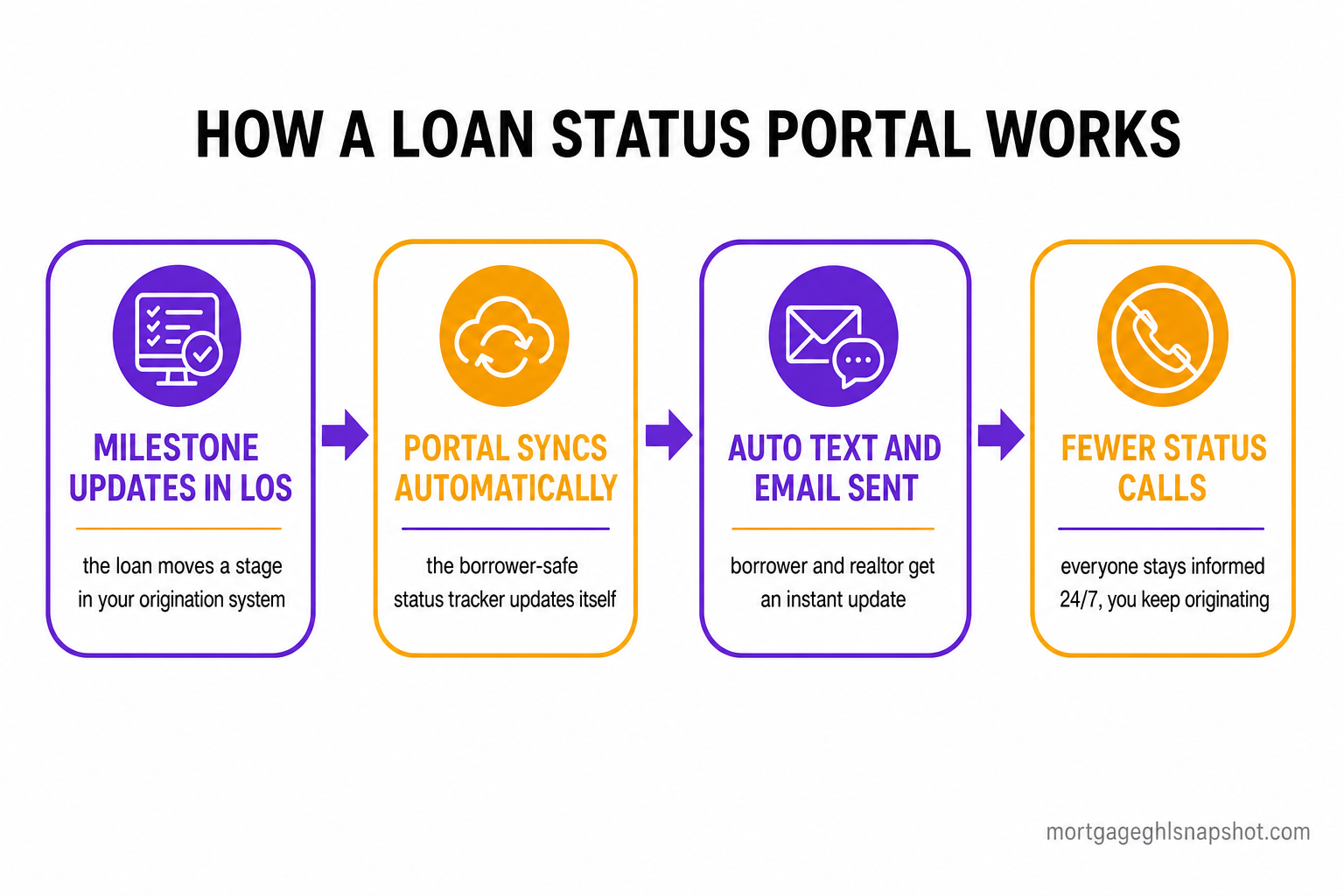
Three things make it work, and each one removes a category of interruption:
- A live milestone tracker the borrower and agent can check anytime, so the default answer to “any update?” is look at the portal — 24/7, no reply from you required.
- Automatic milestone notifications by SMS and email the moment a stage changes, so the good news travels instantly and proactively instead of waiting for your next free minute.
- An LOS/CRM sync so the portal reflects reality without anyone hand-updating it — the status is pulled from where the loan actually lives, not re-typed.
Why “where’s my loan?” quietly costs Los Angeles brokers
The status call feels harmless — a minute here, a text there. The cost is that it lands during a window you can’t shorten and can’t ignore. A purchase mortgage took an average of about 37 days to close in early 2026, which ICE Mortgage Technology noted was among the fastest in its tracking history (ICE Mortgage Technology, 2026). “Fastest ever” still means five-plus weeks of a borrower staring at the biggest purchase of their life with no visibility — and in Los Angeles, that purchase is enormous. The typical LA home was worth about $949,479 in 2026 (Zillow, 2026), and Redfin put the median sale price near $1.0 million (Redfin, 2026). The bigger the number, the more often the borrower — and their agent — will reach for the phone.
Now put the economics next to it. Independent mortgage banks spent $11,076 to produce a single loan in 2024 and made an average net profit of just $443 per loan (Mortgage Bankers Association, 2025). That is a razor-thin margin, and it means two things for a Los Angeles brokerage. First, the hours you burn narrating status are hours you’re not spending on the next file — and each file has to carry its share of an $11,000 cost base. Second, a borrower who gets nervous, feels ignored, and lets a competitor “just double-check the rate” can pull a file you’ve already spent most of that $11,076 on. You don’t earn the $443 until it funds.
None of that shows up on an invoice. It shows up as a slow, expensive way to run a pipeline — where your scarcest resource, originating time, leaks out one status update at a time.
Your pipeline is a referral pipeline — protect it
Here’s the part that makes borrower experience a growth issue, not just a service issue. Mortgage lead generation is overwhelmingly relationship-driven: in a STRATMOR analysis of roughly 82,000 borrowers, 87% found their lender through a person-to-person relationship — 50% by referral and 37% through an existing relationship (Inman / STRATMOR, 2025). The National Association of Realtors’ member data tells the mirror-image story for agents: a typical Realtor earns a large share of business from repeat clients and past-client referrals (NAR via BAM, 2024).
How borrowers find their lender — share of borrowers, % (STRATMOR analysis of ~82,000 borrowers). Source: Inman / STRATMOR, 2025.
Read those two facts together and the loan status portal stops looking like a convenience and starts looking like pipeline defense. The single loudest experience a borrower has with you is the 37 days between application and funding — and the loudest experience your referral partner has is watching whether their client is happy or panicking. Every “where’s my loan?” call the agent has to chase is a small withdrawal from the trust that sends you the next deal. A portal that keeps the borrower calm and the agent informed is, functionally, a referral-retention system. It protects the exact channel that generates 87% of your business.
Communication is the satisfaction lever — the data is blunt
If you needed one number to justify building this, it’s this one. In J.D. Power’s 2025 U.S. Mortgage Origination Satisfaction Study, satisfaction was 32 points higher (on a 1,000-point scale) when a lender engaged the borrower early, and fell 64 points when the lender’s first substantive contact didn’t come until the application stage (J.D. Power, 2025). Proactive, early, continuous communication is not a soft nicety — it is the measurable driver of whether a borrower walks away a promoter or a detractor.
The 2024 edition of the same study made the downside just as clear: overall origination satisfaction slipped to 727, with communication among the factors that fell most as lenders trimmed staff and left borrowers feeling less informed (J.D. Power, 2024). When the humans get busy, communication is the first thing to break — which is exactly the problem automation is built to solve. A portal doesn’t get busy, doesn’t forget to send the appraisal update, and doesn’t go quiet during your busiest closing week.
And borrowers want to serve themselves this way. Fannie Mae found that 75% of recent homebuyers cite speeding up the process, and 71% cite making it easier, as the top benefits of a digital mortgage (Fannie Mae, 2024). The modern borrower doesn’t want to schedule a phone call to learn their file moved to underwriting; they want to glance at their phone and see it, at 9 p.m., from their couch in Silver Lake.
What a loan status portal actually shows
“Loan status” is more than a percentage bar. A portal that actually reduces calls shows the borrower what they care about, in plain language, with the next action always visible. A well-built one includes:
- A live milestone tracker in borrower-friendly words — not “TBD / suspended / cleared,” but “Your file is in underwriting” and “Your appraisal is ordered.” Each step shows done, in progress, or up next.
- The next action, clearly owned. If the ball is in the borrower’s court (a missing bank statement, a signature), the portal says so and links straight to it. If it’s on you or the lender, it says that too — which alone kills a huge share of anxious “did you get my documents?” messages. (This pairs naturally with a borrower document portal for the upload side of the file.)
- Automatic milestone notifications by SMS and email as each stage changes, on your brand and your number, with consent captured up front.
- A realtor-facing view so the buyer’s and seller’s agents can check progress without calling you (more on this below).
- Estimated timeline context — a realistic “typical time to close” so a borrower on day 20 of a ~37-day process understands they’re on track, not stuck.
- Your branding, your contact, one tap to reach a human for the moments that genuinely need one — so self-serve never feels like being abandoned.
Notice what this is not: it is not your loan origination system exposed to the public. Borrowers should never see raw LOS fields, internal notes, or pricing mechanics. The portal is a clean, translated, borrower-safe layer on top of the system of record — which is precisely why it’s usually a custom build rather than a checkbox.
How to build a loan status portal for a Los Angeles brokerage
There are three honest paths, and the right one depends on how your LA shop is set up.
1. Native to your LOS. Some loan origination systems ship a borrower portal. If yours does and it’s usable, start there — it’s the least work. The catch is that these are often generic, hard to brand to your firm, weak on realtor access, and locked to that LOS. If it looks like the software vendor and not like you, it undercuts the referral-experience goal.
2. Assembled inside your CRM (GoHighLevel). If you run GoHighLevel, you can get a real distance down this road: a client portal, pipeline stages mapped to loan milestones, and automated SMS/email that fire on stage changes. For many brokers a well-configured GoHighLevel setup plus tidy CRM workflow automations covers 80% of the value — the automatic milestone texts especially. Where it strains is a polished, borrower-safe milestone tracker and a clean realtor view synced live from your LOS; those push past what the platform does natively.
3. Custom software that syncs with your LOS and CRM. When you want a branded, borrower-safe tracker, a proper realtor portal, and a live sync between your LOS (Encompass, and similar) and your CRM so nobody re-types status, that’s a custom software build. It’s the most work up front and the best fit for a brokerage that treats borrower experience as a growth channel — which, given that 87% of your business is relationship-driven, most Los Angeles shops should.
The economics decide the path. A portal that prevents even a handful of fallouts a year pays for itself against an $11,076-per-loan cost base and $443-per-loan profit (MBA, 2025) — the bar it has to clear is low.
Independent mortgage bank economics per loan, 2024 (USD). A single friction-driven fallout erases the profit on many funded loans. Source: Mortgage Bankers Association, 2025.
Whichever path you choose, the build order is the same: map your real loan milestones to plain-language borrower steps; decide which fields are borrower-safe; wire the LOS/CRM sync so status updates itself; add the automatic SMS/email on each milestone with consent handled first; then layer in the realtor view and your branding. If that sounds like a project, it is — and it’s exactly the kind of thing our custom software team ships for mortgage firms, or a dedicated GHL VA can assemble inside GoHighLevel for a lighter build.
Give your realtor partners their own view
This is the feature most portals skip, and it’s the one with the highest strategic payoff for a referral-driven business. Give the buyer’s and listing agents a read-only view of the milestones for their client’s file — no phone call, no “let me check and get back to you,” no game of telephone with an anxious seller.
Think about what that does to the referral relationship. Right now, the agent’s experience of you is partly a function of how fast you answer their status texts. Hand them a portal and you’ve flipped it: you’re the loan officer whose files the agent can see progressing, who never leaves them in the dark in front of their client, who makes them look organized. In a market where agents’ own repeat and referral business depends on smooth closings (NAR via BAM, 2024), that’s a concrete reason to keep sending you deals. The portal quietly turns your closing process into a co-marketing asset — the same logic behind formal realtor referral partnerships, applied to the middle of the transaction instead of the start.
Keep it secure and compliant
A portal touches sensitive financial data and sends automated messages, so two guardrails are non-negotiable — and both are standard in a proper build.
Data security. Borrower financial data must be encrypted in transit and at rest, access controlled to the right borrower and the right agent, and every view logged. This is a system with real permissions, not a shared spreadsheet link. Whoever builds it should be able to speak to encryption, access controls, and audit trails without hand-waving.
Consent and messaging rules. The automatic milestone texts are a real benefit and a real obligation: SMS notifications need clear consent up front, A2P/10DLC registration for your sending number, and working STOP/opt-out handling — the same TCPA-aware plumbing behind any compliant mortgage texting. Capture consent at application, keep the record, and let borrowers choose their channel. A status portal makes this easier, not harder, because it centralizes what you’re sending and when. (None of this is legal advice — confirm your setup with your compliance counsel.)
Frequently asked questions
Loan status portals for LA mortgage brokers — quick answers
What is a loan status portal for a mortgage broker?
It's a secure, branded web page each borrower logs into to see exactly where their loan is — a live milestone tracker (application received, documents in, underwriting, appraisal, clear to close, funded) that updates automatically as your loan origination system moves the file, with automatic text and email updates on each milestone. It lets borrowers and their real estate agents self-serve status 24/7 instead of calling you. Learn more on our custom software page.
How is a loan status portal different from a borrower document portal?
They solve two halves of the same file. A document portal is for collecting files from the borrower — a live checklist they upload W-2s, bank statements, and pay stubs into. A status portal is for showing information back to the borrower and their agent — where the loan is in the process. Many LA brokers want both; see our guide to a borrower document portal for the upload side.
Can I build a loan status portal inside GoHighLevel?
Partly, and for many brokers that's the right start. GoHighLevel can host a client portal and fire automatic SMS/email when a pipeline stage changes, which covers the milestone-notification value well. A polished, borrower-safe milestone tracker and a clean realtor view synced live from your LOS usually push past what the platform does natively — that's where a custom build or a GHL VA comes in.
Does a status portal integrate with my LOS like Encompass?
That's the point of a custom build: the portal pulls milestones from your loan origination system so nobody re-types status by hand. We build LOS/CRM syncs so the borrower-facing tracker reflects the real file automatically. Scope your setup on a discovery call and we'll map your milestones to plain-language borrower steps.
Will automatic status texts to borrowers be TCPA-compliant?
Yes, when it's set up correctly. Milestone SMS needs clear consent captured up front (typically at application), A2P/10DLC brand registration for your sending number, and working STOP/opt-out handling. A portal actually makes compliance easier by centralizing what you send and when. This isn't legal advice — confirm your specific setup with compliance counsel.
Is a loan status portal worth it for a smaller Los Angeles brokerage?
Often yes, because the math is forgiving. It cost independent mortgage banks $11,076 to produce one loan in 2024 at just $443 profit per loan (MBA, 2025). If a portal prevents even a couple of friction-driven fallouts a year and frees hours you spend reciting status, it clears that bar quickly — while protecting the referrals that drive 87% of your business.
About the author
Emilio Duarte is a GHL Automation Lead for the mortgage niche, based in Tampa, FL. He builds GoHighLevel snapshots, LOS integrations, and custom borrower-facing tools for loan officers and brokers — focused on borrower capture, speed-to-lead follow-up, and closing experiences that keep referral partners loyal. Emilio is a fictional editorial persona for Mortgage Snapshot; nothing here is individualized financial, legal, or compliance advice. We are not a lender, and any figures cited are from the sources linked.
Related reading
- How to set up a borrower document portal for your mortgage business — the upload side of the file, done right.
- Mortgage speed-to-lead: why the first 5 minutes decide the deal — the same responsiveness principle, applied at the top of the funnel.
- Realtor referral partnerships for loan officers — how to build the channel a status portal protects.
- GoHighLevel integration for mortgage brokers — wiring your CRM to the tools your loan process runs on.
- Mortgage CRM for loan officers: the 2026 buyer’s guide — what a well-run pipeline should actually do.