
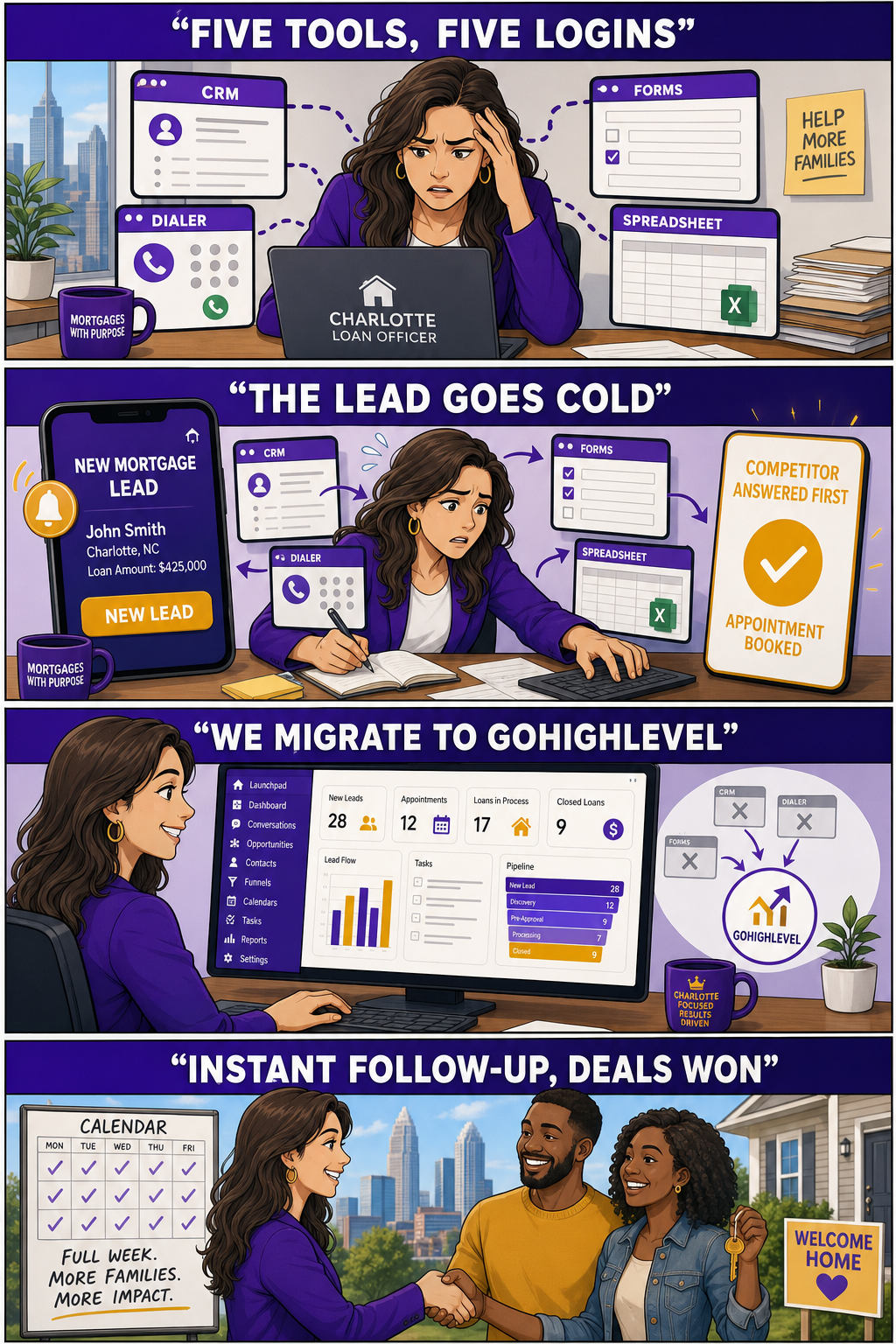
Your Charlotte lead comes in through a Facebook form. It lands in one inbox, gets copied into a CRM, gets a call logged in a separate dialer, gets a pre-qual note dropped into a spreadsheet, and gets an appointment set in yet another calendar tool. Five tools, five logins, and five places for the borrower to fall through — while a competitor who answered first is already collecting documents.
Charlotte loan officers are migrating to GoHighLevel because a single connected system — lead capture, CRM, calls, texts, pipeline, and calendar in one place — closes the gaps a patchwork stack leaves open, and those gaps are exactly where speed-to-lead and thin margins get lost. This post breaks down the real cost of the disconnected stack, why consolidation onto GoHighLevel fixes it, and how a custom GHL migration actually works — data, integrations, and all.
The short answer: why consolidate onto GoHighLevel
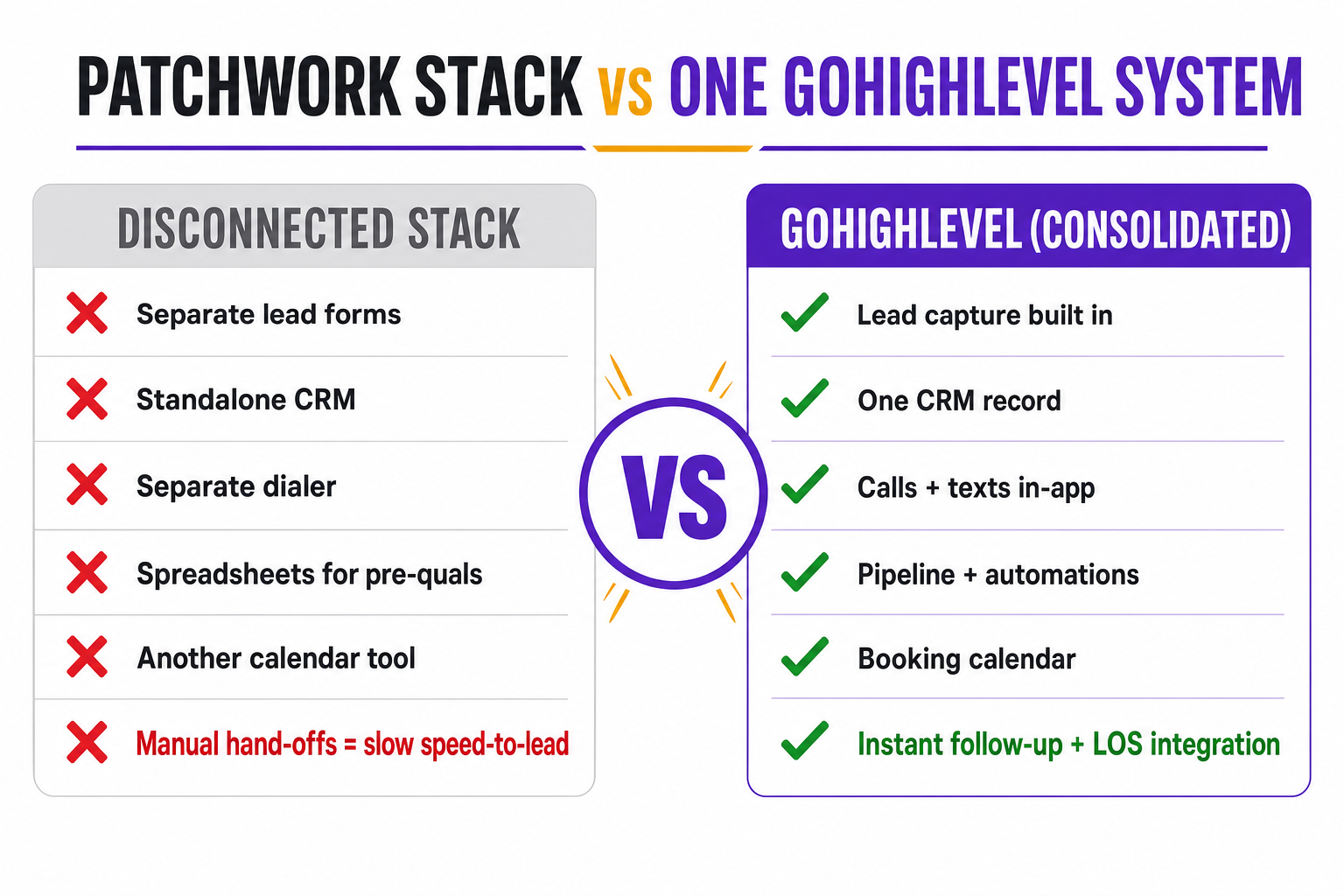
A GoHighLevel migration means moving the jobs your scattered tools do today — capturing leads, storing borrower records, calling and texting, tracking the pipeline, booking appointments, and running follow-up — into one platform where they finally talk to each other. Instead of a lead bouncing between five apps that don’t share data, it flows through a single system: captured, contacted in seconds, qualified, and booked, with every touch logged in one borrower record.
For a Charlotte loan officer, the payoff is speed and visibility. When a form fills, GoHighLevel can fire a text and a call within seconds — no exporting, no copy-paste, no “I’ll get to it after this closing.” And because everything lives in one pipeline, you can see at a glance which files are hot, which went cold, and which need a nudge, instead of reconstructing the picture from four dashboards. The disconnected stack isn’t just annoying; as the data below shows, it’s expensive in exactly the two ways that matter most to an originator — response time and operating margin.
The hidden cost of a disconnected Charlotte tech stack
Most loan officers don’t buy a fragmented stack on purpose. It accumulates: a CRM here, a dialer there, a form tool, a calendar link, a spreadsheet for pre-quals, a separate email platform. Each one solves a single problem. Together they create three expensive ones.
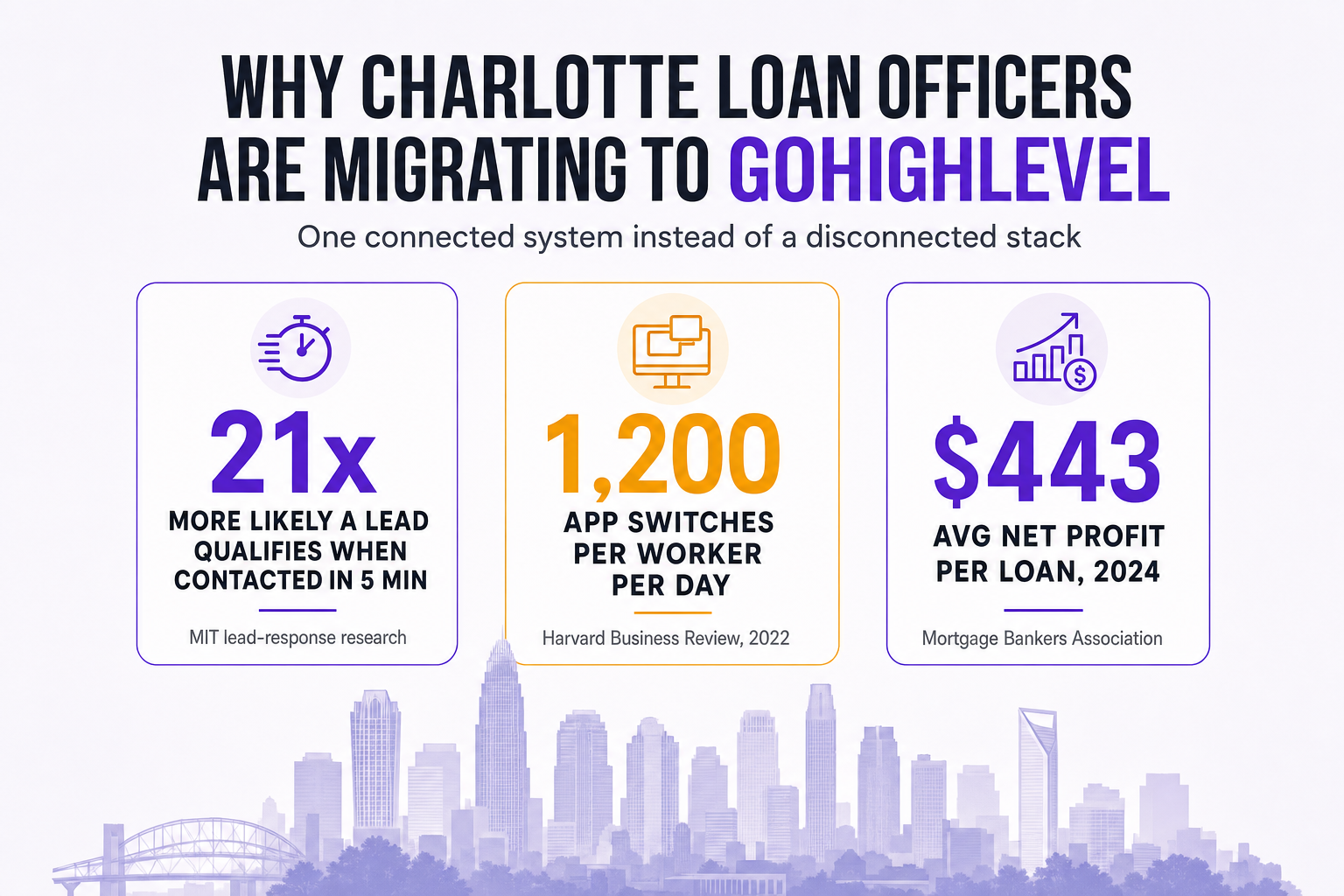
First, every hand-off between tools burns speed-to-lead — the single biggest predictor of whether you win the deal. The canonical lead-response study out of MIT found that contacting a web lead within 5 minutes makes it 21× more likely to convert to a qualified opportunity than waiting just 30 minutes (MIT / Lead Response Management). Harvard Business Review’s audit of 2,241 U.S. companies reinforced it: firms that responded within an hour were 7× more likely to have a meaningful conversation with a decision-maker than those who waited even 60 minutes (Harvard Business Review, 2011). When a Charlotte lead has to be manually moved from a form tool to a CRM before anyone calls, those minutes are gone — and so is the borrower.
Second, the stack itself taxes your team’s time all day. Harvard Business Review found knowledge workers toggle between applications and websites about 1,200 times a day, and that reorienting after each switch adds up to nearly four hours a week — around 9% of their working time — spent just getting back on task (Harvard Business Review, 2022). A separate Qatalog and Cornell University study put the cost of hunting for information scattered across tools at 59 minutes per person, per day (Qatalog / Cornell, 2021). With the average company running 93 different apps in 2024 (Okta, 2024), a mortgage team’s “system” is often a dozen of them duct-taped together. Every one of those switches is a minute not spent with a borrower.
Third — and this is the one that should sting — mortgage margins are too thin to leak. Independent mortgage banks made an average net profit of just $443 per loan in 2024, clawing back from a $1,056 loss per loan in 2023, while it cost $11,076 to produce a single loan (Mortgage Bankers Association, 2025). Do the math: at $443 of profit per loan, letting one qualified Charlotte borrower slip through the cracks of a disconnected stack wipes out the profit on roughly two dozen closed files.
In a market where the typical Charlotte home runs about $397,000 (Zillow, 2026), the commission on a single stalled file dwarfs the monthly cost of running your stack the right way. The disconnected setup feels free because you already pay for each tool. It isn’t — you pay for it in lost speed, lost hours, and lost loans.
What one connected system actually fixes
Consolidating onto GoHighLevel doesn’t just reduce your login count. It closes the specific seams where borrowers and hours leak out.
Instant, automatic first contact. When a lead fills a form, a connected system fires the first text and even an outbound call in seconds — not after someone notices the email and opens the CRM. That’s the difference between the 5-minute window and the 30-minute miss. If you want the mechanics, we cover it in depth in our mortgage speed-to-lead playbook and missed-call text-back guide.
One borrower record, not five. Every call, text, email, form, and appointment attaches to a single contact in one mortgage CRM and workflow system. No more reconciling the dialer log against the spreadsheet against the calendar. Your processor sees the whole file in one view — which is where those reclaimed toggling hours come from.
Follow-up that never forgets. Pre-qual nurture, rate-drop outreach, and post-close check-ins run as automations, not as sticky notes. The same platform that captures the lead can run your rate-drop refi alerts and database reactivation — turning your past-client list into a recurring pipeline instead of a dead spreadsheet.
Your LOS still fits. Consolidation doesn’t mean throwing out your loan origination system. A proper migration integrates it — syncing contacts, loan status, and milestones between your LOS (Encompass, Byte, SimpleNexus, and others) and GoHighLevel — so marketing and origination finally share one source of truth. That LOS-to-GHL connector is one of the most common custom GHL development builds we do.
How a GoHighLevel migration works (6 steps)
A migration sounds scary — it’s your whole book of business. Done right, it’s a controlled, reversible project with no “dark days” where you can’t work. Here’s the sequence we use for a mortgage firm.
Step 1 — Audit the current stack and map the data
Before anything moves, we list every tool you run, what data lives in each, and how a lead flows between them today. Which system holds the master contact record? Where do pre-qual notes live? What triggers a follow-up? This map is the blueprint — it defines exactly what has to come across and where it lands in GoHighLevel.
Step 2 — Design the GHL account and pipeline structure
Next we build the destination: custom fields for loan type, LTV, and loan status; pipelines that mirror how a Charlotte file actually moves (new lead → contacted → pre-qual → application → processing → closed); and the calendars, forms, and phone numbers the account needs. Getting the structure right first is what makes the imported data land clean instead of in a jumble.
Step 3 — Migrate contacts, history, and automations
Now the data moves: contacts with their tags and custom fields, conversation history where the source tool allows it, and the workflows that were running elsewhere, rebuilt as GoHighLevel automations. This is the step DIY migrations most often botch — importing a raw CSV with no field mapping leaves you with 4,000 nameless contacts and no pipeline. A structured import preserves the relationships that make the data useful.
Step 4 — Integrate the LOS and anything you’re keeping
Any tool you’re keeping gets wired in. The big one for mortgage is the LOS: a connector that syncs loan milestones and contact updates between your origination system and GoHighLevel, so a status change in one shows up in the other automatically. Pricing engines, e-sign tools, and accounting can connect the same way. This is the custom-development heart of the project and where a specialist GHL development team earns its keep.
Step 5 — Run in parallel and validate
Before you flip the switch, the new system runs alongside the old one. We push test leads through, confirm every automation fires, check that the LOS sync is two-way and accurate, and reconcile contact counts. Nothing gets shut off until the GoHighLevel version is provably doing the job — so there’s never a window where a real Charlotte borrower falls into a gap.
Step 6 — Cut over, train, and support
Once validated, you cut over: the old tools get archived (not deleted on day one), your team gets trained on the one system they’ll actually use, and support stays on to catch the edge cases that only surface in live use. If you’d rather not run day-to-day operations yourself, a dedicated GHL VA can own the account so you stay focused on originating.
What it costs — and the payoff
A GoHighLevel migration is a project, and the price tracks scope. As a reference from our custom GHL development work: an LOS-to-GHL connector typically runs $3K–$8K, a custom borrower chatbot $5K–$15K, and a loan-milestone dashboard $10K–$30K, with a $75/hour retainer available for iterative work — and full IP transfer plus a 30-day bug-fix warranty on fixed-price builds. Because we build with modern AI-assisted development, timelines run roughly half of what a traditional dev shop quotes. On top of the build, GoHighLevel itself runs about $97–$497/month depending on plan, replacing several tool subscriptions you’re already paying for.
Now weigh that against what the disconnected stack costs. At $443 of net profit per loan and $11,076 to produce one (MBA, 2025), recovering even a handful of Charlotte files a year that would otherwise leak — plus the roughly four hours a week per person that app-toggling eats (HBR, 2022) — pays the project back quickly. And the return compounds: once the system is consolidated, every new lead flows through the same fast, connected pipeline, and every past client sits in one database you can reactivate on demand.
The point isn’t “more software.” It’s less — one connected system instead of a dozen disconnected ones, so your speed-to-lead is instant, your team’s hours go to borrowers instead of busywork, and your thin per-loan margin stops leaking through the seams.
Frequently asked questions
GoHighLevel migration for Charlotte loan officers — quick answers
Will I lose my data when I migrate to GoHighLevel?
Not with a structured migration. Contacts, tags, custom fields, and — where the source tool allows — conversation history are mapped and imported into a GoHighLevel account that's already built to receive them. The new system runs in parallel with your old one and is reconciled (contact counts, automation tests, LOS sync checks) before anything is shut off, so there's never a window where records are missing or a lead falls into a gap.
Do I have to give up my LOS to use GoHighLevel?
No. A migration consolidates your marketing and CRM layer onto GoHighLevel while keeping your loan origination system (Encompass, Byte, SimpleNexus, and others) and integrating the two. A custom LOS-to-GHL connector syncs loan status and contact updates both directions, so origination and marketing finally share one source of truth. Building that connector is one of the most common custom GHL development jobs we do.
How long does a GoHighLevel migration take?
It depends on scope. A straightforward CRM and pipeline consolidation can be a couple of weeks; adding a custom LOS integration typically pushes it to a few weeks more. Because we build with AI-assisted development, timelines run roughly half of a traditional dev shop's. Every project is scoped with a fixed timeline and milestones before work starts.
Why do Charlotte loan officers consolidate their stack in the first place?
Speed and margin. A lead contacted within 5 minutes is 21× more likely to qualify than one contacted after 30 minutes (MIT lead-response research), and manual hand-offs between disconnected tools burn those minutes. Independent mortgage banks netted just $443 profit per loan in 2024 (MBA, 2025), so a single leaked lead in Charlotte's roughly $397,000 market (Zillow, 2026) is expensive. One connected system fixes both.
What does a GoHighLevel migration cost?
The platform itself runs about $97–$497/month depending on plan, replacing several subscriptions you already pay for. The migration and any custom work is a project: LOS-to-GHL connectors typically run $3K–$8K, and larger builds scale from there, with a $75/hour retainer option and full IP transfer on fixed-price work (see custom GHL development). Many firms start with the pre-built Mortgage Snapshot and add custom development on top.
Can someone run the GoHighLevel system for me after the migration?
Yes. If you'd rather originate than operate software, a dedicated, mortgage-trained GoHighLevel VA can own the account day to day — managing pipelines, follow-up, and reporting — starting around $700/month (see hire a VA). That way the consolidation gives you both a better system and fewer hours spent running it.
About the author
Emilio Duarte is a GHL Automation Lead for the mortgage niche, based in Tampa, FL. He builds and migrates GoHighLevel systems for mortgage brokers and loan officers, with a focus on borrower capture, pipeline design, and connecting the tools originators actually use. He writes about the operational side of mortgage marketing — the systems that turn scattered leads into booked, pre-qualified appointments. Emilio is a fictional editorial persona for Mortgage Snapshot; nothing here is individualized financial, legal, or business advice. We are not a lender, and any figures cited are from the sources linked.
Related reading
- Mortgage speed-to-lead: why the first 5 minutes decide the deal — the metric a disconnected stack quietly destroys.
- Mortgage CRM for loan officers: the 2026 buyer’s guide — the hub a migration builds around.
- Missed-call text-back for loan officers — instant response, wired into one system.
- Mortgage database reactivation — turn the list you migrate into a recurring pipeline.
- GoHighLevel VA for loan officers in Phoenix — hand the consolidated system to a mortgage-niche operator.