
Your pipeline in Jacksonville is probably referral-fed. A few Realtor partners, some repeat borrowers, the occasional friend-of-a-friend. It works — right up until a top-referring agent retires, moves their book, or starts sending files to the lender who shows up first when their client Googles “FHA loan Jacksonville.” Referrals are a great channel. They are a terrible only channel.
For a Jacksonville loan officer, the most durable way to stop depending on other people’s clients is a blog content engine: a steady stream of answer-first articles about the loan programs you run and the counties you’re licensed in, published on a fast, schema-marked site so both Google and the AI answer engines name you when a local borrower asks a question. One post is a coin flip. A content engine — the same standard, published every week, compounding — is how a solo originator quietly outranks a national call center in their own market. This is the 2026 playbook: why content is the highest-leverage channel you’re not using, how search actually works now, the five-step engine, and how to run it without giving up your originating week.
The short answer: what a blog content engine actually is
A blog content engine is a repeatable system that turns the questions your borrowers already ask into published articles that rank in search and get quoted by AI — on a schedule, not in bursts. It is the difference between “I wrote a blog post once” and “a new, genuinely useful page about my market goes live every few days, forever.”
The engine has four moving parts: a keyword list built from real borrower intent, an answer-first writing standard that both Google and AI engines can lift a clean answer from, a fast, schema-marked website that earns the ranking, and a cadence that keeps new pages flowing so the whole thing compounds. Miss any one and it sputters. A brilliant post on a slow, unstructured site never ranks. A fast site with three posts from 2023 has nothing to rank. The engine is the system, not any single article.
For a mortgage originator specifically, the fuel is abundant and free: every borrower call is a content brief. “What credit score do I need for an FHA loan in Florida?” “How much are closing costs in Duval County?” “Can I use a VA loan on a condo in Jacksonville Beach?” You answer these ten times a week on the phone. Written down once, answered plainly, and published on a page that loads fast and carries the right schema, each answer works for you around the clock — and it keeps working long after the ad budget for a boosted post runs out.
Why content is the highest-leverage channel for a Jacksonville LO
Jacksonville is one of the best content markets a loan officer can be in, for a boring but powerful reason: it’s big, it’s growing, and it’s still affordable enough that people are actually transacting. The city has grown to nearly a million residents — the most populous in Florida (U.S. Census Bureau) — with a median sale price hovering near $300,000 as of late 2025 (Redfin), well below the Miami and Orlando metros. More transactions at an accessible price point means more borrowers running searches, and more of them are first-time buyers who research obsessively before they ever pick up the phone.
That research happens online, and it favors whoever answers best — not whoever spends most. Consider the economics on both sides:
Look at that last number next to the others. Independent mortgage banks spent an average of $10,936 to produce a single loan in Q2 2026, earning about $973 in net production profit per loan (MBA, 2026) — up from just $727 the prior quarter (MBA, Q1 2026). Margins are recovering but still thin, and most of that production cost is spent acquiring the borrower. A referral you didn’t have to buy is pure leverage. An organic lead that found you through an article you wrote once is the cheapest borrower you’ll ever originate — and unlike a paid click, the article keeps delivering the next one for free.
Content is also the channel your national competitors are worst at locally. A call center can outspend you on Google Ads for “mortgage rates,” but it cannot write a genuinely useful page about down-payment assistance programs in St. Johns County, or how the appraisal process tends to go in Jacksonville’s older Riverside bungalows. Local specificity is the one thing scale can’t fake — and it’s exactly what a content engine produces. (For the broader local-search foundation this sits on, see our guide to local SEO for mortgage loan officers.)
Search changed: zero-click results and AI answers
Here’s the part most “just start a blog” advice skips. The search results page you’re publishing into is not the one from five years ago. Increasingly, Google answers the question itself — with a featured snippet, an AI Overview, or a “People also ask” box — and the searcher never clicks anything. Google’s AI Overviews alone reached 2 billion monthly users by mid-2025 (Google, via TechCrunch).
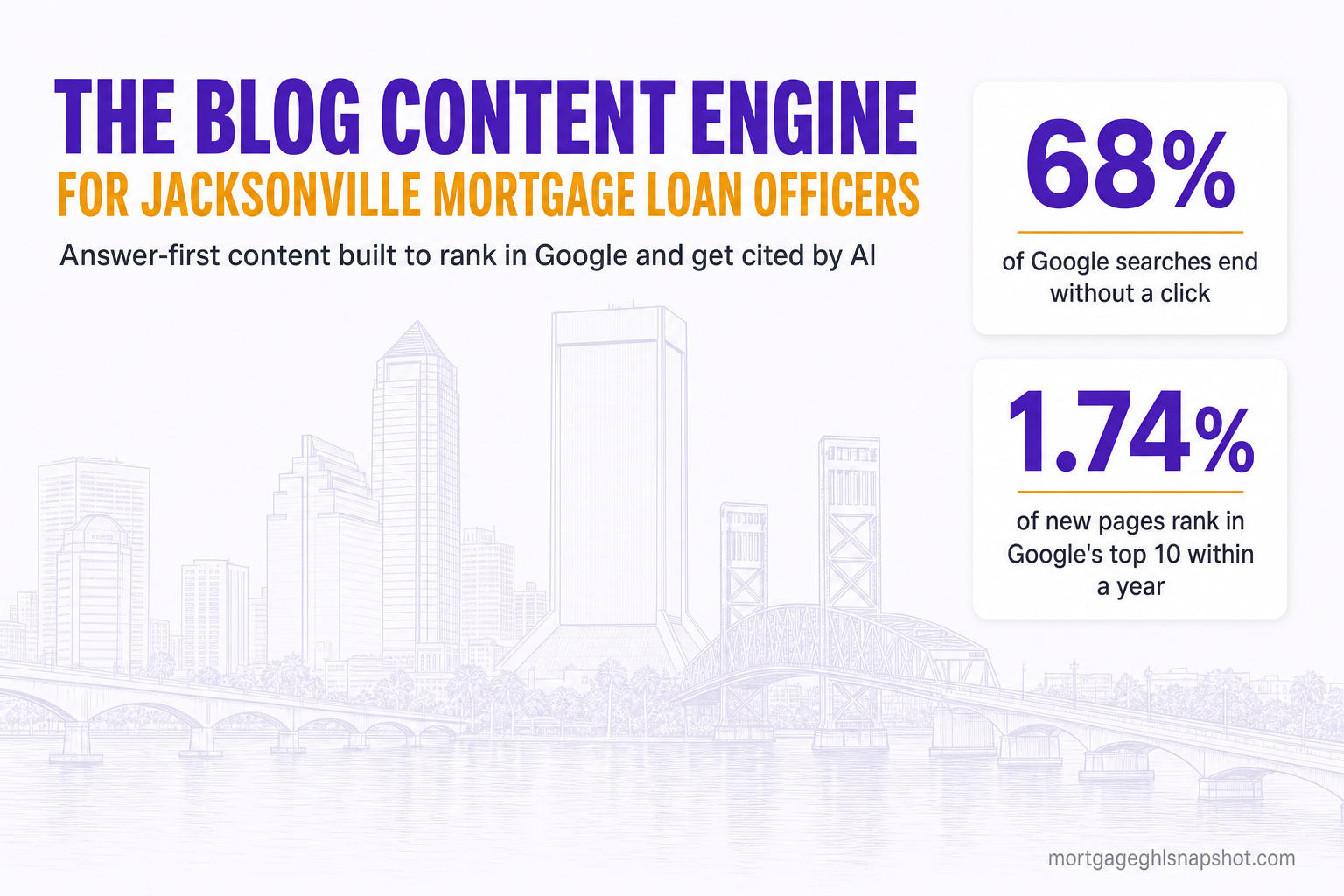
The click math has shifted with it. In early 2026, roughly 68% of U.S. Google searches ended without any click to the open web — up from about 58.5% in 2024 (SparkToro).
Share of U.S. Google searches that end without a click to the open web. Source: SparkToro, 2024 & 2026.
If that sounds like bad news for publishing, it isn’t — it changes what winning looks like. When Google or ChatGPT or Perplexity composes an answer, it composes it from pages. Being the page an AI answer is built on is the new front-page ranking. That’s the whole discipline of answer engine optimization (AEO), and it rewards exactly the writing standard the engine is built around: a clear, self-contained answer right under a question-shaped heading, backed by a cited source. We go deep on this in how AI search is changing lead generation for loan officers, but the one-line version is: write the answer so cleanly that a machine can quote it, and you get named even when nobody clicks.
The practical upshot for Jacksonville: you want content that wins both jobs — the human who clicks through and the AI that cites you to the human who doesn’t. Answer-first posts, on a fast site with proper schema, do both at once. Hand-rolled marketing that isn’t structured for it does neither.
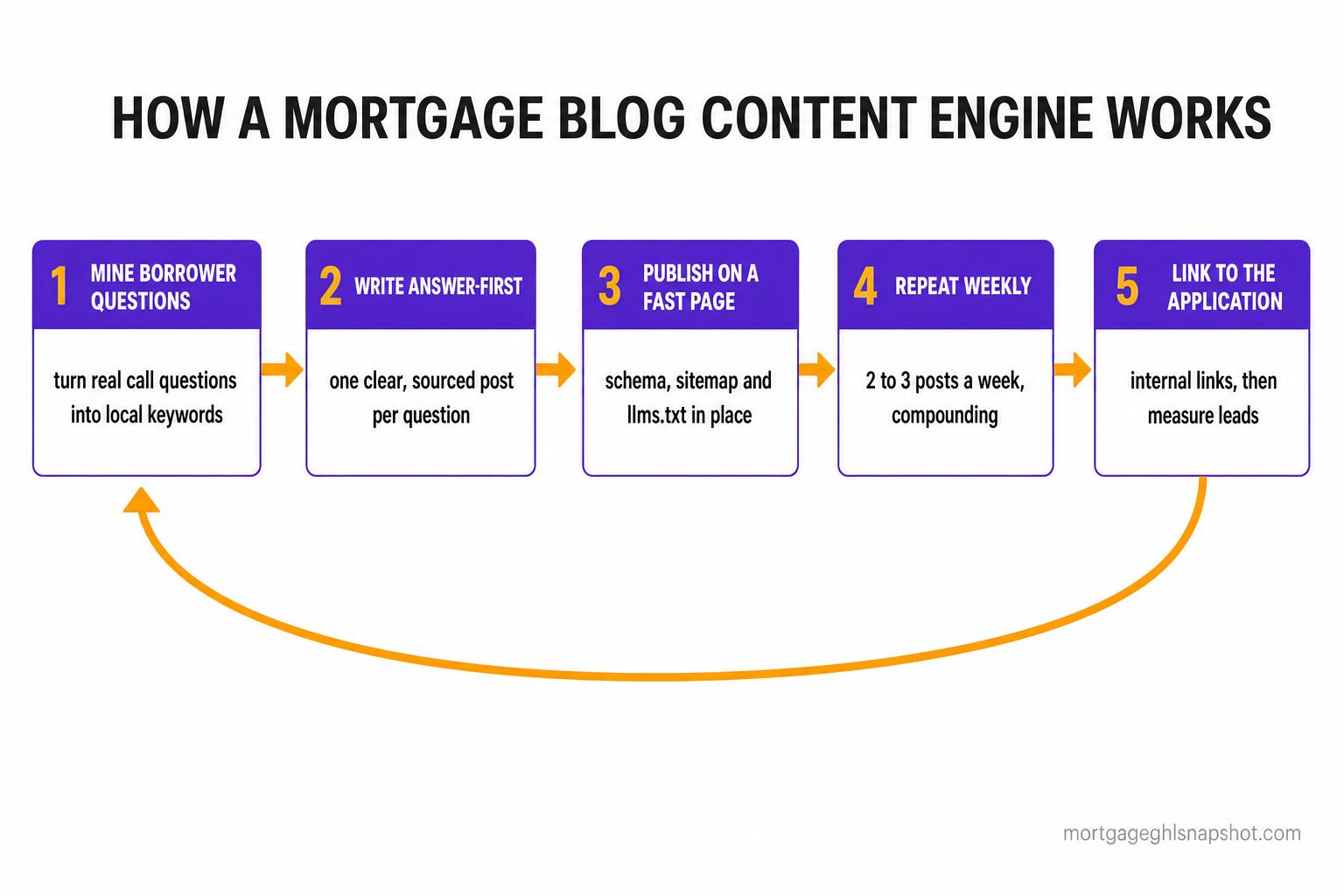
The 5-step blog content engine playbook
Here’s the system itself. Each step feeds the next; skipping one breaks the chain.
Step 1 — Mine borrower questions into local keywords
Start with intent, not volume. The searches that convert for a loan officer are long, specific, and local: “FHA loan limits Duval County 2026,” “first-time homebuyer down payment assistance Jacksonville,” “VA loan condo approval Jacksonville Beach,” “how much income to buy a $300k house in Florida.” These have modest search volume and enormous intent — someone typing them is a borrower, not a browser. Build the list from three sources: the questions you actually get asked on calls, Google’s “People also ask” and autocomplete for your programs, and the county/city names you’re licensed to lend in. One keyword becomes one post.
Step 2 — Write one answer-first post per question
Answer-first means the first sentence under each heading is the answer — the way this post opens with a bolded direct response. Lead with it; explain underneath. This is what earns featured snippets and AI citations, and it happens to be how a busy borrower reads anyway. Keep one post to one primary question, use clean H2/H3 structure, put a real number with a source link on every claim, and write in plain language a first-time buyer understands. Never quote a live rate or promise an approval — a calculator or program explainer is an estimate and an education, not an offer. Compliance isn’t a constraint on good content; it is good content.
Step 3 — Publish on a fast, schema-marked page
This is where most loan-officer blogs quietly fail. A great answer on a page that takes six seconds to load, or that carries no structured data, will not rank and will not be quoted. You need fast pages (Google rewards speed, and borrowers abandon slow ones), clean Article, FAQPage and LocalBusiness schema so machines understand what the page is, and correct sitemap, robots, and llms.txt files so both search crawlers and AI crawlers can read you. If your site is on a slow, plugin-heavy platform, fix the foundation first — see why website speed decides whether your content ranks and what a fast, lead-capturing loan officer website looks like.
Step 4 — Repeat on a weekly cadence
One post doesn’t move a market; fifty do. The engine’s power is compounding: each post adds an indexed page, an internal-link node, and another chance to be the answer. A realistic, sustainable cadence for a working originator is two to three researched posts a week. That’s a small library in a quarter and real topical authority in a year — the thing Google uses to decide you’re the local expert on FHA, VA, or first-time-buyer files.
Step 5 — Link posts to the application and measure
An article that ranks but doesn’t convert is a hobby. Every post should link internally — to related posts (which keeps readers on your site and passes ranking signal) and to your money pages: your calculators, your application, your booking calendar. Then watch two numbers: which posts bring organic traffic, and which bring applications. Double down on the topics that produce borrowers. A content engine that measures is a marketing system; one that doesn’t is journaling.
Cadence: how often to publish and when it pays off
Let’s set an honest expectation, because unrealistic ones are why most LOs quit at post number four. SEO is a compounding asset, not a vending machine. Ahrefs tracked a million newly published pages for a year and found only 1.74% cracked Google’s top 10 in that time, and that the average page ranking #1 is about five years old — with 72.9% of top-10 pages older than three years (Ahrefs).
Age distribution of pages ranking in Google’s top 10 — most are years old. Source: Ahrefs.
Read that chart the right way and it’s the argument for starting, not against. Rankings accrue to pages that have been earning trust for a while — which means the content you publish this month is what ranks next year. Every month you wait is a month your future top-ranking page doesn’t exist yet. Consistency beats intensity: a firm publishing two solid posts a week, every week, will pass one that dumped twenty posts in January and went quiet. With a fast, properly structured site behind it, a disciplined engine typically starts producing local rankings in three to five months and keeps climbing from there.
Run it yourself vs. a done-for-you Content Engine
You now have the whole system. The honest question is whether you’ll actually run it — every week, for a year — while also originating loans, answering borrowers, and having a life. Most loan officers can do any one post well. Almost none sustain the cadence, and cadence is where the compounding lives.
That’s the case for handing the engine to someone whose only job is running it. Our Get-a-Website Content Engine builds you a fast Astro site — 90+ PageSpeed guaranteed, real city and county pages, correct schema and llms.txt — and publishes three research-based posts a week written around your loan programs and the counties you’re licensed in, plus social posts and reels so the same work reaches search and social. It starts at $747/month (there’s a lighter $137/month tier if you want the site first and content later), and it comes with a plain-English guarantee: your site starts ranking in your area within three to five months. You originate. We run the engine.
Frequently asked questions
Content marketing for Jacksonville loan officers — quick answers
How many blog posts does a mortgage loan officer need to see results?
There's no magic number, but cadence matters more than any single post. Two to three researched, answer-first posts a week builds a real content library in a quarter and topical authority within a year. Because rankings compound — the average #1-ranking page is about five years old and 72.9% of top-10 pages are over three years old (Ahrefs) — the goal is consistent publishing, not a one-time burst.
How long until content marketing brings in mortgage leads?
SEO is a compounding asset, not an instant one — only 1.74% of new pages reach Google's top 10 within a year (Ahrefs). On a fast, properly structured site with real local pages and correct schema, a disciplined content engine typically starts producing local rankings in three to five months and climbs from there. Anyone promising day-one rankings isn't being straight with you.
Does blogging still work now that Google shows AI answers?
Yes — but the job changed. About 68% of U.S. searches ended without a click in early 2026 (SparkToro), and AI Overviews reduce link clicks to roughly 8% of visits versus 15% without one (Pew, 2025). AI answers are composed from web pages, so answer-first content structured for AEO gets your firm named even when the searcher never clicks. See our guide to AI search for loan officers.
What should a Jacksonville loan officer write blog posts about?
Write the questions your borrowers already ask, made local: FHA loan limits in Duval County, down-payment assistance programs in Jacksonville, VA condo approval in Jacksonville Beach, closing-cost breakdowns, and program explainers for first-time buyers. Local specificity is the one thing a national call center can't fake, and it's exactly what earns local rankings.
Is it better to run the content myself or hire it out?
Either works if the cadence holds — and cadence is where most self-run blogs fail, usually around the first busy origination week. If you'll reliably publish two to three sourced posts a week on a fast, schema-marked site, do it yourself. If you'd rather originate, our managed Content Engine writes and publishes it for you around your programs and counties, on a site guaranteed to hit 90+ PageSpeed and start ranking in three to five months.
Do I need a new website, or can I add content to the one I have?
You can add content to any site, but the foundation decides whether it ranks. A great post on a slow, unstructured site won't get found. If your current site is slow or missing schema and clean sitemap/robots/llms.txt files, fix that first — see why site speed decides whether content ranks. Our Content Engine ships the fast, schema-marked site and the content together.
About the author
Meera Sundaram is a Mortgage Marketing Strategist based in Austin, TX. She helps loan officers and the agencies that serve them turn calculators, content, and nurture sequences into a steady stream of pre-qualified borrowers — with a particular focus on the handful of touchpoints between a search query and a signed application. Meera is a fictional editorial persona for Mortgage Snapshot; nothing here is individualized legal, financial, or marketing advice. We are not a lender, and every figure cited is drawn from the sources linked.
Related reading
- Local SEO for mortgage loan officers — the local-search foundation a content engine sits on.
- How AI search is changing lead generation for loan officers — writing so AI answer engines cite you.
- Website speed: Astro vs. WordPress vs. GoHighLevel — why the fast page is what actually ranks.
- What a lead-capturing loan officer website looks like — the site your content publishes into.
- Mortgage database reactivation — turning the borrowers your content attracts into repeat business.