
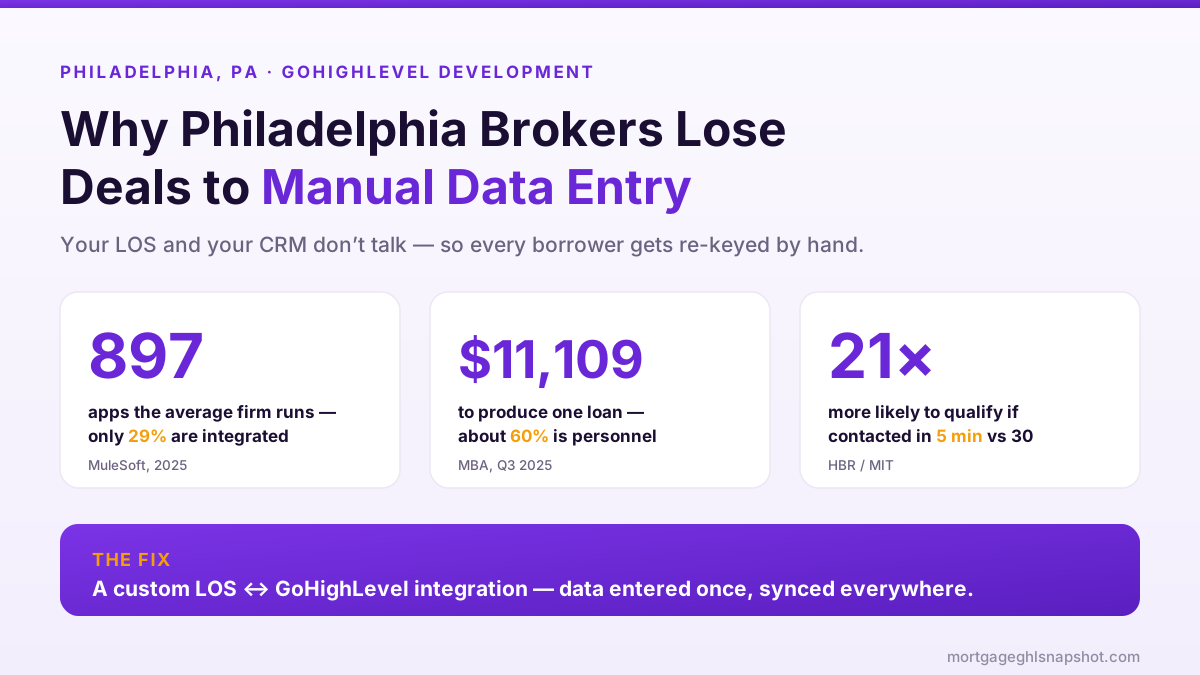
A first-time buyer in Fishtown fills out the rate form on a Philadelphia broker’s website at 8:15 p.m. The lead lands in GoHighLevel. The next morning a loan officer copies the borrower’s name, phone, email, loan amount, and property address out of GHL and re-types all of it into Encompass to start the file. That afternoon the processor asks for the borrower’s status, so someone opens the LOS, reads the milestone, and manually updates the stage back in GoHighLevel. Three systems, one borrower, and a human re-keying the same fields at every step. Somewhere in that shuffle, a second lead who came in at 8:40 never got a call back.
Philadelphia mortgage brokers lose deals to manual data entry because their loan origination system (LOS) and their CRM don’t talk to each other — so every borrower detail gets re-typed by hand between systems, follow-up stalls in the gap, and errors creep into files that cost real money to fix. The problem isn’t that your team is careless; it’s that they’ve been turned into the integration. The fix is a custom GoHighLevel integration that syncs the LOS and your CRM automatically, so data moves itself and your people go back to originating. This post lays out the five hidden costs of that gap — with the 2026 data behind each — and what the integration actually does.
The short answer: why a disconnected LOS and CRM costs Philadelphia brokers deals
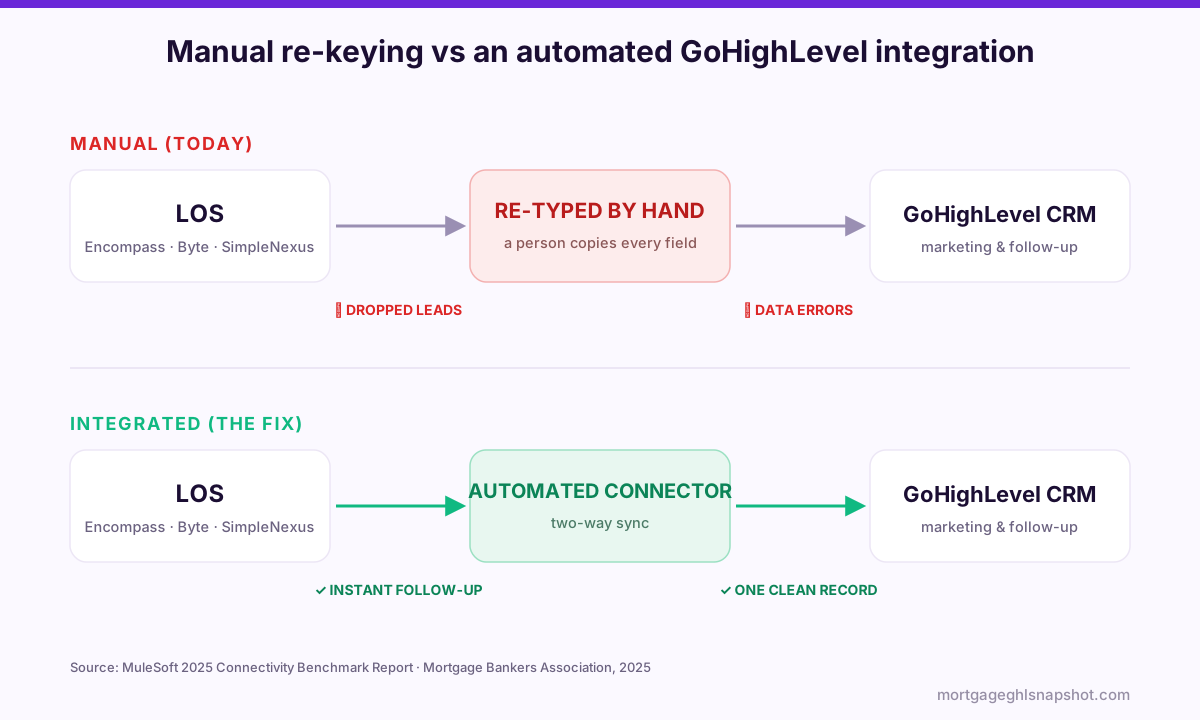
Most Philadelphia mortgage brokers run at least three systems that hold the same borrower: a website/CRM (often GoHighLevel) for lead capture and marketing, a point-of-sale/1003 tool for the application, and an LOS — Encompass, Byte, or SimpleNexus — for underwriting and closing. When those systems don’t share data, a human has to move it. That human is your loan officer or processor, and every hand-off is a chance for the deal to stall, the data to drift, or the lead to cool.
This is not a niche problem. It’s the default state of business software in 2026.
The gap between systems looks free because no one bills you for it. But you pay for it in re-keyed hours, in data errors, and in the leads that slip while your team is heads-down doing data entry instead of talking to borrowers. Here’s the integration reality, in one chart.
Pain #1: Your team is the integration
The cheapest integration to build is the one you never build — because a person quietly absorbs the work. That feels free until you price the person.
Salesforce’s State of Sales research found that reps spend only about 28% of their week actually selling; the other roughly 72% goes to administrative work, internal tasks, and — the big one — manually entering and moving data between systems (Salesforce, 2023). For a loan officer, the pattern is identical: the hours meant for originating and nurturing referral partners get eaten by copy-pasting a borrower from the website form into the 1003 tool, then into the LOS, then updating the CRM when something changes.
Now stack that against what a loan costs to produce. Independent mortgage banks spent $11,109 to produce a single loan in Q3 2025, and personnel expense is roughly 60% of that total (MBA, 2025). In other words, the single largest line item in your cost-to-originate is people’s time — and manual re-keying is one of the least valuable ways to spend it.
Pain #2: Re-keyed data is where errors are born
Every time a human copies a field, there’s a chance they fumble it. Human-factors research puts skilled manual data entry at roughly a 1% error rate per field, and meaningfully higher for free-text and numbers under time pressure (Quality Magazine). One percent sounds trivial until you multiply it across dozens of fields, three systems, and every file in your pipeline.
In a mortgage file, small data errors aren’t cosmetic. A transposed digit in a loan amount, a mistyped property address, an email that bounces because someone dropped a character — these show up later as re-work, a compliance headache, or a borrower who never got the message. And dirty data compounds: duplicate contact records, mismatched statuses between the LOS and CRM, and stale fields that nobody trusts. Gartner pegs the average cost of poor data quality at $12.9 million per year for organizations (Gartner, 2021) — a big-company number, but the mechanism is the same at a five-person brokerage: bad data creates re-work, and re-work is pure cost.
Pain #3: Borrowers go cold in the hand-off
Speed-to-lead is where the disconnect quietly bleeds the most revenue — because when a person has to move the lead, follow-up only happens when that person has a free minute, and borrowers don’t wait.
The data here is well-established. The Lead Response Management study out of MIT found that a lead contacted within 5 minutes is 21× more likely to qualify than one contacted at 30 minutes. The Harvard Business Review follow-up that audited 2,241 U.S. companies found the average first-response time was 42 hours, only 37% responded within an hour, and 23% never responded at all (HBR, 2011). Now picture the Fishtown borrower from the top of this post: their form hit GoHighLevel at 8:15 p.m., but nothing downstream fires until a human notices, re-keys the record, and reacts. By breakfast they’ve filled out two competitors’ forms.
An integration doesn’t just move data — it moves triggers. When a new application starts in the LOS or POS, a synced GoHighLevel account can fire an instant text-back, launch a nurture sequence, and route the borrower to a calendar without anyone touching a keyboard. The 5-minute window gets covered by the workflow, not by whoever happens to be at their desk.
Pain #4: Every dropped deal is expensive in Philadelphia
It’s tempting to treat a leaked lead as “one that got away.” But price it against your market. The median home sale price in Philadelphia is about $299,837 as of 2026 (Redfin, 2026), and it cost your business $11,109 just to produce the loan you did close (MBA, 2025). Every borrower you win is expensive to acquire, and every borrower you lose to a slow, error-prone hand-off is commission you already paid marketing to earn — then dropped on the floor between two systems.
And that per-loan production cost isn’t trending down. It’s been stuck above $10,700 for over a year:
When acquisition is that costly, the cheapest lead is the one you already have — and the fastest way to stop leaking them is to make sure the moment a borrower raises their hand, the system reacts instantly and the file is right the first time. (For recovering the borrowers already sitting in your database, see mortgage database reactivation.)
Pain #5: You can’t see your real pipeline
Here’s the pain that shows up in Monday meetings. Ask “how many files are in processing right now, and which are at risk?” and — with disconnected systems — the honest answer is “let me check the LOS, then reconcile it against the CRM.” Your marketing data lives in GoHighLevel; your loan-status truth lives in the LOS; and no single screen shows both. So pipeline reporting becomes a manual reconciliation job, and by the time it’s done, it’s already stale.
That blind spot has real consequences: you can’t tell which lead source actually produces funded loans (only which produces leads), you can’t spot a file stalling at appraisal until someone flags it by hand, and you can’t give a borrower a straight answer about where their loan stands without opening three tabs. A loan-milestone dashboard built on synced LOS + GoHighLevel data closes that gap — one branded view that shows stage, next action, and source-to-funded conversion, updated automatically.
The fix: what a custom LOS↔GoHighLevel integration actually does
A “GoHighLevel integration” isn’t a vague promise — it’s a specific piece of software that sits between your LOS and your GHL sub-account and keeps them in sync. Done well, it does five concrete things:
- Two-way contact & field sync. A new lead or application in either system creates or updates the matching record in the other — name, phone, email, loan amount, property address, product type — so the borrower is entered once and lives everywhere.
- Pipeline-stage sync. When the LOS milestone changes (application → processing → appraisal → clear-to-close → funded), the borrower’s stage in GoHighLevel updates automatically, and vice versa. No manual reconciliation.
- Trigger-based automation. A milestone change fires the right GHL workflow: an instant text-back on a new application, a “your appraisal is scheduled” update, a review request after funding. The workflow reacts in seconds, not whenever someone remembers.
- A live loan-milestone dashboard. One branded view, built on both systems’ data, that shows every file’s stage, next action, and true source-to-funded conversion — for you and, optionally, for the borrower.
- Compliance-aware messaging. Consent capture, A2P/10DLC registration, and STOP/opt-out handling stay intact across the sync, so automated borrower texting stays on the right side of TCPA. (Our text-message compliance guide covers the rules.)
The difference between the manual world and the integrated one is stark when you line them up.
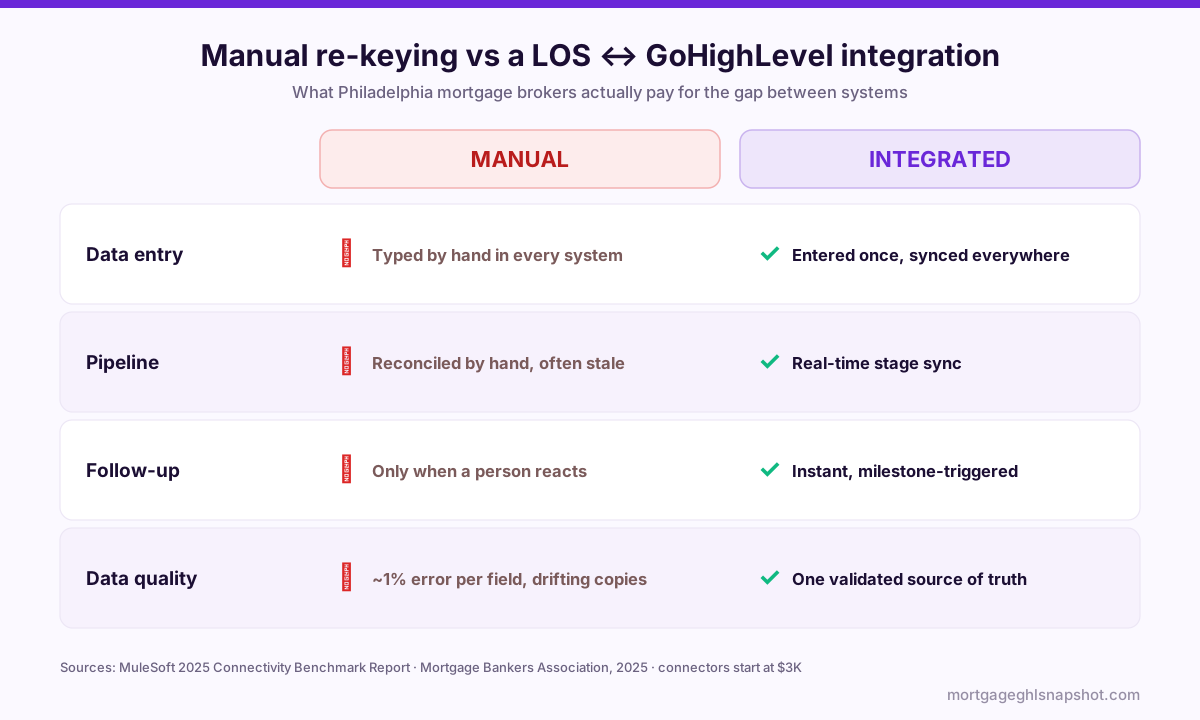
Manual re-keying vs a custom LOS↔GoHighLevel integration
| Plan | Manual re-keying (today) | Custom GHL integration recommended |
|---|---|---|
| Price | Hidden — paid in hours & errors | From $3K one-time (LOS connector) |
| Feature 1 | Entered by hand in every system | Entered once, synced everywhere |
| Feature 2 | Reconciled manually, often stale | Stage syncs automatically, real-time |
| Feature 3 | Fires only when a person reacts | Milestone triggers instant automation |
| Feature 4 | ~1% error per field, drifting copies | One validated source of truth |
| Feature 5 | 3 tabs and a spreadsheet | One live loan-milestone dashboard |
| Feature 6 | Originator time spent on data entry | Originator time spent originating |
| Scope it → |
This is exactly the kind of build our GHL development team does for mortgage firms: LOS-to-GHL connectors start at $3K, custom borrower dashboards run higher, and everything is scoped with a fixed price and timeline before a line of code is written. If your needs go beyond GoHighLevel — a standalone borrower portal, a niche CRM, or an AI agent — that’s what our custom software team handles. And if you’d rather someone operate the system day to day, a dedicated GHL VA can run it for you.
How to scope a GoHighLevel integration without over-building
The most common mistake here is trying to boil the ocean — syncing every field of every system on day one. Don’t. Scope it like a mortgage file: start with the highest-cost leak and expand only as it proves out.
- Map the hand-offs first. Before writing any code, list every point where a borrower’s data gets re-typed today. That map tells you which single sync removes the most manual work — usually the LOS-to-CRM contact-and-stage sync.
- Start with one connector. A focused Encompass, Byte, or SimpleNexus ↔ GoHighLevel connector that handles contacts and pipeline stages is a 2–4 week build and covers the majority of the pain. Ship it, prove it, then add triggers.
- Lock compliance in before automation goes live. A2P/10DLC registration, consent capture, and STOP handling get configured first — not bolted on after the first automated text goes out.
- Add the dashboard once data flows. With the sync running, a loan-milestone dashboard becomes a straightforward read layer on top of clean data, not a rescue mission over dirty data.
- Keep ownership. You own the GoHighLevel sub-account, the LOS, and all the data. The integration works inside your accounts; nothing is hostage to a vendor.
Scoped this way, an integration pays for itself against the very costs above: fewer re-keyed hours (Pain #1), fewer errors (Pain #2), faster follow-up (Pain #3), fewer dropped deals (Pain #4), and a pipeline you can actually see (Pain #5). Philadelphia brokers who’ve already moved onto GoHighLevel — see our GoHighLevel migration playbook — are usually one connector away from closing the last manual gap.
Frequently asked questions
LOS-to-GoHighLevel integrations for Philadelphia brokers — quick answers
Can you connect Encompass, Byte, or SimpleNexus to GoHighLevel?
Yes. We build custom connectors that sync contacts, custom fields, and pipeline stages between your loan origination system — Encompass, Byte, SimpleNexus, or another LOS — and your GoHighLevel sub-account. Depending on the system, we use webhooks for real-time updates or scheduled polling where a webhook isn't available. See our GHL development page for scope and examples.
How much does a GoHighLevel integration cost?
LOS-to-GoHighLevel connectors start at $3K as a fixed-price build. Custom borrower chatbots and dashboards run higher (loan-milestone dashboards typically $10K+), and there's an hourly retainer at $75/hour if you prefer pay-as-you-go. Every fixed-price project is scoped with a written timeline and price before work starts, and includes a 30-day bug-fix warranty.
How long does it take to build?
A focused LOS-to-GHL connector that syncs contacts and pipeline stages is typically a 2–4 week build. A full loan-milestone dashboard on top of synced data runs 4–8 weeks. We scope every project with fixed milestones so you know the timeline before we begin.
Why does manual data entry between systems cost so much?
Two reasons. First, time: loan officers spend roughly 70% of their week on non-selling admin (Salesforce, 2023), and re-keying is a big part of it — while personnel is about 60% of the $11,109 it costs to produce a loan (MBA, 2025). Second, errors: manual entry averages about 1% mistakes per field, and dirty data creates expensive re-work down the line.
Will an integration keep my borrower texting TCPA-compliant?
Yes. Consent capture, A2P/10DLC brand registration, and STOP/opt-out handling are configured before any automated messaging goes live, and the sync preserves consent status across systems. Our text-message compliance guide explains the current rules for mortgage SMS.
Do I keep control of my data and accounts?
Completely. You own your GoHighLevel sub-account, your LOS, and all borrower data. The integration runs inside your accounts, and access can be revoked at any time. We build the connector; you own everything it touches.
I'm a smaller Philadelphia brokerage — is this overkill?
No. Smaller teams often feel the pain most, because every re-keyed hour comes out of the owner's or one processor's day. Start with a single LOS-to-GHL connector — the highest-value sync — and expand only if it proves out. Book a walkthrough and we'll map your hand-offs first.
About the author
Emilio Duarte is a GHL Automation Lead for the mortgage niche, based in Tampa, FL. He builds GoHighLevel snapshots, pipelines, and custom integrations for loan officers and brokers — focused on borrower capture, speed-to-lead follow-up, and connecting the LOS to the CRM so data moves itself. Emilio is a fictional editorial persona for Mortgage Snapshot; nothing here is individualized financial, legal, or compliance advice. We are not a lender, and any figures cited are from the sources linked.
Related reading
- Mortgage speed-to-lead: why the first 5 minutes decide the deal — the follow-up window an integration is built to protect.
- Missed-call text-back for loan officers — the instant response that stops leads going cold in a hand-off.
- Borrower document portal for mortgage brokers — a custom build that lives on top of your GHL data.
- GoHighLevel migration for mortgage loan officers — getting onto GHL cleanly before you connect it.
- Mortgage CRM for loan officers: the 2026 buyer’s guide — what a well-run, connected pipeline should actually do.