
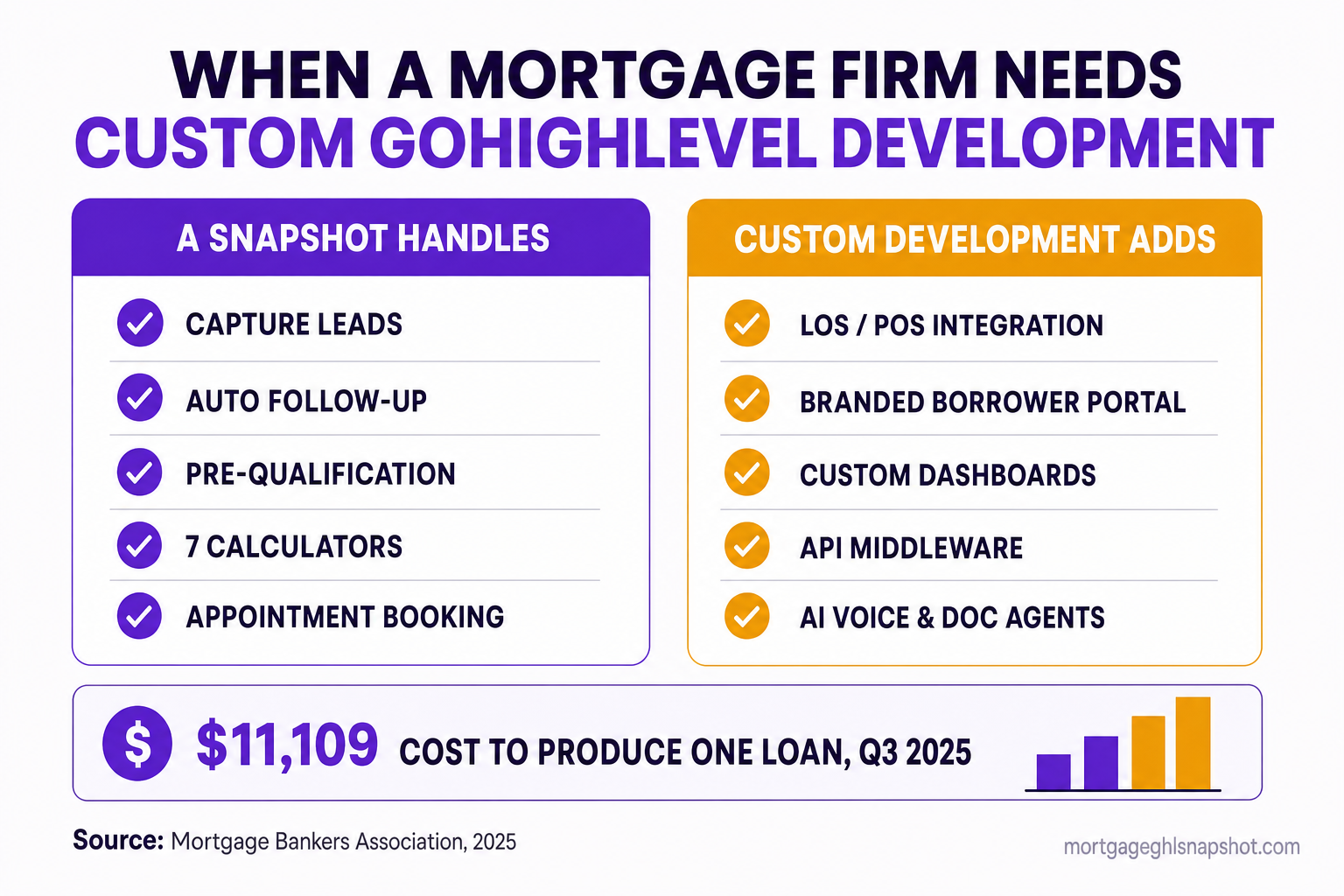
Most mortgage teams should start with a snapshot. A done-for-you GoHighLevel snapshot captures borrowers, runs pre-qualification, fires rate-drop alerts, and books appointments — and for a solo loan officer or a small shop, that’s usually enough to stop the bleeding. But there’s a point where “configure the CRM” stops being the answer and “write the code” becomes it: when your systems don’t talk, when a borrower experience needs to look and behave like your product, or when a workflow needs logic the GoHighLevel UI simply can’t express.
Custom GoHighLevel development for mortgage brokers means building the pieces a template can’t — LOS/POS integrations, branded borrower portals, private API and webhook pipelines, custom dashboards, and AI voice and document agents — so your borrower data flows through one connected system instead of being re-keyed across five disconnected tools. You need it when a snapshot has hit its ceiling: when re-entry, workarounds, and “we just do that part by hand” are quietly costing you loans. This guide draws the line between what a snapshot handles and where a full-stack developer earns their fee, with the real numbers behind the decision.
The short answer: snapshot vs. custom development
Think of it as three layers of the same house. A snapshot is the pre-built home — pipelines, workflows, calculators, and messaging installed and ready to run. A dedicated VA is the person who lives in it and keeps it tidy — tuning campaigns, cleaning data, building the odd new workflow. A full-stack developer is the contractor you call when you need to knock down a wall — when the thing you want doesn’t exist in the catalog and has to be engineered.
You don’t need the contractor to hang a picture. But no amount of tidying turns two disconnected rooms into one. That’s the tell: if the problem is configuration, a snapshot or a VA solves it. If the problem is that two systems refuse to talk, or a borrower needs an experience that isn’t in GoHighLevel’s toolbox, that’s a code problem — and code is what a custom GoHighLevel developer writes.
Custom development picks up exactly where a template stops:
- Integrations between your loan origination system (LOS), point-of-sale (POS), and GoHighLevel, so a borrower is entered once and flows everywhere.
- Branded portals where borrowers upload documents, check loan status, and e-sign — under your firm’s name, not a generic vendor’s.
- Custom logic — pricing tables, eligibility rules, routing, and reporting that GoHighLevel’s visual builder can’t express on its own.
- AI agents — voice callers, chat assistants, and document-reading pipelines wired into your data.
The rest of this guide shows exactly when each of those becomes worth paying for.
Where an off-the-shelf snapshot hits its ceiling
A snapshot is deliberately general. It has to install cleanly into thousands of accounts, which means it can’t assume you use Encompass or Arive, that your borrower portal needs your logo, or that your referral partners want a dashboard. Those assumptions are exactly where a growing firm starts to feel the walls.
Here are the four ceilings mortgage teams hit most often:
1. The re-keying ceiling. Your snapshot captures a borrower beautifully. Then someone opens the LOS and types the same name, income, and loan details in again. Every duplicate entry is a chance for a typo, a delay, and a borrower who feels the friction.
2. The experience ceiling. You want borrowers to log in, see their loan status, upload a pay stub, and get a nudge when a condition is outstanding — all branded as your firm. A generic form can’t do that. A custom borrower portal can.
3. The logic ceiling. You have a pricing sheet, an overlay matrix, or a partner-routing rule that lives in a spreadsheet and someone’s head. The GoHighLevel UI can automate a lot, but some logic needs a real function, a database, and an API call — not a workflow node.
4. The reporting ceiling. You need to see pull-through by loan officer, cost-per-funded-loan by source, or partner production by month. Off-the-shelf dashboards show activity; custom dashboards show the numbers you actually run the business on.
None of these ceilings mean the snapshot failed. They mean you’ve grown past what a template alone can do — which is a good problem, and a solvable one.
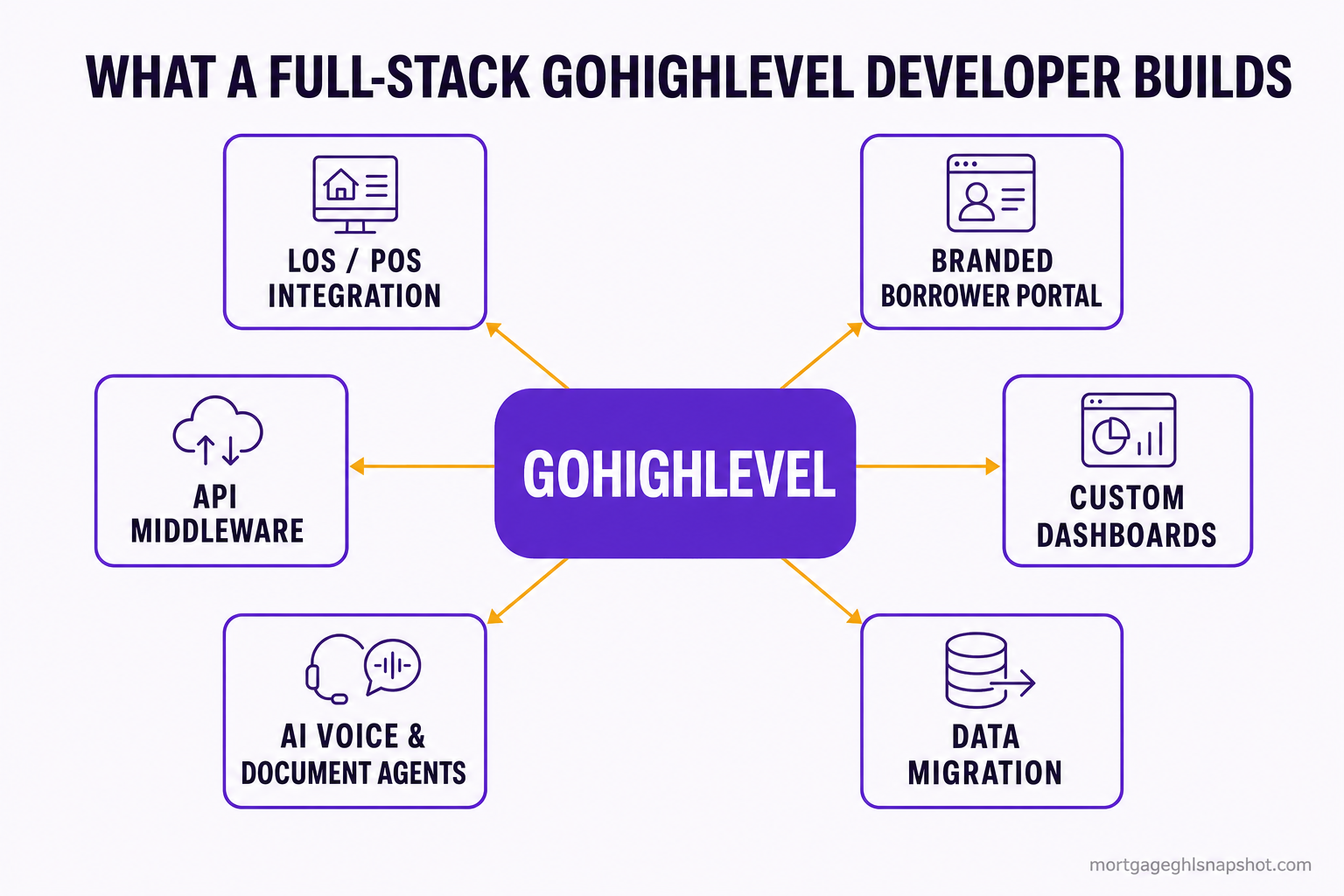
What a full-stack GoHighLevel developer actually builds for a mortgage firm
“Custom development” sounds abstract until you see the concrete builds. For mortgage teams, they cluster into six categories.
1. LOS and POS integrations
This is the most common request, and the highest-ROI. A private integration between GoHighLevel and your LOS or POS — Encompass, Arive, Blend, or another system — means a borrower entered in one place appears in the other automatically, with status changes syncing both ways. No re-keying, no stale records, no “which system is right?” A developer builds this with webhooks, queues, and reconciliation logic that survives an outage instead of silently dropping records.
2. Branded borrower portals
A portal is where the borrower experience lives: secure document upload, loan-status tracking, e-signature, and automated nudges when a condition is outstanding — all under your brand. Firms that have built these describe the same payoff: fewer “where are we?” phone calls and faster document turn times. See how a document-collection portal for a brokerage is put together.
3. Private integrations and API middleware
Not every tool you use has a native GoHighLevel connector — credit vendors, pricing engines, e-sign providers, accounting, and legacy systems often don’t. Middleware is the connective tissue: webhooks, retries, queues, and reconciliation that keep systems that were never designed to talk in sync anyway. It’s unglamorous, and it’s usually the difference between “automated” and “automated except for the part we still do by hand.”
4. Custom dashboards and reporting
Real operating numbers — pull-through, speed-to-lead by LO, cost-per-funded-loan by source, partner production — pulled from your connected systems into one view your team actually opens. This is where consolidation pays off directly: teams working from a single view of priorities report far less time lost to “work about work.”
5. AI agents wired into your data
This is the fastest-moving category. A custom AI software build can include a voice agent that answers and qualifies inbound borrowers 24/7, a chat assistant trained on your programs, or a document-processing agent that reads a 1003, pay stub, or bank statement, extracts the structured data, and files it into the right pipeline. These aren’t off-the-shelf — they’re built against your workflows and your compliance rules.
6. Migrations and data engineering
Moving off a legacy CRM, deduping a database of past clients, or migrating years of borrower history into GoHighLevel without losing tags, notes, or consent records is its own engineering job. Done wrong, it corrupts the database you’re about to market to. Done right, it turns a dormant list into a reactivation engine.
The hidden cost of disconnected systems
The case for custom development isn’t “shiny software.” It’s arithmetic. Mortgage margins are thin and the cost to originate is high, so every hour of manual re-work comes straight out of a small number.
Start with the cost to produce a loan. Independent mortgage banks spent $11,109 to produce a single loan in Q3 2025, and the figure has swung between $10,965 and $12,579 across the four most recent quarters (Mortgage Bankers Association, 2025) — far above the long-run average near $7,900. Personnel is the biggest slice of that cost, which means staff time spent re-keying data and chasing documents is quite literally part of what makes a loan expensive to make.
Total cost to produce a single loan, independent mortgage banks, by quarter (USD). Source: Mortgage Bankers Association, 2025.
Now the tax you don’t see on any invoice. Across three Fortune 500 companies, researchers found the average worker toggles between apps and windows roughly 1,200 times a day, and loses just under 4 hours a week — about 9% of their work time — simply reorienting after each switch (Harvard Business Review, 2022). A mortgage processor bouncing between the LOS, the CRM, email, a pricing engine, and a document portal is living that statistic. Integration doesn’t just save clicks — it gives people back the focus those switches steal.
And the sprawl is bigger than it feels. The average organization now runs 1,061 different applications, yet only 29% of them are integrated with one another — leaving roughly 71% of the stack disconnected (Salesforce / MuleSoft 2023 Connectivity Benchmark). Your GoHighLevel snapshot is one app in that stack. It can be the best-configured app you own and still be an island if nothing bridges it to your LOS, your pricing engine, and your document tools. Bridging those islands is exactly the work custom development does.
Share of the average organization’s applications that are integrated vs. disconnected (%). A snapshot is one app in a stack that mostly doesn’t talk. Source: Salesforce / MuleSoft, 2023.
There’s a borrower side to this too. Homebuyers consistently say they want a digital process and a human loan officer — the Ellie Mae Borrower Insights research has long found that borrowers expect digital mortgages but still want the human touch (Ellie Mae Borrower Insights, 2018). That’s the whole design brief for custom software in this niche: give borrowers slick digital tools while keeping your LO in the loop. The systems that win make your loan officers faster and more present, not the ones that try to remove them.
Finally, speed. The classic MIT / InsideSales lead-response study found that contacting a web lead within 5 minutes makes you 21× more likely to qualify it than waiting 30 minutes (MIT / InsideSales, Lead Response Management). A real-time integration that fires the instant a borrower comes in — routing them to the right LO and triggering an immediate response — is how you actually hit that window instead of missing it because the lead was sitting in a system nobody had open. It’s the same reason speed-to-lead is the metric we obsess over across every build.
Build vs. buy: snapshot, VA, or developer
The wrong question is “should I build custom software?” The right one is “what’s the smallest thing that fixes my actual bottleneck?” Three options, three different jobs:
- Start with a snapshot when you need the fundamentals — capture, follow-up, pre-qual, calculators, booking — installed fast. Most firms should begin here, and many never need more. It’s the fastest path from “leaking leads” to a working system.
- Add a dedicated GHL VA when the system exists but nobody has time to run it — you need someone tuning campaigns, cleaning data, and building routine workflows week to week. Our hire-a-VA service starts at $797/month for exactly this.
- Bring in a full-stack developer when the problem is engineering, not configuration — a system that won’t integrate, an experience that has to be custom-built, or logic a UI can’t express. Our full-stack GoHighLevel development runs $2,000–$5,000/month for dedicated hours, priced on the seniority the build needs rather than a fixed menu.
These aren’t mutually exclusive — the common path is a snapshot to get live, a VA to run it, and a developer for the one or two custom pieces that a template can’t reach. If you’re not sure which you need, that’s genuinely worth a conversation before you spend a dollar.
What to look for in a GoHighLevel developer
Not every “GHL expert” is a developer, and not every developer understands mortgage. When you’re evaluating who builds the custom layer, weigh five things:
- Real engineering, not just workflow clicking. Ask what they build backends in. A genuine full-stack shop works in a real stack — Laravel or Node on the backend, a database underneath, proper APIs — because integrations and portals need code, not just automation nodes.
- Mortgage fluency. They should already speak 1003, LOS, POS, conditions, pull-through, and TRID timelines. You shouldn’t have to teach them the domain before they can build in it.
- Compliance built in from the first commit. Borrower data is non-public personal information under GLBA, and messaging is governed by TCPA and consent rules. Encryption, access controls, audit logging, and opt-out handling should be architecture decisions, not afterthoughts. (See our note on mortgage text-message compliance.)
- Data ownership. You should own the code, the integrations, and the data outright — no black boxes you can’t leave.
- A path back to simple. The best developers hand routine maintenance back to a VA or your team once the custom piece is live, so you’re not paying senior-engineer rates to keep the lights on.
Whichever route you choose, the framework is the same: use a template for the standard 80%, and reserve custom development for the 20% that’s genuinely yours — the integrations, portals, and logic that make your firm run differently from the shop down the street. Get that split right and you stop paying to build what already exists, and start paying only for the edge that’s actually worth engineering. Pair the custom layer with a solid mortgage CRM foundation and the whole system compounds.
Frequently asked questions
Custom GoHighLevel development for mortgage brokers — FAQ
What is custom GoHighLevel development for a mortgage broker?
It's engineering work that goes beyond configuring a GoHighLevel snapshot — building things a template can't. For mortgage firms that usually means integrations between GoHighLevel and your LOS or POS (so a borrower is entered once and flows everywhere), branded borrower portals for document upload and loan-status tracking, private API and webhook pipelines to connect tools that have no native connector, custom dashboards for real operating metrics, and AI voice or document agents wired into your data. It's for the 20% of your system that has to be built, not clicked together.
How do I know if I've outgrown a GoHighLevel snapshot?
The clearest signs are re-keying (staff typing the same borrower into two systems), workarounds (a spreadsheet or a manual step that everyone just accepts), an experience you wish were branded to your firm but isn't, or reporting you can't get out of off-the-shelf dashboards. If your problem is configuration, a snapshot or a VA fixes it. If two systems refuse to talk or you need logic the UI can't express, that's a code problem — and that's when custom development pays off.
How much does custom GoHighLevel development cost?
Our full-stack GoHighLevel development runs $2,000 to $5,000 a month for dedicated hours, priced on the seniority the build requires rather than a fixed menu — a straightforward integration sits near the lower end, while a HIPAA-grade platform with cloud architecture and AI work sits at the top. A dedicated GHL VA (for running an existing system rather than engineering new pieces) starts at $797/month, and a done-for-you snapshot is a one-time install. Many firms use all three at different stages.
Can a developer integrate GoHighLevel with my loan origination system?
Yes — LOS and POS integration is the most common custom request. A developer connects GoHighLevel to systems like Encompass, Arive, or Blend using webhooks and API middleware, with queues, retries, and reconciliation so records don't silently drop during an outage. The result is a borrower entered once who appears everywhere, with status changes syncing both ways, which eliminates the re-keying that slows files down and introduces errors.
Will custom software replace my loan officers?
No, and it shouldn't try to. Borrowers consistently say they want digital convenience and a human loan officer — Ellie Mae's Borrower Insights research has long found homebuyers expect digital mortgages but still want the human touch. The goal of custom software in the mortgage niche is to make loan officers faster and more present — automating re-keying, document chasing, and routine follow-up so LOs spend their time on the borrower conversations that actually close loans.
Related reading: The GoHighLevel integration that fixes manual data entry · How brokers build a branded borrower document portal · Migrating a mortgage database into GoHighLevel · Why speed-to-lead decides who wins the borrower