
Rates slipped three-eighths overnight. By 7:15am a borrower you closed two years ago is reading a refi ad on her phone, and a call center that bought her loan data is about to dial. Your window is measured in hours, not days. The loan officer who reaches her first with something useful keeps the loan. Everyone else sends a “just checking in” text next week and loses her.
So here is what you came for: the texts, the voicemail, the email, and the live call script to use the morning rates drop, each with the timing and the compliance line that keep it working and legal. Save this page.
Why the first callback wins the refi
When rates fall, a refinance is one of the easiest loans you will write: the borrower trusts you, you have their file, the math sells itself. The only problem is everyone else sees the same drop.
The numbers tell the story. Refinance retention climbed to 28% in Q3 2025, the highest in about three and a half years, and non-banks held borrowers at roughly three times the rate of banks, 35% versus 13% (ICE Mortgage Monitor, 2025). Even in a peak quarter, close to 7 in 10 refinancing borrowers left whoever closed their last loan. That is not a loyalty problem; it is a speed-and-contact problem you fix with a phone and the right words.
Refinance retention rate (%) by lender type, Q3 2025. The gap is the loans that walked. Source: ICE Mortgage Monitor, December 2025.
Speed is the other half. Harvard Business Review’s study of 1.25 million leads found firms that reached out within an hour were nearly seven times more likely to reach someone (Harvard Business Review, 2011). And the window is tight: the market moves borrowers in and out of refinance range on small daily shifts, with a KBW estimate putting about 3.7% of the mortgage universe “in the money” at just a half-point incentive (HousingWire, 2025). You need the words ready before the alert fires.
This playbook is the human-copy layer on an automated rate-drop refi alert system: the system flags who crossed their threshold, these scripts are what you say next.
Before you send a word: who to call and when
A script fired at the wrong person burns a relationship you will want later, so spend two minutes on setup first.
Pull the right list, not the whole database. You want past borrowers whose locked rate sits at least 0.5% to 0.75% above today’s market, enough to clear closing costs. Sort by biggest monthly saving first, where the easy yeses are. If nobody has touched the database in two years, do the reactivation groundwork first so you are not dialing dead numbers.
Know their trigger. A borrower at 7.1% on a $505,000 loan who could move to 6.4% is a different conversation than an ARM about to reset or a homeowner sitting on equity. Tag each contact with old rate, loan amount, and loan type so the first line is their number, not a generic “rates dropped.”
Time it for a human hour. An automated alert might fire at 2am; your outreach should not. Queue texts and calls for 9am to 6pm in the borrower’s time zone.
The first-touch text, and three variants you can steal
Text first. It is read in minutes and opens a thread. Keep it short, lead with their number, ask one easy question, include an opt-out. Three variants for the three people you will be texting:
Variant 1: the clean in-the-money past client.
Hi [First name], it’s [Your name] at [Company]. Rates moved and based on your current loan you may be able to drop from about [old rate]% to roughly [today’s estimate]%, which could save you around $[estimate]/mo. Worth a quick look? Reply YES and I’ll run your exact numbers. Reply STOP to opt out.
Variant 2: the ARM reset or cash-out candidate.
Hi [First name], [Your name] at [Company]. Your adjustable rate is set to reset soon and today’s fixed pricing may let you lock in before it does. Want me to run what a fixed payment would look like for you? Reply YES or STOP to opt out.
Variant 3: the old pre-approval that never closed.
Hi [First name], it’s [Your name]. You were pre-approved with me a while back and never found the right home. Rates just improved, so your budget may stretch further than it did. Want an updated number? Reply YES, or STOP to opt out.
Every version names who you are in the first six words (an unknown number gets ignored), leads with the borrower’s situation, makes one small ask (a reply, not a booking), and carries an opt-out. The automation lives in your SMS automation workflows; the words get the reply.
The voicemail that gets a callback
If the text gets no reply within a couple of hours, call. Most loan officers waste the voicemail with “hey, give me a call back.” A good one does the text’s job: names you, gives the reason, makes it easy to call back. Fifteen seconds.
Hi [First name], it’s [Your name] at [Company], your loan officer from [year or property]. Quick reason I’m calling: rates came down and I think you could save real money on your payment. I ran a rough number and wanted you to see it before the window closes. Call or text me back at [number] whenever you get a sec. Talk soon.
That is the whole script. It reminds them who you are, it is about their money not your pipeline, and it creates mild urgency. Say your callback number slowly, and leave one good voicemail, not three.
The rate-drop email: subject lines and body
Email is your third touch on day one, and it does what the text cannot: show the math. People who ignore a text will open an email, see the numbers, and forward it to their spouse. The subject line does the heavy lifting.
Subject lines that get opened:
- Your rate vs. today’s rate, [First name]
- Quick number for you (could save ~$[estimate]/mo)
- Worth a 5-minute refi check?
The body:
Hi [First name],
Short version: rates have come down since we closed your loan, and based on your current rate of about [old rate]%, you may be able to refinance to roughly [today’s estimate]%. On your balance, that could be in the neighborhood of $[estimate] a month, or about $[annual estimate] a year.
These are estimates, not an offer. The only way to know your real number is to run it, about ten minutes with the file I already have on you.
Want me to? Just reply to this email or grab a time here: [booking link].
[Your name], [Title] [Company] · NMLS #[your number] Reply STOP to any text to opt out of messages.
The email shows the annual number, not just the monthly one, because “$340 a month” and “about $4,000 a year” land differently. And it carries your NMLS ID, which advertising needs under the SAFE Act.
The live call script, opening to booked consult
When a borrower replies YES or picks up, you need a call that goes from hello to booked consult. Four beats:
Open (reconnect, do not pitch).
Hey [First name], it’s [Your name], good to hear your voice. I’ll keep this quick. Rates came down and on your loan that actually matters, so I wanted to get you the real number before it moves again.
The value (their math, out loud).
Right now you’re at about [old rate]%. Today, for a file like yours, we’re seeing around [today’s estimate]%. On your balance that’s roughly $[estimate] a month back in your pocket, and even after closing costs you’d be ahead inside [break-even] months. Sound good?
Handle the two objections you will hear most. For “I’ll wait, rates might drop more”:
Totally fair, and they might. But every month you wait, you’re paying the higher payment anyway, and if rates drop again later we can look again, there’s no penalty to refinancing twice. The saving starts the month you close, not the month rates bottom.
For “someone else already called me about this”:
I’m not surprised, a lot of shops buy that data the second rates move. The difference is I already have your file, so I can get you a real number faster, and you know who you’re dealing with.
Book the consult (assume the next step).
Let’s do this. I’ll put together your exact numbers and we’ll go through them. Does tomorrow at 10 work, or is the afternoon better? I’ll send a confirmation and a secure link to update anything that’s changed.
You never argue: acknowledge, reframe, move on. If a reply lands at 9pm when you are off, an AI receptionist can answer the basics and book the consult so the warm moment is not lost.
The ten-day follow-up cadence
Most borrowers do not reply to the first touch. That is not a no. The money is in the cadence that catches people when they finally have a minute.
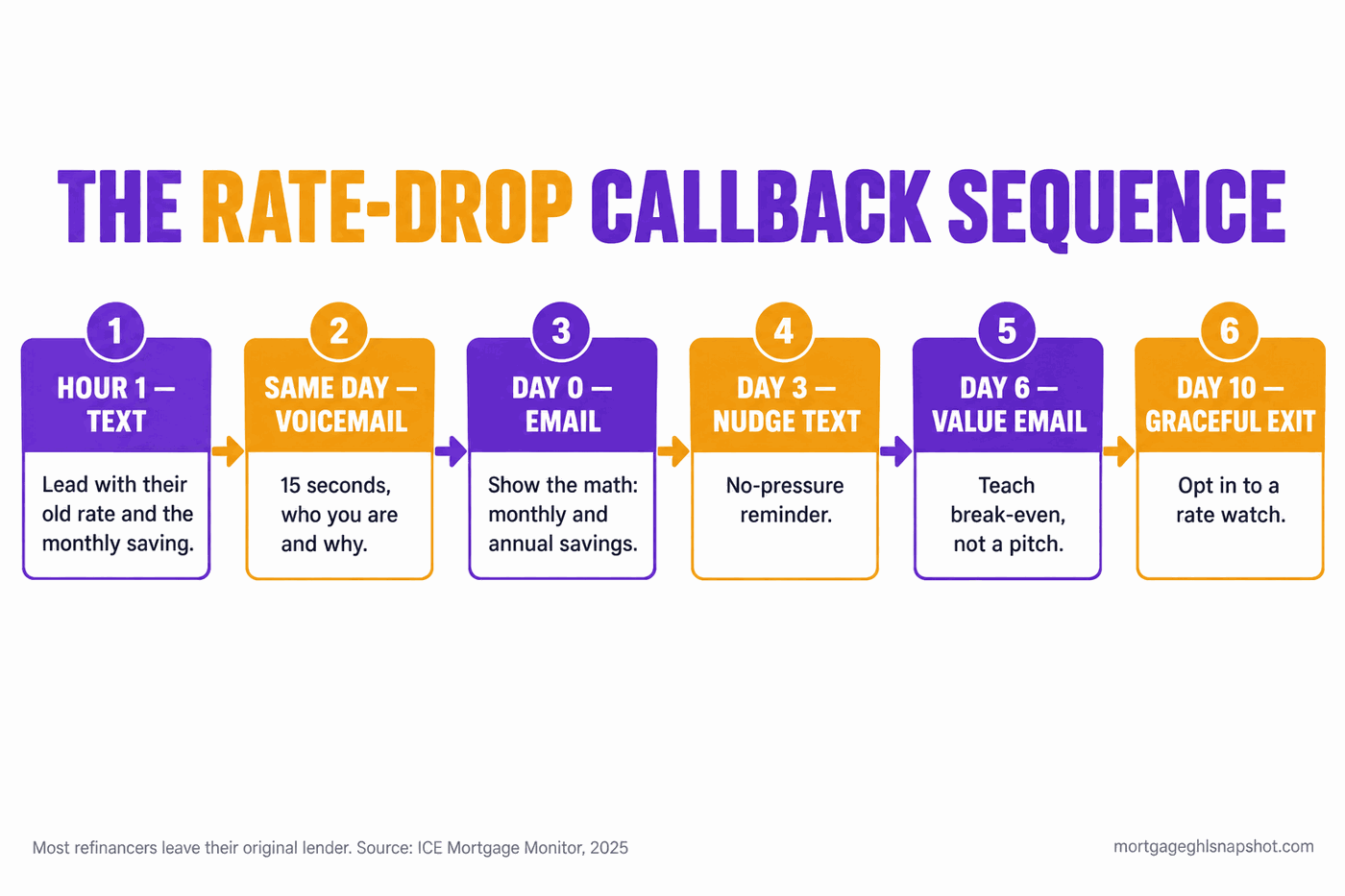
- Day 0, morning: the first-touch text (Variant 1, 2, or 3 above).
- Day 0, afternoon: the voicemail, if no text reply.
- Day 0, evening: the rate-drop email with the math.
- Day 3: a soft nudge text.
Hi [First name], no pressure at all, just didn’t want you to miss the window. Still happy to run your exact refi number whenever. Reply YES or STOP to opt out.
- Day 6: a value email that teaches break-even, so you stay useful to people not ready yet.
- Day 10: the last call and a graceful exit.
Hi [First name], last note from me on this for now. If rates in the [today’s estimate]% range would help your payment, I’m here. If not, no worries, I’ll keep an eye on it for you and reach out if it moves again. Reply STOP to opt out.
After day 10, non-responders drop into a long rate-watch nurture, re-alerted on the next dip. That day-10 “I’ll keep an eye on it for you” is the highest-return line in the library: it turns a dead end into an opt-in and makes your next rate-drop call expected instead of cold. Same discipline that makes pre-approval follow-up convert: the first message rarely closes, the cadence does.
Run it as a solo LO, a small team, or a brokerage
The scripts do not change with your size. Who sends them, and how much is automated, does.
The solo loan officer. Your enemy is time. Automate the first text and email to fire the morning a borrower crosses their threshold, load the three variants as templates, and reserve yourself for the live calls. That hour is your highest-value work; protect it and let automation do the rest.
The small team, 2 to 15 LOs. The hard part is routing. A rate-drop reply has to land with the LO who closed that borrower instantly, or two people call the same client and nobody calls forty others. Route replies by original loan officer, run a shared “rate-drop” pipeline in your CRM workflows, and standardize the scripts so every LO sounds like the same firm. This is where speed-to-lead discipline pays the most.
The brokerage or high-volume shop. At volume, this is a machine and the scripts are its fuel. Every touch is automated and measured, the live call becomes a trained standard, and reporting shows which segments (ARM resets, high-balance, FHA streamlines) convert best so you aim the next push where the money is. Your LOs never see an unsorted list, only a queue of warm borrowers.
Keep every script legal: TCPA, DNC, and the “not a quote” line
A rate-drop callback touches calling, texting, and advertising at once, so three rule sets apply from the first message. Not legal advice, but these are the lines I build every sequence to respect.
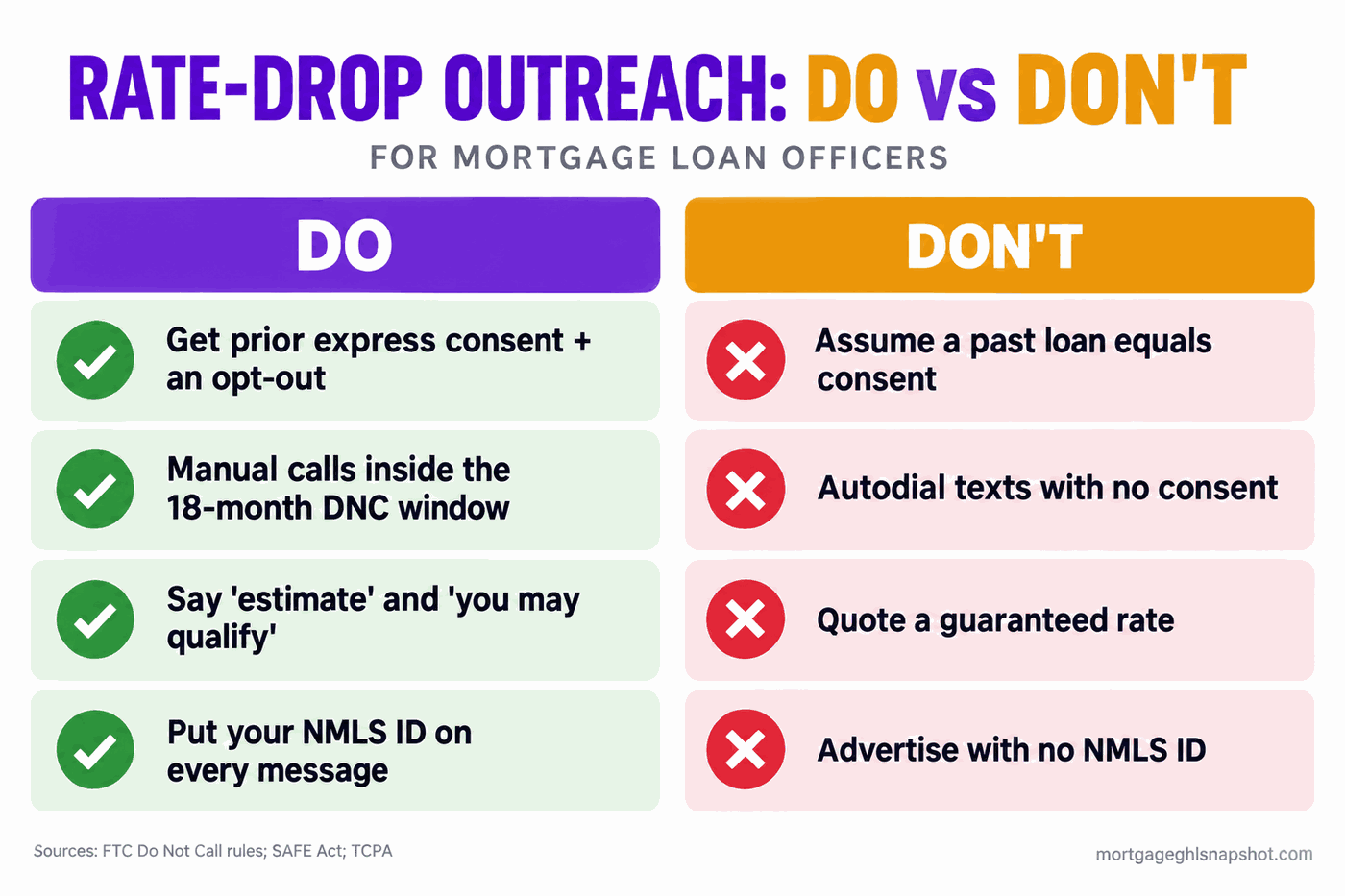
TCPA consent is not the same as a past relationship. Closing someone’s loan does not grant consent to send an autodialed marketing text. Prior express consent captured at intake, plus a working opt-out on every message, keeps automated texting clean. Note the moving target: the FCC’s one-to-one consent rule was vacated by the Eleventh Circuit in January 2025 just before it took effect, so the older standard stands for now (Debevoise, 2025).
The Do Not Call established-business-relationship exemption has a clock. A manual, live call to a past client is generally allowed for 18 months after their last transaction, three months after an inquiry, unless they have asked you not to call (FTC). Past that window, or after an opt-out, stop. Prerecorded and AI-voice calls are stricter and need their own consent.
Never quote a live rate as a promise, and put your NMLS ID on advertising. Every script above says “about,” “estimate,” and “you may qualify” on purpose, because a number a borrower reads as a guarantee you cannot deliver is a UDAAP problem. And your NMLS unique identifier belongs on the messages that advertise your services, as the SAFE Act and most state advertising rules require, so put it in your text templates and signatures too.
The objections I hear every week
“Won’t past clients be annoyed that I’m texting them about money?” Not when the message is about their money and sent once, well. People do not resent a specific “you could save $340 a month” from the loan officer they trust; they resent generic blasts and relentless follow-up. Lead with their saving and include an easy out.
“I don’t have time to call a hundred past clients.” You do not need to. Automate the first text and email and reserve yourself for the replies. If ten percent of a well-targeted list replies, you are making warm calls to engaged people, not cold-dialing.
“What if rates drop more and the client blames me?” Handle it in the script: the saving starts the month they close, not the month rates bottom, and there is no penalty to refinancing again later, so waiting for the perfect bottom is the expensive choice.
“My database is a mess and I’m not sure who consented.” Fix that before you automate. Clean the list, confirm consent, and when in doubt use manual calls under the DNC window rather than automated texts. A smaller consented list beats a big one that earns you a complaint.
Frequently asked questions
How fast do I actually need to call after a rate drop?
Same day, ideally the same morning. Most refinancing borrowers leave their original lender, and the odds of a good conversation fall sharply after the first hour. You do not need to be first by minutes, but being first by days loses the loan. Automate the first text so it fires the moment a borrower crosses their threshold.
Can I legally text a past client about a refinance?
Only with prior express consent and a working opt-out on every message. A past loan does not by itself grant consent for automated marketing texts under the TCPA. Live, manual calls are different: generally allowed for 18 months after the last transaction under the Do Not Call established-business-relationship exemption, unless the client has asked you not to call.
What is the single most important line in a rate-drop text?
The borrower's own number. Open with their old rate and an estimated monthly saving, not 'rates dropped, call me.' Specific beats generic, because it answers the only question they care about: what does this mean for my payment?
How many follow-ups is too many?
The ten-day cadence in this guide, three touches on day one and three more across the next nine days, is the ceiling for most shops. After that, move non-responders into a long rate-watch nurture and re-engage on the next dip rather than keep pushing the current one.
Can I automate all of this, or send each message by hand?
You can automate the first text, the email, and the nurture cadence, and route replies to the right loan officer, while keeping the live call human. A system fires the scripts with compliant opt-outs, and you handle the conversations that close.
It is next Tuesday, and rates slip again overnight. The alert fires at 2am and queues itself. By 9:05 your borrower from two years ago gets a text with her old rate and a real number, and she replies YES before her coffee is cold. The call-center dialer that bought her data reaches a voicemail she never checks. You already have the consult booked for ten. The whole difference is having the words ready before the window opens.