
It is day nine of a clean purchase file. Credit was fine, income checked out, the appraisal is ordered. You have not called the borrower since the application because nothing is wrong, right? Then your processor forwards an email: the borrower is asking for their file so another lender can “match the rate.” You never heard a problem because you never heard anything. The silence you read as “smooth” the borrower read as “forgotten,” and a competitor filled the gap with a call you did not make.
Losing a borrower after they applied is the most expensive kind of loss, because you already did the hard part. The fix is not a better rate or a faster appraisal. It is a communication system that runs from application to funding, so the borrower never has a quiet week long enough to start shopping. This guide walks the six stages, the exact messages for each, and the ways it breaks.
What losing a borrower in underwriting really costs
A lead that never converts costs you time. A borrower who applies, gets conditionally approved, and then closes elsewhere costs you the pull, the appraisal coordination, the processor hours, and the deal itself. It is the only loss where you paid for everything and got none of the revenue.
The market is making this worse. Pull-through, the share of applications that actually fund, has been sliding. For independent mortgage lenders it fell to 69% in the first half of 2025, the lowest since 2012, and for depository lenders it hit 55% (MBA/STRATMOR Peer Group Roundtables). Asked why, lenders put borrowers applying with several lenders and picking a different one near the top of the list. That is not a pricing problem, it is a relationship problem, and relationships are built with contact.
The window is long enough to lose. The average purchase mortgage took about 43 days to close in early 2025 (ICE via NerdWallet). Six weeks is a long time to stay top of mind by accident. And borrowers are primed to compare: nearly half consider only one lender, so the other half are shopping you right now (CFPB), and Freddie Mac found those who gather five quotes save around $2,914 over the life of the loan (Freddie Mac, 2023). Your job is to give them a reason not to look.
Sources: MBA/STRATMOR, ICE via NerdWallet, CFPB, Congress.gov.
Mortgage pull-through rate (funded loans as a share of applications). 2021 Q1 from MBA reporting; H1 2025 from the MBA/STRATMOR Peer Group Roundtables. Peer-survey data, not the whole market.
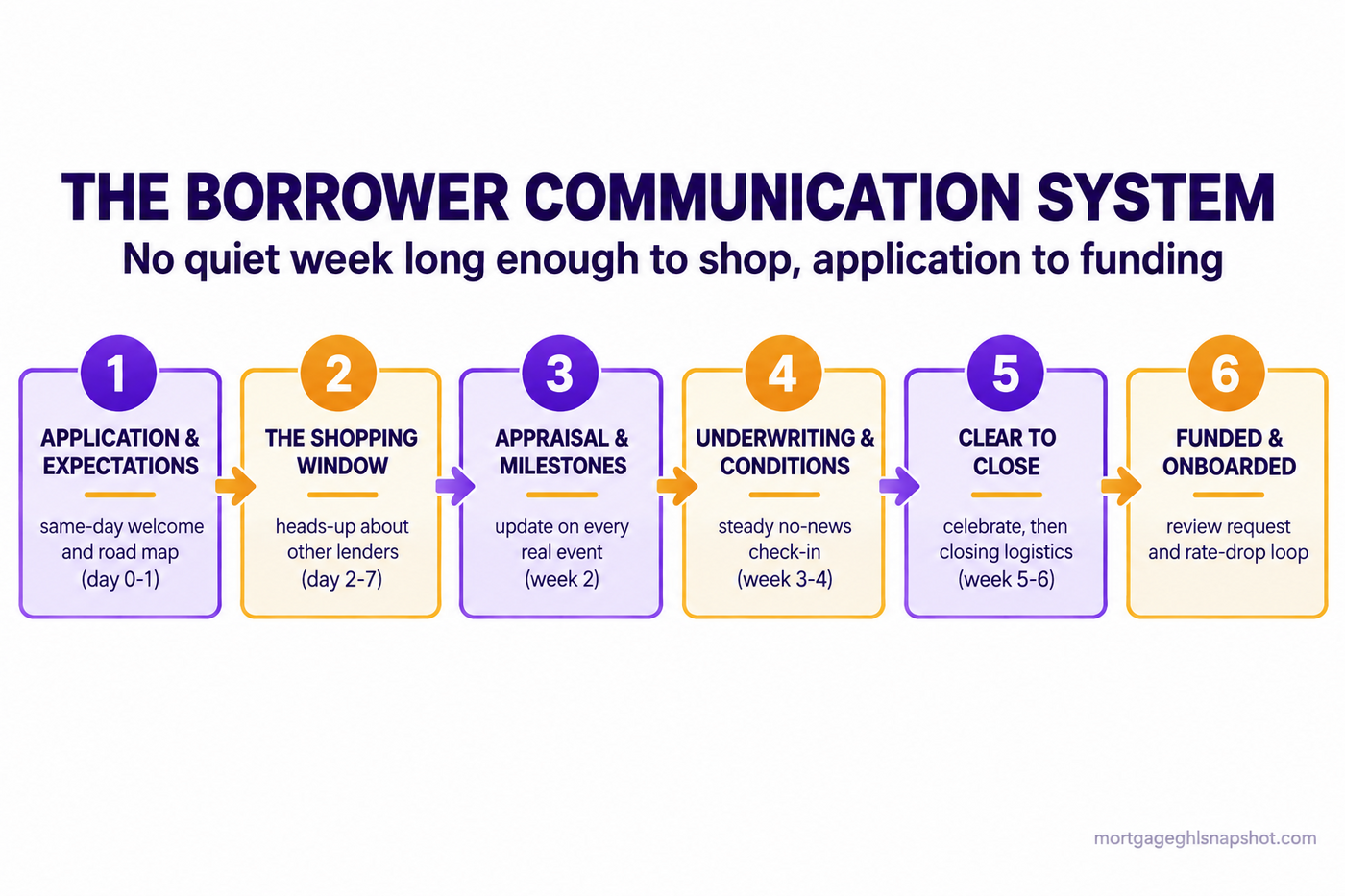
The six stages of a borrower communication system
A good system maps to the loan, not to your calendar. Each stage below has a job, a cadence, and a failure mode, and the borrower always knows what just happened, what happens next, and that you are the one telling them. Build it in whatever you already pay for. Most of my installs run on GoHighLevel because the texts, emails, and pipeline triggers live in one place, but the cadence matters more than the tool. One rule holds throughout: each message reports progress or sets the next expectation. A borrower can forgive a slow appraisal. They cannot forgive feeling ignored.
Stage 1: Application and expectations (day 0 to 1)
The first 24 hours set the tone. The borrower just handed you their financial life and is quietly anxious. Send a same-day welcome that does three things: confirm you received everything, lay out the road map with rough timing, and warn them about the calls they are about to get. That last part is your inoculation against the competition, and almost nobody does it. This is where speed-to-lead stops and relationship-keeping starts.
Failure mode: you skip the road map because you “will just call if something comes up.” The borrower fills the silence with worry and other lenders. Make the welcome automatic the moment the application hits your pipeline, so it never depends on you remembering.
Stage 2: The shopping window (day 2 to 7)
This is the dangerous week. The borrower’s credit was pulled, they are comparing, and historically their inbox and phone filled with offers from lenders who bought their inquiry. The Homebuyers Privacy Protection Act has narrowed that firehose (more below), but it did not end shopping. Your borrower can still Google a rate at midnight and talk themselves into a call.
Get ahead of it with a short, honest message early in the window: you will get calls from other lenders, here is why, and here is what to do if someone promises something too good. You are not bad-mouthing competitors, you are being the trustworthy one, which keeps the file.
Failure mode: you say nothing and hope. When a competitor calls, your borrower has no frame for it, so the pitch lands clean. A borrower who was warned treats the same call as noise you predicted.
Stage 3: Appraisal and milestones (week 2)
Now the file is moving and there are real events to report: appraisal ordered, appraisal received, disclosures signed, submitted to underwriting. Each one is a natural reason to reach out and makes the borrower feel the loan progressing. Tie a short message to each milestone so updates fire off real events, not a guess.
Failure mode: you batch everything into one weekly call and it slips when you are busy. Milestones do not wait for your Thursday. Trigger the update off the event so “we just got the appraisal back, value came in at or above contract” goes out the hour it happens.
Stage 4: Underwriting and conditions (week 3 to 4)
This is the longest quiet stretch and the one that kills deals. Underwriting can take days with nothing visible to the borrower, and conditions can feel like the lender does not trust them. Two moves. First, a steady “still on track” check-in even when there is no news, so the quiet never stretches past a few days. Second, when conditions come back, frame them as normal and specific: here are the items, here is what each looks like, send them back and we keep moving. It is the same dynamic that makes pre-approvals go quiet and die: a borrower who does not understand what is happening assumes the worst.
Failure mode: you go dark during underwriting because you have nothing new, and the borrower reads the silence as trouble. A “no news, still on track, expecting conditions by Friday” message costs nothing and holds the relationship.
Stage 5: Clear to close and closing prep (week 5 to 6)
Clear to close is the best message you will send all file, so make it feel like the win it is. Then pivot straight to logistics: closing date, what to bring, how the funds move, the final numbers. Anxiety spikes again right before closing, and a borrower confused about wiring instructions or cash to close is one a smoother-sounding lender could still spook.
Failure mode: you celebrate the clear to close and go quiet until the signing. The logistics gap gets filled by the title company, the realtor, and the borrower’s own Googling, and handoffs get crossed. Own the closing-week communication yourself.
Stage 6: Funded and onboarded (closing day and after)
The loan funded, so most LOs stop. That is the mistake that starts the next quiet database. The day of funding is when you enroll the borrower into your long-term loop: a thank-you, a review request while the gratitude is fresh, and a standing place in your past-client nurture. This is where the system hands off to your rate-drop refi alerts and your past-client reactivation, so a closed loan becomes the start of a relationship instead of the end of one.
Failure mode: you treat funding as the finish line. Two years later this borrower is a cold name nobody has touched, and a random ad wins the refi you earned.
Steal this: the exact messages for each stage
Copy these, make the voice sound like you, and load them in. Keep every text short, sign with your name, and include your NMLS ID and an opt-out where required. These are templates, not legal or rate advice, and nothing here should promise a rate or an approval.
That is roughly a dozen touches across six weeks, almost all automatic, each with your name on it. The wire-fraud warning in the clear-to-close message is not padding, it is real protection.
Solo LO, small team, and a high-volume shop
The same six stages apply to everyone. The build differs with your volume.
The solo loan officer. You are the system right now, which is why files go quiet when you get busy. Start with the two messages that save the most deals: the Stage 2 heads-up and the Stage 4 no-news check-in, automated off your application and underwriting triggers. Keep the clear-to-close and funded messages personal, because at your volume the human touch at the finish line is your edge.
The small team (3 to 15 LOs). Your problem is consistency. One LO communicates beautifully and another ghosts every file, and the shop’s reputation is the average. Standardize the six-stage cadence as a shared workflow so every borrower gets the same baseline, and let LOs add personal touches on top, never below the standard. A shared pipeline also lets a manager spot files that have gone quiet and step in before the borrower walks. The staffing trade-offs here look a lot like an in-house assistant versus a GHL-driven setup.
The high-volume shop. At scale, communication cannot depend on anyone remembering anything, so everything fires off loan-origination-system events: appraisal received, submitted to underwriting, conditions issued, clear to close. The LO’s job narrows to the human moments, a real call at application and at clear to close, while the system handles the drumbeat between. The risk at volume is sounding robotic, so invest in copy that still sounds like a person and keep consent records clean.
The compliance lines you cannot cross
A communication system that lands you in front of a regulator is not a system, it is a liability. Four lines matter.
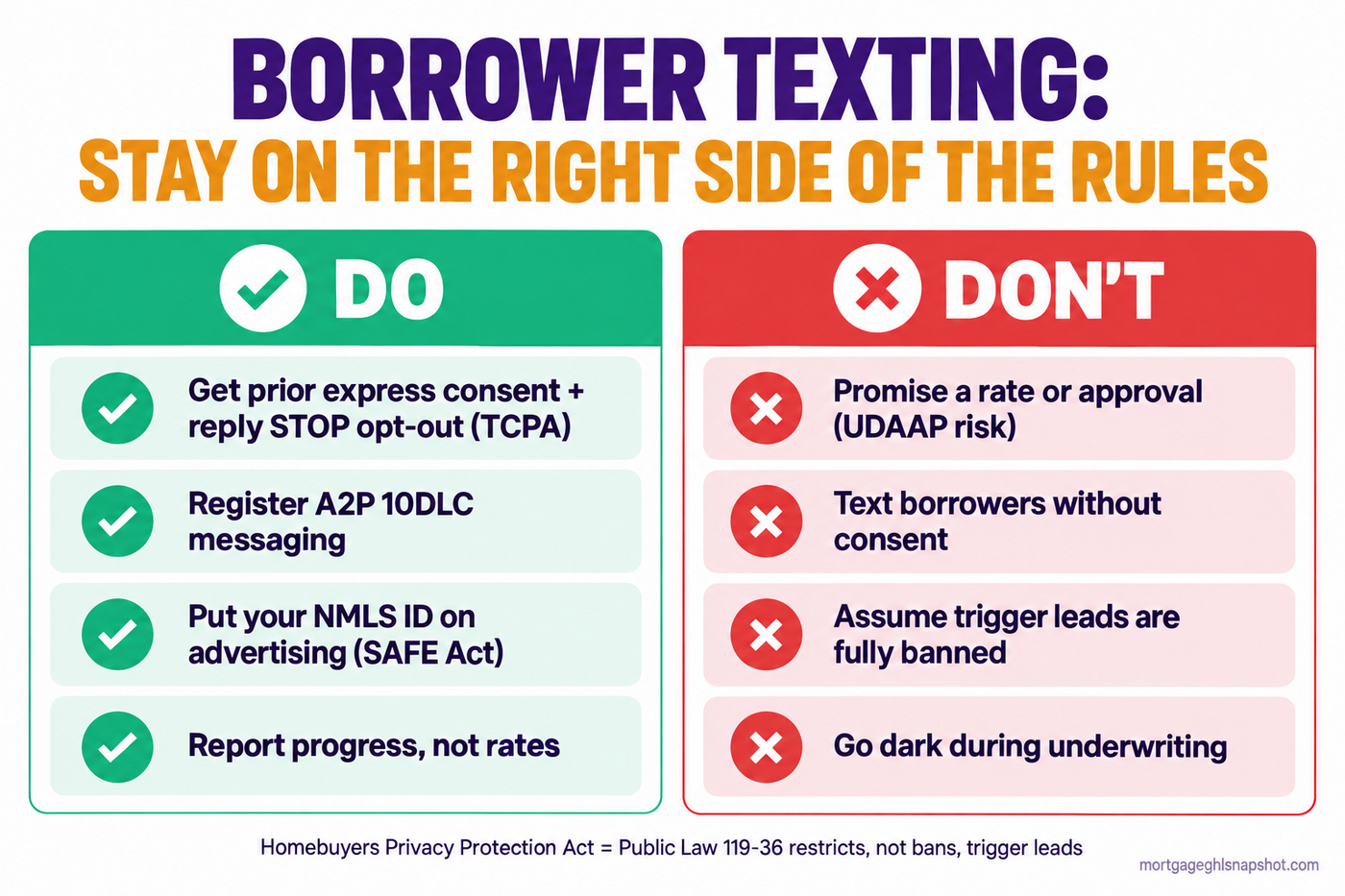
On that last point: the Homebuyers Privacy Protection Act, now Public Law 119-36, amended the Fair Credit Reporting Act to limit when a credit bureau can sell a “trigger lead,” the list generated when a borrower’s credit is pulled for a mortgage (Congress.gov). In broad terms, a third party can now only receive that lead if it already has a relationship with the consumer, such as servicing their current mortgage or holding their deposit account, or the consumer consented. That thins the flood of calls, but it does not stop your borrower from shopping on their own. The Stage 2 heads-up still matters, it just reflects the new reality: fewer random calls, but the ones that come may be from lenders with a real hook.
The objections I hear every week
“Won’t borrowers feel spammed by a dozen messages?” Not when every message earns its place. The texts that annoy people are the empty “just checking in” ones. A message that reports a real milestone or heads off a real worry reads as service, and borrowers reply with thank-yous, because the alternative is silence.
“My LOS already sends milestone emails. Isn’t that enough?” Those emails are generic, come from a no-reply address, and get tuned out within a week. They also miss the two highest-value touches, the shopping-window heads-up and the no-news underwriting check-in, because those are not loan events, they are human reassurance. Your system layers on top, in your voice, from your number.
“Isn’t this the processor’s job?” Your processor handles the file. The relationship is yours, and it is the relationship the borrower decides to keep or leave. The reassurance, the framing, the warning about competitors, that is loan-officer work that a system lets you do consistently.
“I close most of my loans anyway. Is this worth the setup?” Look at your own fallout, not the industry average. Even a few saved files a year beats the cost, and the funded-borrower loop at Stage 6 keeps paying through refinances and referrals for years. Repeat and referral business is the backbone of this industry, and 88% of buyers still purchased through an agent or broker in NAR’s 2025 data (NAR).
Frequently asked questions
How many times should I contact a borrower during the loan process?
Plan for roughly a dozen touches across a six-week file: a welcome, a shopping-window heads-up, a message on each real milestone, a no-news check-in during underwriting, a clear-to-close, and a funded message. The exact number matters less than the rule that no quiet stretch runs more than a few days.
What is the single most important message to keep a borrower from shopping?
The early heads-up that other lenders may call them and why. It reframes every competitor pitch as noise you predicted, which is far more durable than trying to win on rate after the fact. The no-news underwriting check-in is a close second.
Does the Homebuyers Privacy Protection Act mean I no longer have to worry about losing borrowers?
No. Public Law 119-36 restricts who can buy a trigger lead, which cuts the volume of unsolicited calls after a credit pull. It does not stop borrowers from shopping on their own, and lenders with an existing relationship may still reach them.
Can I automate borrower texts legally?
Yes, with consent and an opt-out: prior express consent, a working opt-out such as reply STOP on every message, registered A2P 10DLC messaging, your NMLS ID on advertising, and clean records of consent. Without those, automated texting is a TCPA risk.
What should I say when a borrower says another lender offered a lower rate?
Ask them to forward the full offer, then compare it honestly, including fees and whether the rate is real or a teaser. Giving them a straight read, rather than panicking or bad-mouthing the competitor, is usually what keeps the file. Never promise to beat a number you cannot deliver.
When does borrower communication stop?
It does not. The funded message hands the borrower into your long-term loop of review request, annual check-in, and rate-drop alerts, so a closed loan becomes the start of a relationship instead of a cold name in a database.
It is day nine again on the next clean file. This time the borrower got a welcome the hour they applied, a heads-up about the shopping calls on day three, and an appraisal update the moment it cleared. When a competitor calls promising to “match the rate,” the borrower forwards you the text and asks if it is even real. The difference is that this borrower never had a quiet week long enough to wonder, and that is the whole job: be the lender who keeps talking, all the way to the keys.