
It is 8:15 on a Tuesday and you have 23 new leads from the weekend. Two are ready to buy this month. The other 21 are rate-shoppers, people six months out, a couple of bots, and one person who typed their income as “yes.” You cannot tell which is which, so you dial from the top and burn your best two hours on the people who will never close. Meanwhile the borrower who was ready at 8:16 got a callback from another lender at 8:19 and is already under contract in their head.
That is the cost of doing pre-qualification by hand. Sorting ready borrowers from tire-kickers is a job a system should do before you ever pick up the phone. This guide walks the full pre-qualification system I build for loan officers and small brokerages: how to make borrowers qualify themselves, route the ready ones straight to your calendar, and keep the not-yet crowd warm without touching them. Done right, your phone only rings for people worth talking to.
What manual pre-qualification is really costing you
The problem is not effort. It is that you are the sorting machine, and a human sorting machine is slow, expensive, and only awake part of the day. You treat every lead the same because you cannot tell which are real, and the two deals that mattered slip to the afternoon when they have already moved on.
Two numbers make the cost concrete. First, speed. The Lead Response Management study of more than 15,000 web leads found that reaching a lead within 5 minutes instead of 30 makes you 21 times more likely to qualify it (Oldroyd/MIT, 2007). If your “system” is calling back when you get a minute, you lose the race before it starts.
Second, shopping. Nearly half of borrowers consider only one lender, so the other half are comparing you right now (CFPB), and Freddie Mac found borrowers who gather five quotes save around $2,914 over the life of the loan (Freddie Mac, 2023). The first lender to respond usually wins. Respond last and you compete on rate alone, the one fight you do not want.
Sources: Lead Response Management (Oldroyd/MIT), CFPB, Freddie Mac (2023).
There is a third cost nobody tracks: the leads you lose at the form. The longer your intake, the fewer people finish it, and most mortgage forms ask for 15 fields and wonder why people bail (form research). Ask for almost nothing, then let automation fill in the rest.
Form completion rate (%) by number of fields on a short lead form. Source: form conversion research. Directional benchmarks, not a promise for your exact form.
The six stages of a pre-qualification system that runs itself
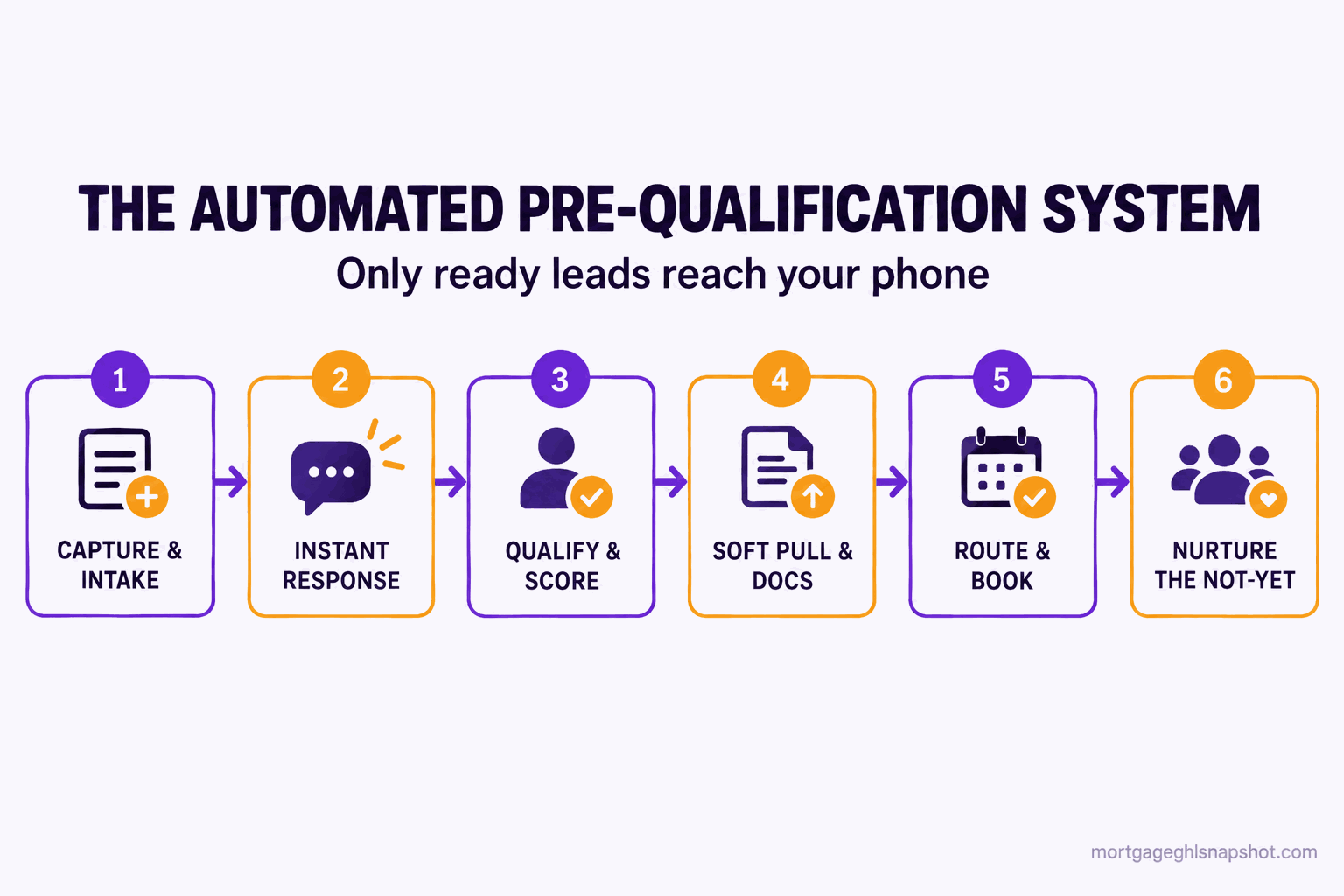
A pre-qualification system is not one tool. It is six stages wired together so a borrower moves from “clicked an ad” to “booked call with a ready, scored file” without you touching anything until the end: capture and intake, instant response, qualify and score, soft pull and docs, route and book, then nurture the not-yet. Each stage has a job and a specific way it breaks. Here is each one in detail.
Stage 1: The intake form that qualifies as it collects
The setup. Build a short, mobile-first intake, the kind people call a 1003-lite. Ask only what you need to start sorting: name, phone, email, loan purpose, and a rough price range. Five fields, one screen, under a minute. Income, timeline, and property details get collected in stage 3 by conversation, not a wall of boxes. The form exists to get a real human into your system before they close the tab, not to underwrite. Wire your white-label mortgage calculators into the same pipeline so a borrower who runs an FHA or affordability number lands pre-tagged.
How it breaks. The number one failure is asking for too much, especially a Social Security number or date of birth on the first screen, which kills trust and is not needed yet. Completion under 20% means the form is the problem, not the traffic.
Stage 2: The instant response that wins the speed race
The setup. The second a lead comes in, an automated text and email go out under your name, in under 60 seconds, any hour of any day. Not a generic “we got your request,” but a warm reply that confirms what they asked for and says what happens next. If they called and you missed it, a missed-call text-back fires within seconds so the conversation does not die in voicemail. This is where the 21x speed advantage stops being a stat: a borrower who hears from you at 11pm remembers it.
How it breaks. Two ways. One, the message reads like a robot, so the borrower ignores it. Write it like a text you would actually send. Two, there is no consent language, so you are texting someone without a clear opt-in. Capture consent at the form and your TCPA footing is solid. Skip it and the system is a liability.
Stage 3: The qualification logic that sorts without you
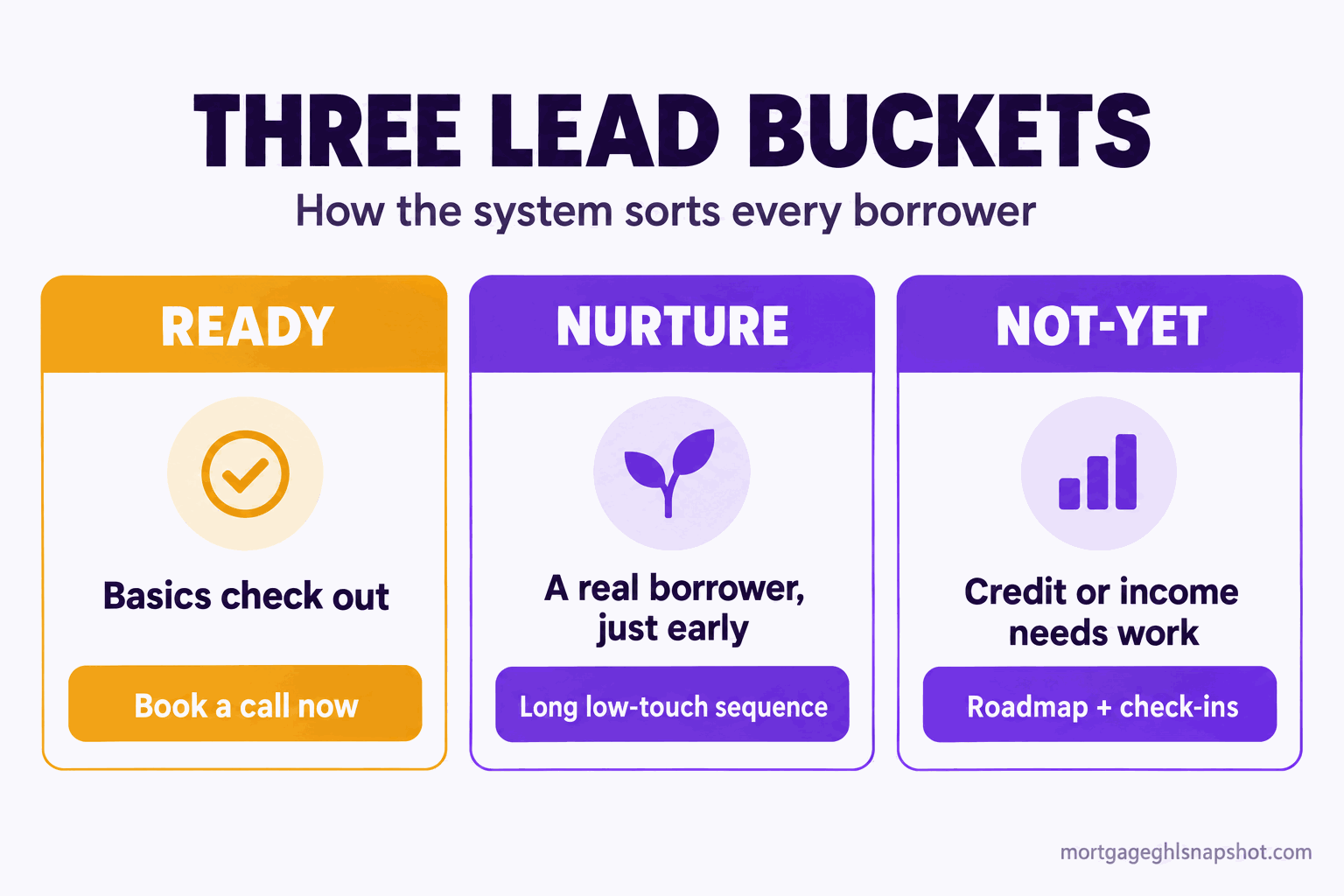
The setup. Now the system collects the rest through a short conversation, by text or chat, and scores the file against rules you set, into three buckets. “Ready” means the basics check out: reasonable timeline, loan amount in range, nothing disqualifying. “Nurture” means a real borrower who is just early, like someone four months from a lease ending. “Not-yet” means a credit or income picture that needs work first. The borrower answers a few plain questions and the system tags them in minutes, never waiting on you.
How it breaks. The classic mistake is treating your score as an underwriting decision. It is a sorting signal, nothing more. Keep thresholds operational (timeline, purpose, rough ratios) and leave the real credit decision for a human and a full file. If the automation tells someone they are “approved” or “denied,” you have crossed a compliance line and set a false expectation. Score to route, not to rule.
Stage 4: The soft pull and the document request
The setup. For borrowers who want to go further, invite them to a soft credit check, triggered only after explicit consent and once they land in “ready.” A soft inquiry does not affect their credit score (Experian), so you can say that plainly, which removes the biggest objection to pulling early. The system requests only the documents that match their path, so an FHA buyer and a jumbo refi borrower get different checklists, not the same scary pile. Drip the requests: ask for two things, get them, then ask for two more.
How it breaks. Asking for a hard pull too early is the big one: it affects the score and borrowers resist it. The quiet one: if your soft-pull step evaluates credit and you decline someone based on it, Regulation B may treat that as an application and an adverse action notice is owed. Build that notice path before you turn the pull on.
Stage 5: Routing the ready borrower straight to your calendar
The setup. When a file hits “ready,” the borrower gets a booking link the instant they qualify, while they are still engaged, and you get an alert with the scored summary: purpose, amount, timeline, soft-pull result, documents received. No data entry, and you walk into the call already knowing the file. Solo operators route it to themselves; a team round-robins it to the right loan officer by availability or specialty.
How it breaks. The failure is friction at the finish line. If booking takes five clicks or offers no times this week, you lose the borrower you worked to qualify. One-tap booking, real availability, and appointment reminders are the difference between a booked call and a no-show.
Stage 6: The nurture track that keeps the not-yet crowd warm
The setup. Most of your leads are not ready today, and that is fine, because they are early, not worthless. The nurture and not-yet buckets drop into a long, low-touch sequence measured in months: a useful message every few weeks, a rate-context note, a check-in that asks nothing. When their timeline arrives, they re-enter the qualification flow automatically. This is also where rate-drop alerts live for past clients and refi prospects.
How it breaks. Two failures. One, you never build this track, so every not-ready lead rots in a spreadsheet and you buy new leads to replace borrowers you already had. Two, the nurture is all pitch and no value, so people opt out. Give before you ask, and the not-yet bucket becomes your cheapest source of future loans. The database reactivation playbook goes deeper, stage by stage.
Steal this: the exact intake and follow-up copy
Swap in your name, firm, and NMLS ID. These are templates, not legal advice, and your compliance review comes first.
Every message confirms what the borrower wanted, offers one clear next step, carries the NMLS ID and an opt-out, and never promises an approval. That is what keeps the system effective and compliant.
Solo LO, small team, and a high-volume shop
The same six-stage framework runs at every size, but what you automate and what you keep human changes.
The solo loan officer. You are the sales team, so your enemy is time, not volume. Automate everything through stage 4, then route every “ready” file to yourself with the scored summary. Keep thresholds generous early: a solo would rather have a quick conversation with a borderline file than lose a real borrower to an over-strict rule. The stage 6 nurture track is your biggest win, the only way a one-person shop stays in front of a database without working nights, and a single CRM running it replaces an assistant you cannot afford yet.
The small team (2 to 15 LOs). Now routing is the hard part. The system adds round-robin or specialty-based assignment at stage 5, so a VA file goes to your VA specialist and a jumbo goes to the LO who closes them. Scoring tightens because you can afford to be selective, and a manager view means nobody’s ready borrower sits unclaimed. This is the size where manual pre-qualification costs the most, because leads fall through the cracks between people and everyone assumes someone else called. If you are weighing a hire for this, the in-house assistant versus automation math is worth a read.
The high-volume shop. At serious volume, the system is your front line and your filter. Every stage runs tighter: stricter scoring, mandatory soft pull before a human call, hard response-time targets measured in the CRM. Your loan officers never see an unscored lead, and reporting shows which sources produce “ready” files versus noise, where small gains are worth real money.
The compliance lines you cannot cross
Automating pre-qualification touches credit, advertising, and messaging at once, so three sets of rules apply from the first message. This is not legal advice, but these are the lines I build every system to respect.
Adverse action under ECOA and Regulation B. This is the one people miss. If your automation evaluates a borrower’s information, decides to decline, and tells them so, Regulation B can treat that prequalification as an application, which means you owe an adverse action notice with reasons, generally within 30 days (Federal Reserve). Never let the automation issue a flat “denied.” Route weaker files to a human, and build the notice path before you turn credit evaluation on.
Soft pull versus hard pull. Prequalification runs on a soft inquiry, which does not affect the borrower’s score (Experian). Be accurate about which you are running and get consent before either. Calling a check “soft” when it is actually a hard pull loses trust and invites a complaint.
NMLS ID and the not-a-lender line. Every automated message that advertises your services needs your NMLS ID, which the SAFE Act requires. Your system must never imply an approval, quote a live rate, or act like a lender. Say “you may qualify” and “estimate,” never “approved” or “guaranteed.” A number a borrower reads as a promise is a UDAAP problem.
TCPA and messaging consent. Because the system texts and emails automatically, you need consent captured at intake, a working opt-out on every message, and records of both. The short rule: no consent, no automated message, no exceptions.
The objections I hear every week
“Won’t an automated process feel cold and scare borrowers off?” Only if it is written like a robot. Done well, it feels faster and more attentive than a human, because it replies in seconds at any hour and never forgets to follow up. Borrowers do not resent a quick, helpful text at 9pm. They resent silence.
“I already pay for a CRM. Why do I need this?” Most loan officers pay for a CRM they barely use (the math on that is brutal). The question is not whether you have a CRM, it is whether it sorts and follows up on its own. If yours just stores contacts and waits for you, you own a filing cabinet, not a system.
“My leads come from referrals, not forms. Does this apply?” Even more so. A referred borrower is your warmest lead and the one you most want to answer instantly. Referrals convert on speed and a clean process, and 66% of sellers pick an agent by referral or repeat business (NAR, 2025), so the reflex that serves your borrowers protects your realtor relationships too.
Frequently asked questions
What is the difference between pre-qualification and pre-approval?
Prequalification is a preliminary read based largely on what the borrower reports, often with a soft pull. Pre-approval verifies that information with documents and a fuller review. The CFPB notes lenders use the terms differently, so be clear about which you offer and that neither is a guaranteed loan offer.
Does automating pre-qualification require a hard credit pull?
No. The top of the funnel runs on a soft inquiry, which does not affect the borrower's credit score or show as a hard inquiry to other lenders. You save the hard pull for later, once the borrower is committed and you have consent.
Will this replace my loan officers?
No. It replaces the manual sorting, data entry, and chasing that eat their day. Loan officers still run the calls and structure the loans. The system just sends their time to files that are actually ready.
Is automated borrower texting legal?
Yes, with consent: a clear opt-in at intake, a working opt-out such as reply STOP on every message, your NMLS ID on advertising, and records of consent. Without those, automated outreach is a TCPA risk.
Can the system tell a borrower they are approved or denied?
It should not. Let it say a borrower may qualify and route them to a human, and never let it issue a flat denial, which can trigger an adverse action notice under Regulation B. Use the score to route files, not to decide credit.
How long does it take to set up?
A solo loan officer can stand up a basic version in a few days. A done-for-you install into GoHighLevel is typically running within 24 hours once account access is in place. The copy and compliance review are the parts worth slowing down for.
It is 8:15 again, next Tuesday. Same 23 leads. This time, by the time you sit down with coffee, the two ready borrowers already got a warm reply the minute they came in, answered a few questions, cleared a soft pull, and booked calls for later that morning. The other 21 sit in a nurture track that surfaces them the month they are ready. You did not dial a single dead lead. You just show up to the calls that close. That is what a pre-qualification system that runs itself buys you: your mornings back, and your best borrowers reached first.