
It is a Tuesday and you are looking at a borrower named David in your pipeline. You pulled his credit three weeks ago, ran the numbers, and sent a clean pre-approval up to $420,000. He thanked you, said he was excited, and mentioned two showings that weekend. Then nothing. No offer, no questions, no reply to the text you sent Thursday. His letter has 41 days left and you already know, in your gut, that this one is drifting toward the pile of pre-approvals that never became loans.
Every loan officer has that pile. It is quiet, it is expensive, and most people treat it as bad luck. It is not. A pre-approved borrower who goes silent is telling you something specific, and if you read the signal you can usually pull the deal back before the clock runs out. This is the diagnostic I run when pre-approvals stop converting: why borrowers go quiet, how to tell which one you are looking at, and the follow-up that reopens the file.
What a quiet pre-approval is actually costing you
A pre-approval feels like progress because it took real work. You pulled credit, reviewed income, ran the ratios, and put your name on a number. So when the borrower goes silent, it does not feel like a lost lead. It feels like a deal taking its time. That is the trap. A pre-approval that stalls past its expiration date is dead, and you paid for it twice: in the work, and in the loan you never booked.
The math is worse than it looks, because a pre-approved borrower is your warmest prospect. They have shared documents, they trust your number, and they are actively trying to buy. If ten pre-approvals go quiet in a quarter and even four would have closed with the right nudge, that is four loans of lost commission out of prospects you already qualified. You did not need new leads.
Sources: CFPB mortgage shopping study, Experian, ICE Mortgage Monitor (2026).
There is a clock on all of it. A letter is usually valid for 60 to 90 days because the credit report behind it has a shelf life of about 120 days across conventional, FHA, and VA loans (Experian). Purchase loans have been closing in roughly 37 days on average (ICE Mortgage Monitor, 2026). A borrower who goes quiet for six weeks has almost no room to find a house, write an offer, and close before you re-pull and re-qualify. Silence burns the runway.
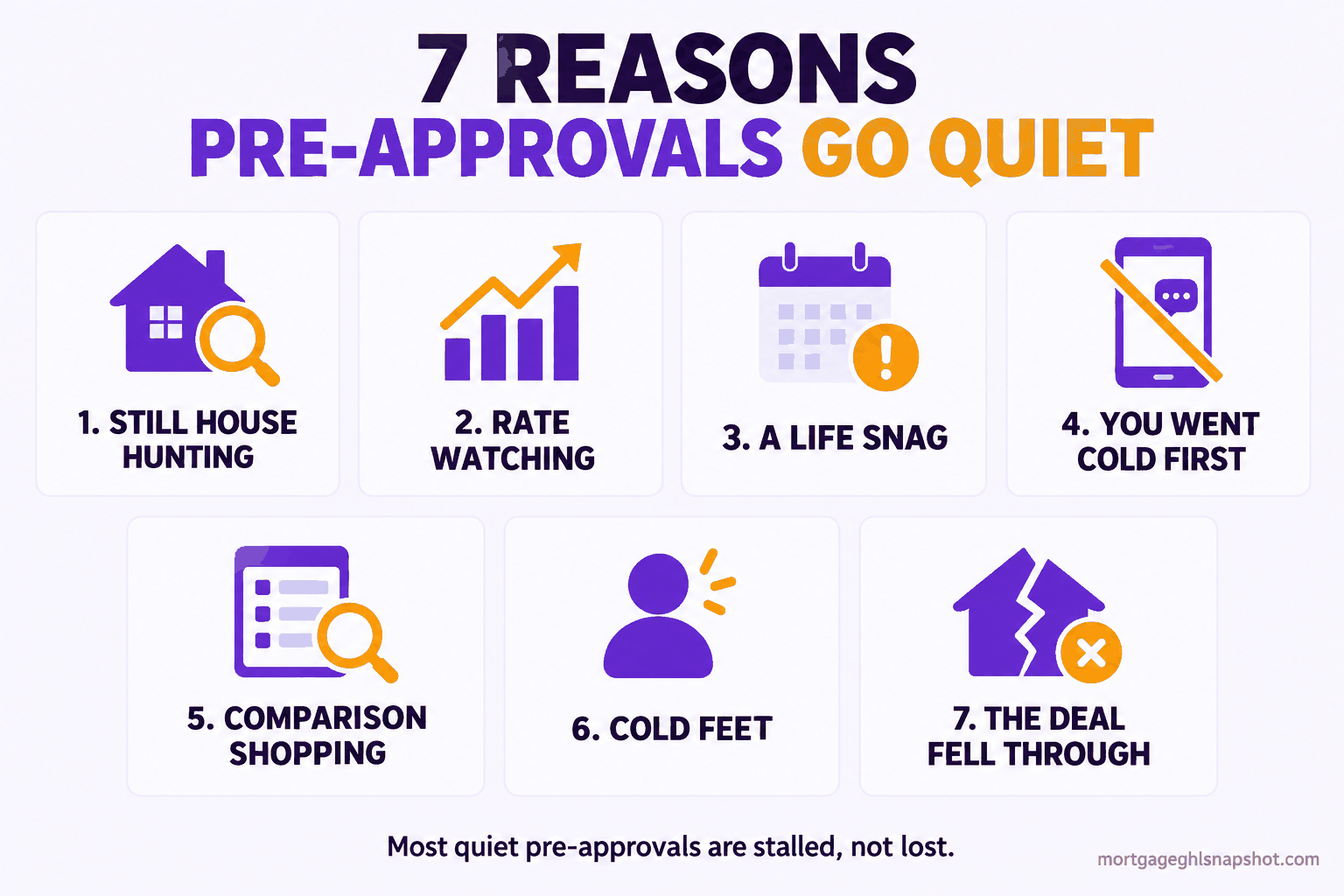
The seven reasons pre-approvals go quiet
Borrowers almost never tell you why they went dark. They just stop replying. Here are the seven causes I see over and over, each with the signal that gives it away, what is happening, and how to pull the file back. Most quiet pre-approvals are one or two of these, and five of the seven are fixable with a message, not a miracle.
| What you see | What it usually means | Your move |
|---|---|---|
| No offer, still browsing | Still house hunting | Stay useful, not pushy |
| Quiet the week rates rose | Rate watching | Give a reason to act |
| Sudden silence mid-process | A life snag | Ask, do not sell |
| Warm at the letter, then gone | You went cold first | Restart the cadence |
| Vague, slow replies | Comparison shopping | Win on service |
| Excited, then hesitant | Cold feet | Shrink the next step |
| Was under contract, now nothing | The deal fell through | Re-engage fast |
1. They are still house hunting and have nothing to tell you
The signal: friendly when you reach out, still looking, but has not written an offer.
This is the most common one and the easiest to mishandle. Nothing is wrong. They have not found the house, and every “any updates?” reminds them they have no news. In 2025, 88% of buyers still purchased through an agent (NAR), so the timeline is tied to their realtor’s inventory.
The fix: stop asking for updates and start giving value. Send a listing that fits, a note on what a rate change does to their target payment, or a quick “still holding your pre-approval, here is what is moving in your range.” Be helpful while they wait, so you are the obvious call the day they find one.
2. They are rate watching and waiting for a number
The signal: they went quiet around the time rates moved, and they mentioned rates more than once.
Some borrowers are waiting for a rate they have decided is their trigger. They are watching a headline number that has nothing to do with what they would actually get, so they wait for a moment that may never come while the letter expires.
The fix: give them a reason to act that is specific to their file. Show them today’s payment versus a buydown, or set up a genuine rate-drop alert that reaches them the moment their scenario improves. The borrower who learns that shopping and locking are two different decisions is far more likely to move.
3. A life snag knocked them off track
The signal: a sudden, complete silence from someone who was engaged.
Life happens to borrowers. A job wobble, a medical bill, a co-borrower who got nervous. When something real disrupts them, the mortgage is the first thing to go quiet. If you read that silence as rejection and stop reaching out, you confirm you were only after the deal.
The fix: ask like a human. “Haven’t heard from you in a bit, everything okay on your end? No pressure on the house, just checking in.” That message costs nothing and it separates the people who hit a snag from the ones who wandered off. Some re-engage months later precisely because you checked in without pitching.
4. You went cold first, right after the letter
The signal: the relationship was warm through pre-approval, then you got busy and contact stopped.
This one is on you, and more common than any loan officer wants to admit. You issue the letter, feel the win, and move to the next fire. The borrower who felt looked after now feels dropped. Poor communication is the single most common complaint borrowers file about lenders (Floify).
The fix: the follow-up cannot depend on you remembering, because you will not, not in a busy month. Build a pre-qualification follow-up cadence that fires on its own the moment a letter is issued. If your reliability lives in your calendar, it fails every time your week gets loud. Put it on rails.
5. They are quietly comparison shopping
The signal: vague answers, slow replies, and questions that sound like they are checking your numbers against someone else’s.
Not every quiet borrower is loyal. Nearly half of borrowers consider only one lender, so the other half are actively comparing (CFPB), and shopping pays for them: Freddie Mac found borrowers who gather five quotes can expect to save around $2,914 over the life of the loan (Freddie Mac, 2023). You will not out-quote every lender.
The fix: win on what a rate table cannot show. Answer faster than anyone else and explain the trade-offs honestly. Reaching a lead within 5 minutes instead of 30 makes you 21x more likely to qualify it (Oldroyd/MIT, 2007). A shopper picks the lender who made it easy, not the one an eighth of a point cheaper.
6. They have cold feet about the whole thing
The signal: real excitement during pre-approval that cooled into hesitation, with the borrower finding reasons to stall.
Buying a house is the biggest financial decision most people make, and pre-approval makes it real in a way that scares some borrowers. They do not go quiet because they lost interest. They freeze.
The fix: shrink the next step until it is easy to say yes to. Do not ask them to commit to a house. Ask them to hop on a 15-minute call to review their real monthly payment. When the process feels like tiny steps instead of one giant leap, the frozen borrower thaws.
7. The deal fell through and they are embarrassed
The signal: they were under contract, then everything went dark.
Sometimes the house fell out. The inspection killed it, they got outbid, the seller walked. The borrower is disappointed and often embarrassed, and starting over feels exhausting. This silence is dangerous, because they are still ready to buy, and if you are not there they restart with whoever answers.
The fix: move fast and reset the energy. “Sorry that one didn’t work out, it happens more than you’d think and it’s not a reflection on you. Your pre-approval is still good, so you’re ready the second the right place shows up. Want me to keep an eye out with your agent?” Be the lender who kept the door open.
Relative odds of qualifying a lead by response time, indexed to a 5-minute reply. Source: Lead Response Management Study (Oldroyd/MIT, 2007) and Harvard Business Review (2011). Figures illustrative of the study’s findings.
Steal this: the follow-up that keeps a pre-approval warm
Diagnosis is half the job. Here is the copy I hand loan officers to keep a pre-approved borrower engaged without nagging. The rule underneath it: lead with usefulness, keep the next step small, and never open with “any updates?”
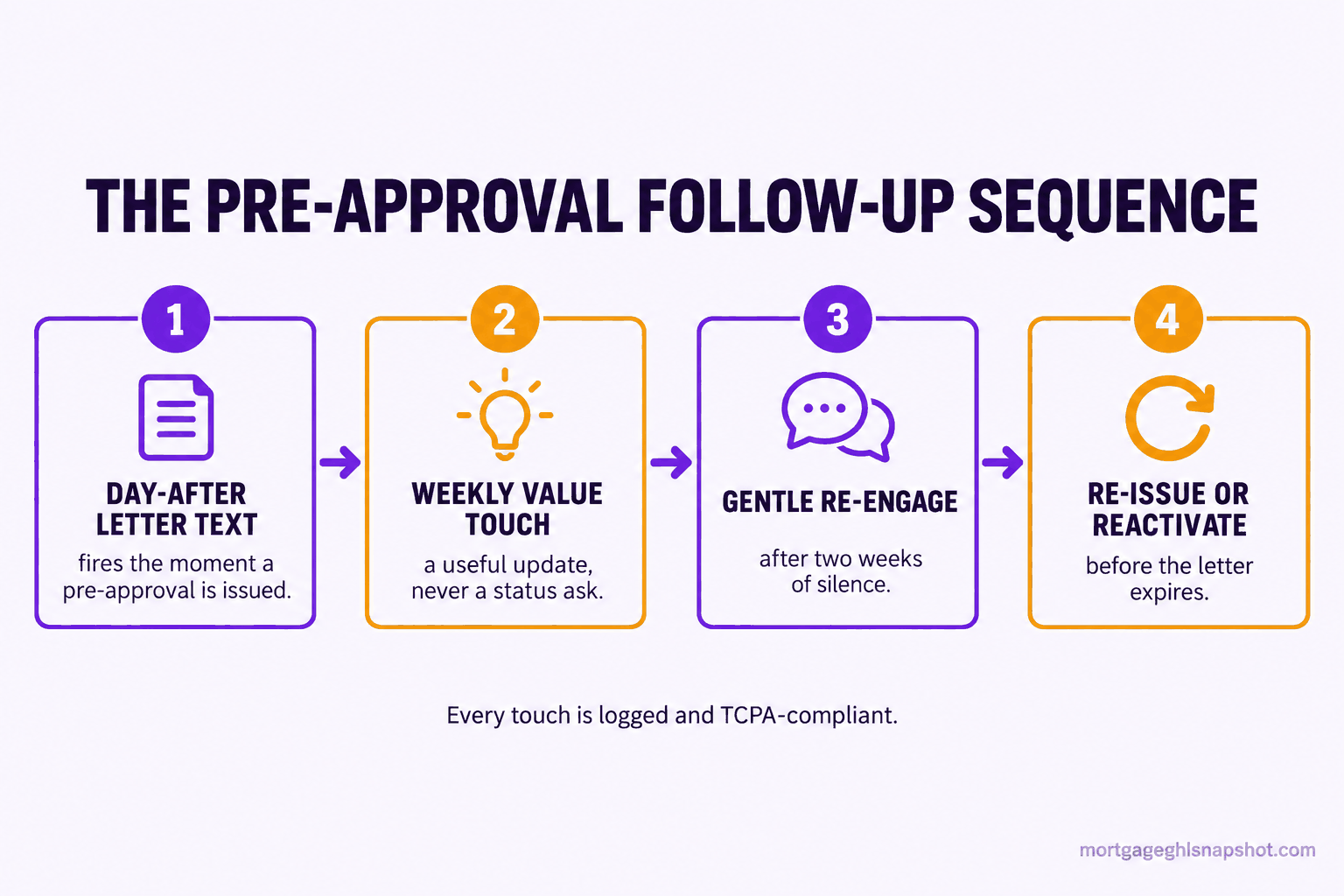
The pattern is identical: give first, keep the ask tiny, make it easy to reply with one word. Set the day-after text and the weekly touch to fire off your CRM’s workflow automations the instant a letter is issued, and put the re-engage on a timer. The copy is not the hard part. Making it happen on every file, when you are slammed, is, and that is what a system solves.
Solo LO, small team, and a high-volume shop
The seven reasons are the same at every size. What changes is how much of the follow-up runs on you versus a system.
The solo loan officer. You are the bottleneck, and reasons three and four are your biggest risk, because you cannot personally check on thirty pre-approvals while processing live files. Automate the day-after text and the weekly touch so every pre-approval gets consistent contact, then spend your time on the ones the system flags as going quiet. One good follow-up cadence does the work of an assistant you cannot yet afford.
The small brokerage with 2 to 15 LOs. Here the problem is consistency across people. One LO who is great at follow-up and three who let pre-approvals rot makes your conversion rate a coin flip. You need a standard: every pre-approval enters the same cadence automatically, the same messages fire regardless of who owns the file, and quiet borrowers surface on a shared dashboard. When follow-up is identical no matter who is behind it, your whole shop converts like your best originator.
The high-volume shop. At real volume the danger is that pre-approvals become a number on a report, and the quiet ones vanish into the pile. You need automation doing the routine touches at scale plus a scoring layer that ranks pre-approvals by likelihood to close and days to expiration, so your team calls the right file first. Pair that with database reactivation for expired pre-approvals worth a second run, and you recover loans most shops write off.
The compliance lines you cannot cross
Following up feels harmless, but the way you do it is regulated, and the automated text that saves your pipeline is the same message that gets a firm in trouble when it is set up wrong. Two lines matter most.
First, consent. Under the TCPA and the A2P 10DLC rules that govern business texting, you need the borrower’s prior express consent before you text, clear identification of who you are, and a working opt-out on marketing messages. A borrower who filled out an application and agreed to be contacted has usually given it, but the burden is on you to prove it, so log the consent and honor every opt-out instantly. Our mortgage text message compliance guide covers what changed and what did not.
Second, watch your words on rate. A touch that references a payment is useful, but the moment you state a specific rate or APR as an offer you step into advertising rules and UDAAP exposure. Keep payment talk illustrative and tied to a scenario you can deliver, remind the borrower that a quote is not a lock, and never imply an approval you have not issued. A rate claim you cannot honor destroys trust faster than silence. Automation makes this easier to prove, because every touch is logged.
The objections I hear every week
“If they were serious, they’d call me. Chasing them looks desperate.” There is a difference between chasing and being useful. “Any updates?” is chasing. “Rates eased, here’s what that does to your payment” is a value touch. Borrowers do not resent the lender who is helpful while they wait.
“I don’t have time to follow up with every pre-approval.” That is exactly why you automate the routine touches. The day-after text and the weekly message fire on their own, so the borrower gets consistent contact while you do zero work. You save your real time for the quiet files that need a conversation, which the system surfaces for you.
“Won’t automated texts annoy people?” Only if they read like a robot or come too often. A short, specific, useful message that sounds like you, about once a week, reads as attentive. The borrowers who opt out were never going to close. The ones who stay are telling you they still want to buy.
“My pull-through is fine, this isn’t my problem.” Maybe. But most loan officers have never counted how many pre-approvals expired without a loan last year, because that number lives in the quiet pile nobody looks at. Pull the report. If even a few would have closed with better follow-up, the system pays for itself on the first deal.
Go back to David. The right move is not a guilt-trip text or a hard push on a house he has not found. It is one useful message that meets him where he is, a cadence that keeps you in his phone without nagging, and a system that carries the routine so you show up human when it matters. That is what turns a quiet pre-approval back into a closing.
Frequently asked questions
Why do pre-approved borrowers stop responding?
Usually because they are stalled, not gone. Common reasons: still house hunting with no news, waiting on a rate, a life event, or the loan officer went cold first after issuing the letter. Some are quietly shopping and a few have cold feet. Most can be re-engaged with a useful, low-pressure message.
How long is a mortgage pre-approval good for?
Typically 60 to 90 days, with 90 common because it aligns with the roughly 120-day shelf life of the credit report across conventional, FHA, and VA loans (Experian). After it expires the lender generally re-pulls credit and re-verifies income, so a borrower who goes quiet for weeks has little runway left.
How often should I follow up with a pre-approved borrower?
Send one message the day after the letter is issued, then a light, useful touch about once a week while they search, plus a gentle re-engage if they go silent for a couple of weeks. Every touch should give something rather than ask for a status. Automate the routine messages so the cadence never lapses.
Is follow-up or a lower rate more important for converting a stalled pre-approval?
Follow-up, in most cases. Nearly half of borrowers consider only one lender (CFPB), and shoppers tend to choose the lender who made the process feel easy over one a fraction of a point cheaper. Responding within 5 minutes instead of 30 makes a loan officer 21x more likely to qualify a lead (Oldroyd/MIT, 2007), and that responsiveness keeps a pre-approval warm.
Can I text pre-approved borrowers to follow up?
Yes, if you comply with the TCPA and A2P 10DLC rules. You need prior express consent, which a completed application usually provides, and you must identify yourself and honor opt-outs immediately. Log the consent so you can prove it, and keep any rate references illustrative rather than stating a specific rate as an offer.
What should I do with pre-approvals that already expired?
Do not write them off. Many belong to borrowers who still plan to buy and simply lost momentum. Run a database reactivation campaign that re-engages them with a fresh message, re-pull credit for the ones who respond, and re-issue letters. It is far cheaper to recover a borrower you already qualified than to buy a new lead.