
You bought GoHighLevel because someone told you it would automate your follow-up. Six weeks later you’re the one inside it every night — building a workflow that half-works, chasing a form that isn’t posting to your pipeline, and re-typing the same text to a borrower you should have called back three hours ago. Meanwhile the Phoenix purchase you were counting on went to the loan officer who picked up first.
For most Phoenix loan officers, the real cost of “doing GoHighLevel yourself” isn’t the $97–$497 software bill — it’s the originating hours you burn on setup, the leads that go cold before you follow up, and the loans you lose in a market where each one now costs over $12,500 to produce. A dedicated, mortgage-niche GoHighLevel VA removes that cost: they run the platform, you run your pipeline. This post breaks down exactly what DIY is costing you, with real numbers, and where handing GHL to an expert pays for itself.
The short answer: what DIY GoHighLevel really costs Phoenix loan officers
GoHighLevel is a genuinely powerful CRM and automation platform. That’s not the problem. The problem is that it’s a platform — a deep toolkit that rewards people who spend all day inside it and quietly punishes people who don’t. For a producing loan officer, that’s the wrong trade.
The DIY cost shows up in four places, and none of them appear on your software invoice:
- Your originating time, spent building and fixing workflows instead of talking to borrowers and referral partners.
- Speed-to-lead, lost because there’s no one watching the pipeline the moment a lead comes in.
- Lost loans, which are expensive to replace in a market where production costs have climbed past $12,500 per loan.
- The slow, costly alternative of hiring and training an in-house person who also has to learn GoHighLevel from scratch.
Add those up and the “free” DIY approach is usually the most expensive way to run GoHighLevel. Here are the numbers that make the case.
Pain #1: You’re doing admin instead of originating
The most expensive line item in a DIY GoHighLevel setup is you. Every hour you spend building a pipeline stage, debugging a workflow trigger, or copy-pasting a follow-up text is an hour you are not spending on the two activities that actually grow a mortgage business: originating loans and nurturing referral partners.
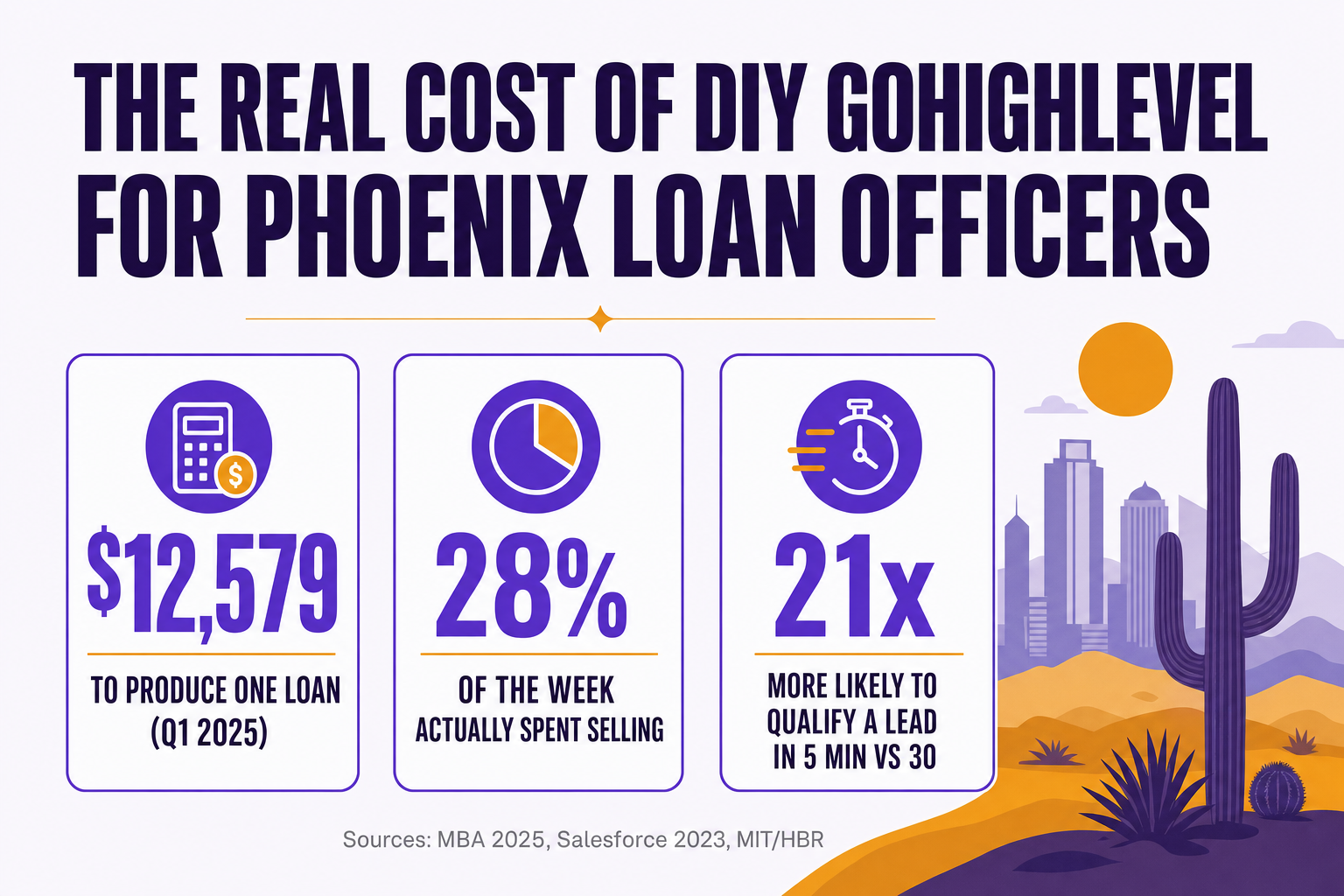
You’re not alone in this. Salesforce’s State of Sales research found that reps spend only 28% of their week actually selling — the other ~72% goes to administrative work, data entry, and internal tasks (Salesforce, 2023). For a loan officer, the platform you bought to reduce admin can easily become the admin.
Do the arithmetic on your own rate. If you close, say, two loans a month at an average Phoenix loan amount and your time is worth even $150/hour of originating value, ten hours a week lost to GoHighLevel housekeeping is not a rounding error — it’s a part-time salary you’re paying yourself to do the wrong job. That’s the exact trade a dedicated GHL VA is designed to reverse: they take the platform work, you take back the selling hours.
Pain #2: Leads go cold before you call back
Speed-to-lead is where DIY GoHighLevel quietly bleeds the most money — because when you are the automation, follow-up only happens when you have a free minute, and borrowers don’t wait.
The data here is brutal and well-established. The classic Lead Response Management study (Prof. James Oldroyd, MIT) found that a lead contacted within 5 minutes is 21× more likely to qualify than one contacted at 30 minutes. The Harvard Business Review follow-up that audited 2,241 U.S. companies found the average first-response time was 42 hours, only 37% responded within an hour, and 23% never responded at all (HBR, 2011). Widely cited sales research adds that 80% of sales require five or more follow-ups (The Brevet Group) — a cadence almost no busy LO sustains by hand.
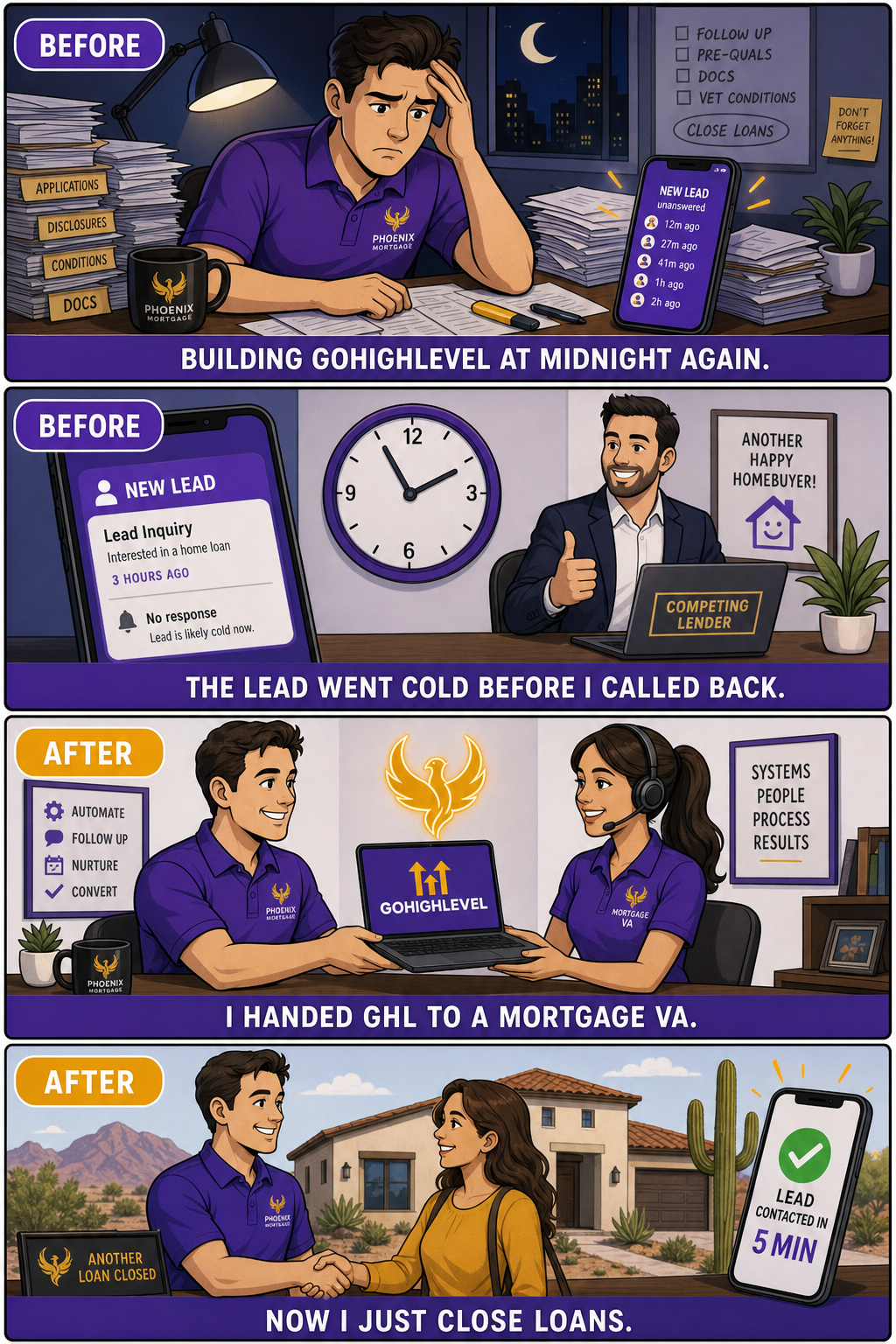
Here’s the mortgage-specific version of the problem: a Phoenix buyer fills out your rate form at 8:40 p.m. If your GoHighLevel account has no live workflow to text them back in 60 seconds and no one monitoring the pipeline, they’ve filled out two competitors’ forms before you see the notification at breakfast. The loan was winnable. The follow-up wasn’t there.
The catch is that “properly built” is exactly the part DIY LOs get wrong or never finish. A mortgage-niche VA builds the speed-to-lead engine once, tests it, and monitors it daily — so the 5-minute window is covered whether you’re on a call, at a closing, or asleep. That’s the entire premise behind Mortgage Snapshot and why we pair it with hands-on GHL management.
Pain #3: Every lost loan is expensive — especially in Phoenix
If leads were cheap and loans were easy to replace, slow follow-up wouldn’t matter much. Neither is true right now.
The Mortgage Bankers Association reports that independent mortgage banks spent $12,579 in total production expense per loan in Q1 2025, up from $11,230 the prior quarter (MBA, 2025). Full-year 2024 averaged $11,076 per loan, itself down slightly from $11,258 in 2023 (MBA, 2025). That figure — commissions, compensation, occupancy, tech, and corporate overhead — is what it actually costs the industry to originate one loan.
Now layer on the Phoenix market. The average home value in Phoenix sits around $410,000 as of mid-2026, with the broader Phoenix–Mesa–Scottsdale metro higher still (Zillow, 2026). These aren’t small-ticket loans, and the Valley’s buyers are online, mobile, and comparison-shopping lenders in real time. When acquiring and originating a loan is this expensive, the cheapest loan you can close is the one already in your pipeline that you simply followed up with faster. Letting a warm Phoenix borrower go cold because GoHighLevel wasn’t set up to catch them is one of the most expensive mistakes an LO can make — and it’s entirely preventable.
This is also why reactivating your existing database beats buying new leads: the borrower already knows you, and a VA-run GHL campaign can surface the ones ready to move without a dollar of new ad spend.
Pain #4: Hiring in-house is slow and pricey
The obvious answer to “I don’t have time for GoHighLevel” is “hire someone.” But an in-house hire is often the slowest and most expensive path — especially for a solo LO or a small Phoenix brokerage.
Start with the salary. The U.S. Bureau of Labor Statistics puts the median pay for secretaries and administrative assistants at $47,460 per year as of May 2024 (BLS, 2024). That’s before payroll taxes, benefits, software seats, equipment, and a desk — realistically $60,000+ all-in. And for that money you get someone who, on day one, does not know how to build a mortgage pre-qual pipeline, register A2P/10DLC for TCPA-compliant texting, or wire a rate-lock reminder sequence. You’re paying a full salary and training them on GoHighLevel while your leads keep coming.
Compare the three realistic options:
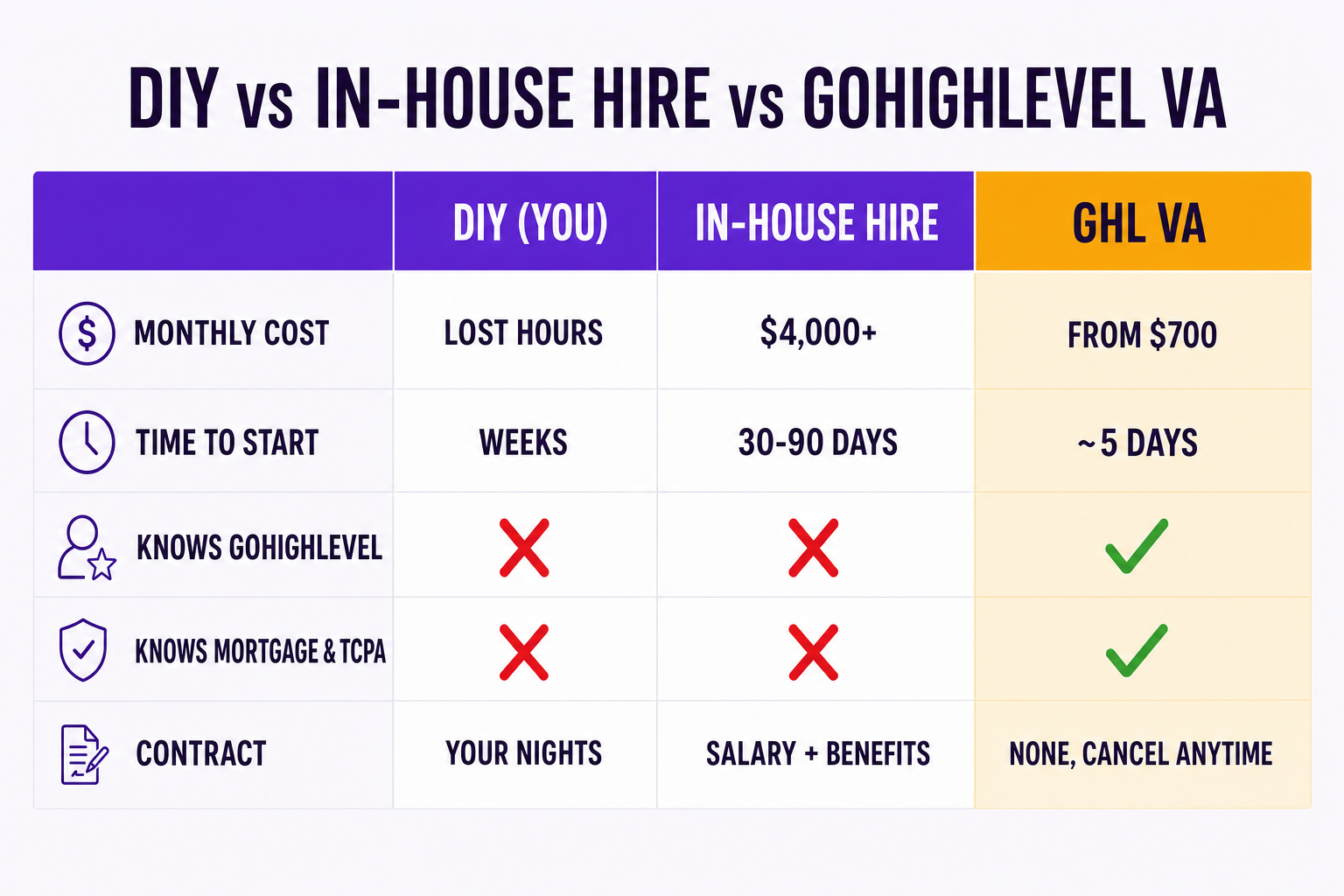
| Factor | DIY (you) | In-house hire | Mortgage GHL VA |
|---|---|---|---|
| Monthly cost | “Free” — paid in lost originating hours | ~$4,000–$5,000 loaded | From $700 |
| Time to productive | Weeks of trial and error | Hire + train (30–90 days) | Starts in ~5 days |
| Knows GoHighLevel | Learning as you go | Usually not — you train them | Yes, day one |
| Knows mortgage & TCPA | You do; no leverage | Rarely | Yes — niche-trained |
| Commitment | Your nights and weekends | Salary, benefits, contract | No contract, cancel anytime |
The math isn’t close. A dedicated mortgage GHL VA starts at $700/month — roughly $8,400/year against a $47,460+ in-house salary — and skips the 30-to-90-day ramp entirely because they already run GoHighLevel for mortgage firms. You get expert output in about five days, at a fraction of a loaded in-house cost, with no contract.
The fix: a mortgage-niche GoHighLevel VA
“Hire a VA” only works if the VA actually knows your platform and your business. A general virtual assistant who’s never touched GoHighLevel or a loan pipeline will cost you the same training time as an in-house hire. The fix is a VA who specializes in GoHighLevel for mortgage originators — someone who has built these systems before and can be productive immediately.
That’s exactly what our Hire a GHL VA service is. Here’s what a mortgage-niche GHL expert actually does for a Phoenix loan officer:
- Builds your pre-qual pipeline — lead → pre-qual → application → processing → closing, with custom fields for loan type, LTV, credit tier, and referral source, so you always know what each borrower needs next.
- Wires speed-to-lead follow-up — instant SMS + missed-call text-back the moment a lead hits the form, then a multi-touch nurture so the 5-minute window is always covered.
- Handles A2P/10DLC and TCPA setup — brand registration and consent-safe campaigns, so your Phoenix SMS outreach is compliant before it ever sends.
- Runs refi and database reactivation — rate-drop triggers and past-client outreach that recover loans from contacts you already own.
- Reports daily — a short progress update and weekly pipeline audit (often with a Loom walkthrough), so you always know which borrowers need a call and what’s been done.
And it stays 100% white-label and NMLS-aware: your brand, your number, your reputation on every touchpoint. Plans scale with your pipeline — Growth at $700/month (part-time), Power at $1,250/month (full-time), and Elite at $1,500/month (full-time plus dev support) — with no contract and cancellation anytime. If you’d rather own the whole system outright, the one-time Mortgage Snapshot installs 13 pipelines and 50+ workflows into your GHL account in 24 hours, and a VA can run it for you afterward.
How to hand off GoHighLevel without losing control
The fear that keeps LOs stuck in DIY is loss of control — “it’s my database, my brand, my compliance exposure.” Fair. Here’s how a clean handoff protects all three:
- Start with a pipeline audit. Before anyone changes a thing, the VA maps your current GHL setup, your loan stages, and where leads are leaking — so the work is targeted, not guesswork.
- Keep ownership of the account. You own the GoHighLevel sub-account and the data. The VA works inside it under your brand; you can revoke access any time.
- Set compliance guardrails first. A2P/10DLC registration, consent capture, and STOP handling get locked in before a single automated text goes out. (Our TCPA-safe texting guide covers the rules that changed and the ones that didn’t.)
- Review the daily report. You stay in the loop with a short daily update and a weekly audit — you’re delegating the work, not the visibility.
- Scale as it proves out. Start on the part-time Growth plan, and move to Power or Elite only when your pipeline justifies it.
Done this way, delegation increases control: you finally have a documented, monitored system instead of a half-built one only you understand. If you want a heavier build — custom integrations to your LOS, a borrower portal, or logic GoHighLevel can’t do natively — that’s what our GHL development and custom software teams handle, and the same VA can operate it day to day.
Frequently asked questions
GoHighLevel VAs for Phoenix loan officers — quick answers
What does a GoHighLevel VA do for a mortgage loan officer?
A mortgage-niche GHL VA runs your GoHighLevel account for you: they build and maintain your borrower pipeline, wire speed-to-lead follow-up (instant SMS and missed-call text-back), set up TCPA-compliant A2P/10DLC texting, run refi and database-reactivation campaigns, and send you daily progress reports. You keep originating; they keep the platform running. See our Hire a GHL VA page for the full scope.
How much does a mortgage GoHighLevel VA cost in 2026?
Plans start at $700/month for a part-time (Growth) expert, $1,250/month for full-time (Power), and $1,500/month for full-time plus development support (Elite). All are month-to-month with no contract. For comparison, the median U.S. administrative assistant salary is $47,460/year before benefits (BLS, 2024) — and that hire still has to learn GoHighLevel.
Is it worth hiring a GHL VA if I only close a few loans a month?
Often yes, because the cost of a lost loan is high — independent mortgage banks spent $12,579 to produce one loan in Q1 2025 (MBA, 2025). If a VA helps you convert even one extra warm lead a month through faster follow-up, the part-time plan pays for itself several times over. Add up your GHL hours times your originating value per hour; if it beats $700, a VA is already cheaper than DIY.
Will a VA keep my Phoenix SMS outreach TCPA-compliant?
Yes — a mortgage-niche VA sets up A2P/10DLC brand registration, consent capture, and STOP/opt-out handling before any automated texting goes live, which is exactly where DIY setups create compliance risk. Compliance guardrails are configured first, not bolted on later. Our text-message compliance guide explains the current rules.
Do I lose control of my database and brand if I hire a VA?
No. You own the GoHighLevel sub-account and all your data; the VA works inside it under your brand (white-label) and access can be revoked any time. You get a daily report and a weekly pipeline audit, so you're delegating the work while keeping full visibility and ownership.
How fast can a GHL VA get started?
Typically about 5 days. Because a mortgage-niche VA already knows GoHighLevel and how to structure a pre-qual pipeline, there's no 30-to-90-day training ramp like an in-house hire — they audit your account, lock in compliance, and start building immediately. Book a walkthrough to scope your setup.
About the author
Emilio Duarte is a GHL Automation Lead for the mortgage niche, based in Tampa, FL. He builds GoHighLevel snapshots and pipelines for loan officers and brokers — focused on borrower capture, speed-to-lead follow-up, and turning raw leads into booked appointments without anyone touching a keyboard. Emilio is a fictional editorial persona for Mortgage Snapshot; nothing here is individualized financial, legal, or compliance advice. We are not a lender, and any figures cited are from the sources linked.
Related reading
- Mortgage speed-to-lead: why the first 5 minutes decide the deal — the follow-up window a VA is built to protect.
- Missed-call text-back for loan officers — the instant response that stops leads going cold.
- Mortgage database reactivation — recover loans from contacts you already own, no ad spend needed.
- Mortgage CRM for loan officers: the 2026 buyer’s guide — what a well-run pipeline should actually do.
- Mortgage Snapshot vs a DIY GHL build — when to buy the system versus build it yourself.