
You already have the leads. They are sitting in a spreadsheet, an old CRM you barely log into, and a phone full of contacts from closings you did in 2022. Hundreds of past borrowers, stalled pre-approvals, referrals you never followed up. You paid to get every one of them, and most have not heard your name in two years.
Here is the part that stings. When rates dropped this year and those borrowers refinanced, most did it with someone else. Not because that lender was better, but because that lender called and you did not. A database you never touch is not a backup plan for later. It is a slow, quiet leak draining the cheapest deals you will ever get. This guide shows what the silence costs in real numbers, the six places the money leaks out, and the messages that plug the holes.
What a database you never touch actually costs
A cold lead you buy costs money up front and converts at a low rate. A past client costs you nothing to acquire again and already knows your name. That makes your database the most valuable thing you own and the thing you most consistently ignore, and the cost shows up as deals that quietly close somewhere else.
Look at what happened when rates moved in 2025. Refinance retention, the share of borrowers who refinanced with the lender who did their last loan, hit a 3.5-year high of 28% in the third quarter (ICE Mortgage Monitor, December 2025). A 3.5-year high, and still only 28%. Earlier in the year it sat below one in four. So in the best stretch of the cycle, roughly 7 of 10 people who refinanced did it with a lender who was not the one who originally helped them, usually whoever was in front of them when the rate made sense. The gap is even wider at banks, which retained only 13% (the chart below breaks it down). The borrower you already closed is up for grabs the moment rates move, and the lender who stays in touch wins them.
Sources: ICE Mortgage Monitor, Dec 2025; NAR 2025 Profile of Home Buyers and Sellers.
Now add the half the retention number does not capture: referrals. This is a referral business, and a happy past client is a referral machine until they forget you. In the latest National Association of Realtors data, 88% of buyers purchased through an agent, 43% found that agent through a referral, and 66% of sellers used an agent who was referred or one they had worked with before (NAR 2025 Profile). More than 9 in 10 buyers would use their agent again. The same loyalty runs through a loan officer’s database, and since nearly half of borrowers do not shop their mortgage at all, being the name they remember is often the whole game.
So the real cost is not one lost refinance. It is the refinance, plus the move-up purchase three years later, plus the referrals that borrower would have sent. A thousand silent contacts, year after year, is why your pipeline feels empty every time rates make you earn it.
Share of refinancing borrowers retained by their prior lender, Q3 2025. Source: ICE Mortgage Monitor, December 2025. Even the strongest categories leave most borrowers unretained.
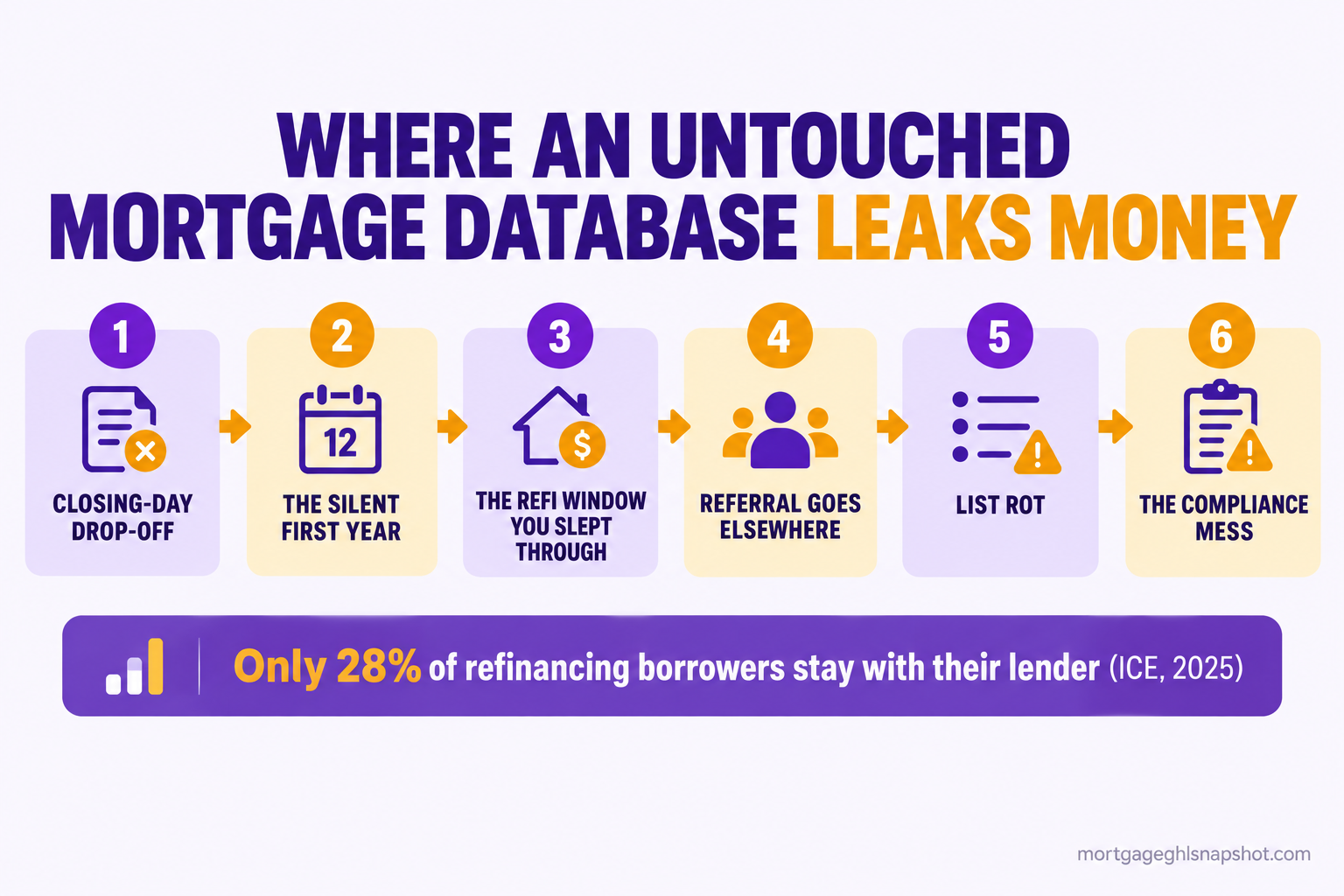
The six places an untouched database leaks money
A database does not die all at once. It leaks, in six predictable places, and most loan officers never see any of them because the loss is invisible by design. Here is where the money goes, why it happens, and what a touched database does instead.
Leak 1: The closing-day drop-off
The loan funds, the borrower gets their keys, and most LOs move on to the next file. That is the exact moment the leak starts. Closing is the high point of trust you will ever have with this person, and almost nobody uses it.
Why it leaks: closing feels like a finish line, so you treat it as one, and the borrower walks away warm into silence.
What a touched database does: it treats funding as the start. A same-week thank-you, a review request, and enrollment into a nurture loop so the contact is never cold again. That is the handoff the whole borrower communication system exists to automate.
Leak 2: The silent first year
Twelve months go by and you never reach out. No annual loan review, no equity update, no anniversary note. The borrower is not angry. They just stop associating you with their mortgage, and when a question comes up, they Google instead of texting you.
Why it leaks: nothing on your calendar fires at “it has been a year,” so it never happens.
What a touched database does: it sends a genuine annual review: current rate, current balance, a rough equity estimate, and one line inviting a conversation if anything changed. It reminds them you exist before they need you.
Leak 3: The refi window you slept through
This is the expensive one. Rates drop into the money for a chunk of your past borrowers, and the ones who hear from a lender refinance. If it is not you, it is whoever bought an ad or ran a rate-watch alert. The 72% of refinancers the ICE number above did not count were all somebody’s past client, contacted by somebody else.
Why it leaks: you cannot watch hundreds of individual rates by hand, so you watch none, and the window closes before you notice it opened.
What a touched database does: it monitors the gap between each borrower’s locked rate and the market, and fires an alert the moment a refinance makes sense. That is the premise of a rate-drop refi alert system, the highest-return automation you can run against an old list.
Leak 4: The referral that went to the LO who stayed in touch
Your past borrower’s coworker is buying a first home and asks around. Your borrower would have recommended you in a heartbeat two years ago, but the last loan officer who sent them anything useful was someone else, so that is the name that comes out of their mouth. The referral you earned at closing went to whoever stayed visible.
Why it leaks: referrals go to the top-of-mind name, and top-of-mind is built by contact. No contact, no recall, no referral.
What a touched database does: it keeps you lightly present all year with useful touches, so when someone near your past client needs a loan, you are the name they trust. It is the same engine behind strong realtor referral partnerships, aimed at your own past clients.
Leak 5: List rot
Even people who want to reactivate hit this wall. Numbers are dead, emails bounce, there is no record of who closed when or at what rate, and nothing is segmented. A list you cannot sort is a list you cannot work, so it rots while you promise to clean it up later.
Why it leaks: data decays constantly, and without a system that updates details at every touch, a database degrades a little every month until it feels hopeless.
What a touched database does: it keeps records clean as a side effect of contact. Every reply and updated number refreshes the record, and basic segments (year closed, loan type, rate band) let you target the right slice.
Leak 6: The compliance mess when you finally reach out
You finally decide to work the database, upload two years of contacts into a texting tool, and blast them. Now you have a new problem, because a stale list is where consent is murkiest and complaints are most likely. One careless campaign turns a dormant asset into a TCPA headache.
Why it leaks: reactivation done in a panic skips consent, opt-out handling, and the registration that makes automated texting legal. The rules did not go away while the list sat idle.
What a touched database does: it reactivates deliberately, with consent and opt-out baked in, which is the whole next section.
Steal this: the messages that bring a database back to life
You do not need a campaign agency. You need a short, honest set of messages on a schedule. Make the voice sound like you, sign with your name, include your NMLS ID where required, and give a clear opt-out. These are templates, not legal or rate advice.
Four messages cover the lifecycle: waking a quiet contact and cleaning the list in one motion, the annual review that keeps you present, the rate-watch alert that captures the refi, and the value touch that earns referrals. Set them on a schedule and off real triggers, and most of this sends itself. The point is that no contact ever goes more than a few months without hearing something useful, in your voice, with your name on it. For the full playbook, read our deeper guide to mortgage database reactivation.
Solo LO, small team, and a high-volume shop
The leak is the same for everyone. The way you plug it changes with your volume and database size.
The solo loan officer (a few hundred contacts). Small enough to feel manageable, big enough that you still ignore it. Start with the two touches that pay for themselves: the rate-watch alert and the annual review, automated off your closing dates and current rates. Keep the referral-ready value touch personal, because at your size a note that clearly came from a human is your edge.
The small team (3 to 15 LOs, a few thousand contacts). Your problem is ownership. A borrower closed by an LO who left two years ago is a borrower nobody is watching. Standardize the touches as a shared workflow so every past client gets the same baseline, and keep records in one place so a departing LO does not take the relationships. The build-versus-staff math looks a lot like an in-house assistant versus a GHL-driven setup.
The high-volume shop (thousands of contacts). At scale, nothing can depend on anyone remembering anything. Touches fire off data, and segmentation is automatic: loan type, year closed, rate band, and opt-in status all driving who gets what. Invest in copy that reads like a person and in clean consent records. A big dormant database is the largest buried asset most shops own, and the one most often left in the ground.
Texting a two-year-old database without a TCPA problem
This is where good intentions become legal exposure. A dormant list is the riskiest kind to text: consent gets stale, numbers change hands, and the people likeliest to complain are the ones who forgot they gave you their info. Four lines keep you safe.
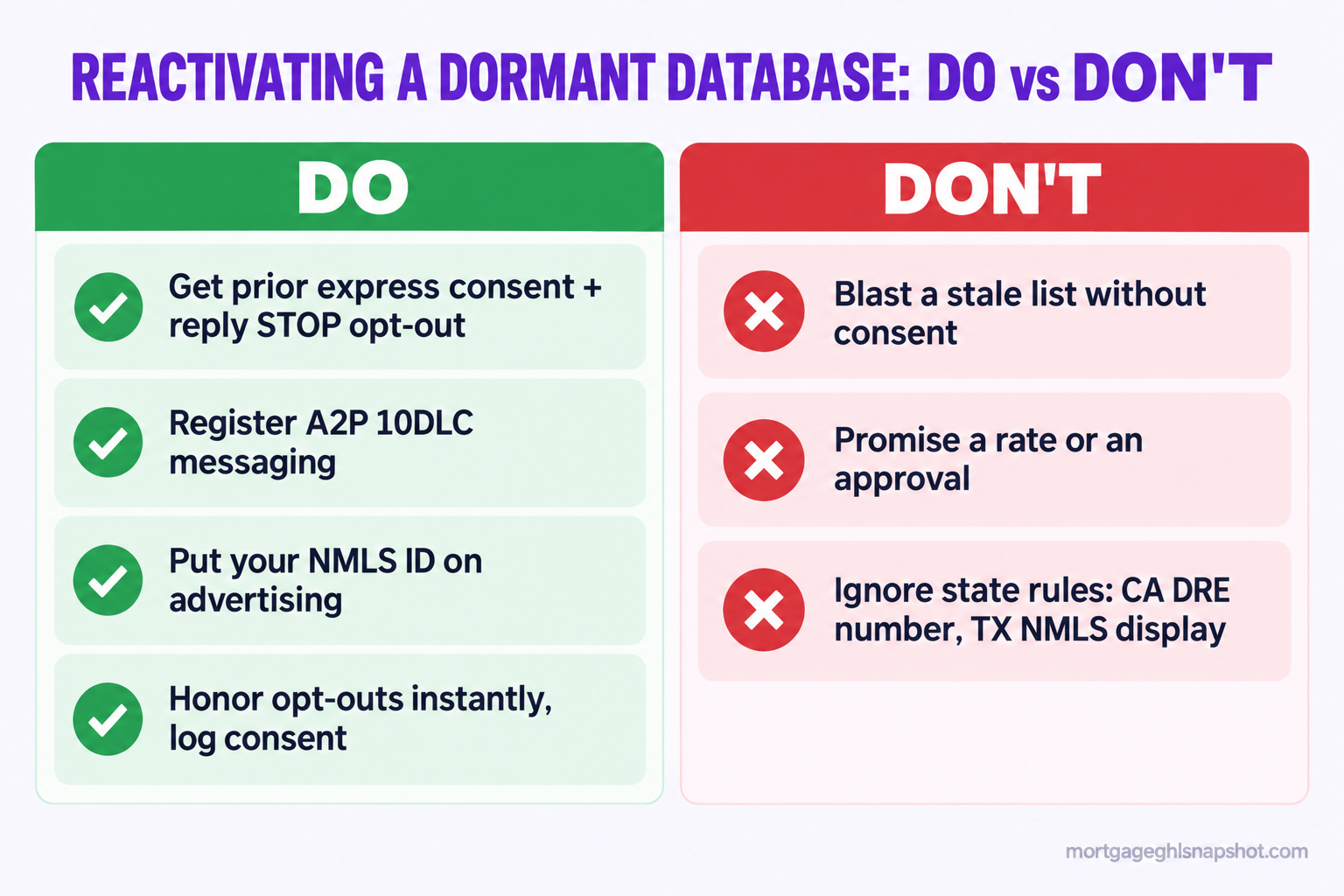
The practical move is simple. Before you run any rate or refi messaging at a dormant contact, send the opt-in re-engagement text first. It re-establishes a clear yes, cleans your list, and turns a legally murky blast into a permission-based conversation. The ones who say yes are worth ten times the ones you would have annoyed.
The objections I hear every week
“My past clients will think I’m bothering them.” Not if the contact is useful. The texts that annoy people are empty “just checking in” messages. A real annual review or a genuine heads-up that their rate is worth a look reads as service, and people reply with thank-yous.
“I don’t have time to work a list of 600 people.” That is the point of putting it on a system. You set the annual review, the rate-watch trigger, and the re-engagement sequence once, and the database works itself. The cost is the setup, a weekend against years of recovered refinances and referrals.
“My list is too old and messy to be worth it.” You do not reactivate a database, you reactivate the next contact in it. A messy list of 2,000 that yields 300 engaged past clients is still 300 warm borrowers you were about to let someone else close.
“I already pay for a CRM. Isn’t this what it does?” A CRM you do not touch is a nicer-looking version of the spreadsheet you also do not touch. The value is in the triggers that reach out on their own, which most LOs never set up. It is the same reason pre-approvals go quiet and past clients drift.
Frequently asked questions
How much is a dormant mortgage database actually worth?
More than most loan officers think, because past clients convert far better than cold leads and cost nothing to acquire again. The clearest proxy is retention: even at a 3.5-year high, lenders held just 28% of refinancing borrowers in Q3 2025, so roughly 7 in 10 refinanced elsewhere. Add the move-up purchases and referrals a stayed-in-touch borrower generates, and an ignored database of a few hundred contacts is easily a six-figure leak over a few years.
How often should I contact my past clients?
Often enough that no contact goes more than a few months without hearing something useful, but not so often that it feels like spam. A practical baseline is an annual loan review, a rate-watch alert that fires only when a refinance is worth looking at, and a couple of value touches a year. The cadence matters less than the rule that they never go fully quiet.
Is it legal to text past clients who closed years ago?
It depends on consent. Automated texting requires prior express consent and a working opt-out under the TCPA, plus registered A2P 10DLC messaging. If your consent for an old contact is unclear, send a plain opt-in message first rather than a marketing blast, honor every opt-out immediately, and keep records.
What is the single highest-return thing to automate against an old database?
A rate-drop refi alert. It watches the gap between each past borrower's rate and the current market and reaches out the moment a refinance makes sense. Refinance windows are where retention is won or lost, and no human can watch hundreds of loans by hand, so this is the automation with the clearest payback.
Will reactivating old clients bring in new loans, or just refinances?
Both, and the referrals are often the bigger prize. Past clients refinance, they move up and buy again, and they refer the people around them. In NAR's data, 66% of sellers used a referred or repeat agent and more than 9 in 10 buyers would use their agent again. The same loyalty sits in a loan officer's database, but only the one who stays in touch gets to collect it.
It is a year from now and rates just moved again. This time your phone is not quiet. The past borrower you closed in 2022 got your annual review in the spring, a rate-watch text the week the market shifted, and a straight answer when they replied. They refinanced with you, and two weeks later they sent their coworker. The database did not get bigger. You stopped ignoring it, and the cheapest deals you will ever close were in your phone the whole time.