
It is the first week of a new quarter and your pipeline looks thin, so you spend the morning buying leads. Meanwhile, three hundred people who already trust you, who you already closed, sit in your CRM waiting for a call that never comes. One refinanced last month. With someone else.
The fix is not another lead source. It is a repeatable annual mortgage review: a scheduled, scripted check-in with every past client, once a year, that finds the loans already hiding in your database and asks for the referral you earned at closing. This is the whole system, with the scripts you can copy today.
Why the annual review is the cheapest loan you will write
Winning a brand-new borrower is expensive. Independent mortgage banks spent $12,579 in total production expense on each loan they originated in the first quarter of 2025, up from $11,230 the prior quarter (MBA, 2025). That is advertising, lead buys, and hours poured into a stranger who may never close.
A past client is the reverse trade. They know your name, you have their file, the trust is already paid for. The only thing between you and the next loan is a conversation nobody scheduled.
Total production expense per loan for independent mortgage banks, by quarter. Winning a new borrower is a five-figure cost; a review call is not. Source: MBA Quarterly Mortgage Bankers Performance Report, 2025.
It is also where referrals live. Most sellers do not shop from scratch: roughly 38% found their agent through a referral and another 28% used someone they had worked with before (NAR 2025 Profile of Home Buyers and Sellers). The loan officer who calls once a year is the one whose name comes up when a neighbor asks who to use.
And the refi math punishes silence. Even in a strong quarter, refinance retention topped out at 28%, so close to 7 in 10 refinancing borrowers left the lender who closed their last loan (ICE Mortgage Monitor, 2025). They did not leave unhappy. They left because nobody reached them first.
The six-stage annual review system
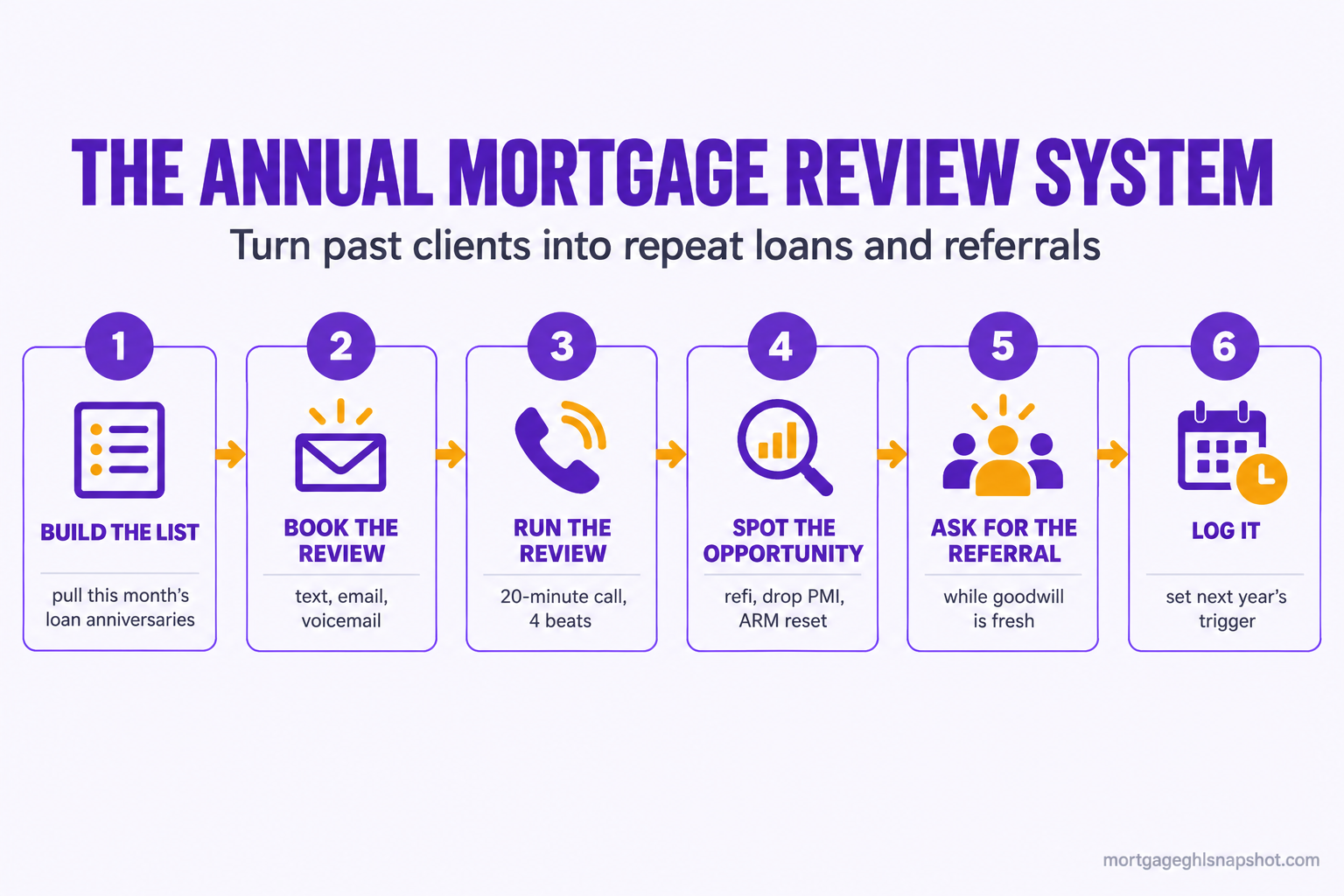
The review is not one phone call. It is a small machine with six stages, and most loan officers never get past stage one. Here is the whole thing:
- Build the review list so you know who to call and what to look for.
- Book the review with a short, scripted outreach sequence.
- Run the review on a simple twenty-minute agenda.
- Spot the opportunity: refinance, PMI removal, an ARM reset, equity, a recast.
- Ask for the referral while the goodwill is fresh.
- Log it and set the trigger that fires the same review next year.
Done once, this dies. Built as a repeating workflow in your CRM, it runs every year without you remembering.
Stage 1: Build the review list
You are not calling the whole database at once. You pull a clean monthly slice so the work is steady. The cleanest trigger is the loan anniversary: twelve months after closing, each client drops onto that month’s review list.
Before you dial, tag each contact with four fields: closing date, original rate, loan balance, and loan type. Those decide what the call is about. A borrower who closed at 7.25% is a refinance conversation. One two years into an FHA loan with rising equity is a mortgage-insurance conversation. One with an adjustable rate near its first reset is urgent.
If nobody has touched your database in two years, the anniversary list will be full of dead numbers. Do the database reactivation groundwork first so your calls land on real people, because the cost of a database you never touch compounds every month you ignore it.
Stage 2: The outreach that books the review (steal this)
The goal of outreach is one thing: book a twenty-minute review. Not sell, not quote, just book. Three touches over a week: text, email, then a voicemail if they go quiet. Copy these and swap in your details.
The booking text (day 0):
Hi [First name], it’s [Your name] at [Company]. It’s been about a year since we closed your loan, so I set aside time for your annual mortgage review, a quick check on your rate, your payment, and any way to save. 15 minutes, no cost. Does Thursday at 10 or 2 work? Reply STOP to opt out.
The booking email (day 0, same morning):
Subject: Your annual mortgage review, [First name]
Hi [First name],
It’s been about a year since we closed your loan. I run a quick annual review for every client: whether today’s rates could lower your payment, whether you can drop mortgage insurance yet, and whether your current loan still fits your plans.
About 15 minutes, no cost. Grab a time here: [booking link].
[Your name], [Title] [Company] · NMLS #[your number]
The voicemail (day 3, if no reply):
Hi [First name], it’s [Your name], your loan officer from [year or property]. Nothing is wrong, I just do a yearly review for my clients and yours is due. Fifteen minutes to make sure your rate and payment still make sense. Call or text me back at [number]. Thanks.
Three touches, then stop for this cycle and let the anniversary catch them next year. The automation is the same SMS and email workflow you would use for any nurture; the difference is the reason for the call is real and specific to them.
Stage 3: The review meeting, start to finish
The review follows four beats every time, so it never rambles and you never forget the referral ask. Twenty minutes, by phone or video.
Open (reconnect, then set the agenda).
Hey [First name], good to catch up. This is quick and it’s for you, not a sales call. I want to check three things: your rate against today’s, whether you can drop mortgage insurance, and whether your loan still fits your life. Sound good?
Review the numbers (their file, out loud).
You closed at about [old rate]% on a balance of roughly [balance]. Today, for a file like yours, we’re seeing around [estimate]%. If that holds, a refinance could be worth a look. And based on your balance, you may be close to dropping mortgage insurance. Let me walk you through both.
Ask the life question (where the next loan hides).
Anything changed or coming up? A renovation, a second property, a kid heading to college, thinking about moving? I ask because your mortgage is usually the cheapest money you have, and sometimes there’s a smarter way to use it.
Close with the next step and the referral ask.
Here’s what I’ll do: put together your exact numbers on the refinance and the mortgage-insurance question and send them over. And one favor, if you know anyone buying or refinancing, I’d love an introduction. Most of my business comes from clients like you.
That is the whole meeting. Write the life answers into the file; that is where next year’s conversation starts.
Stage 4: Spot the opportunity
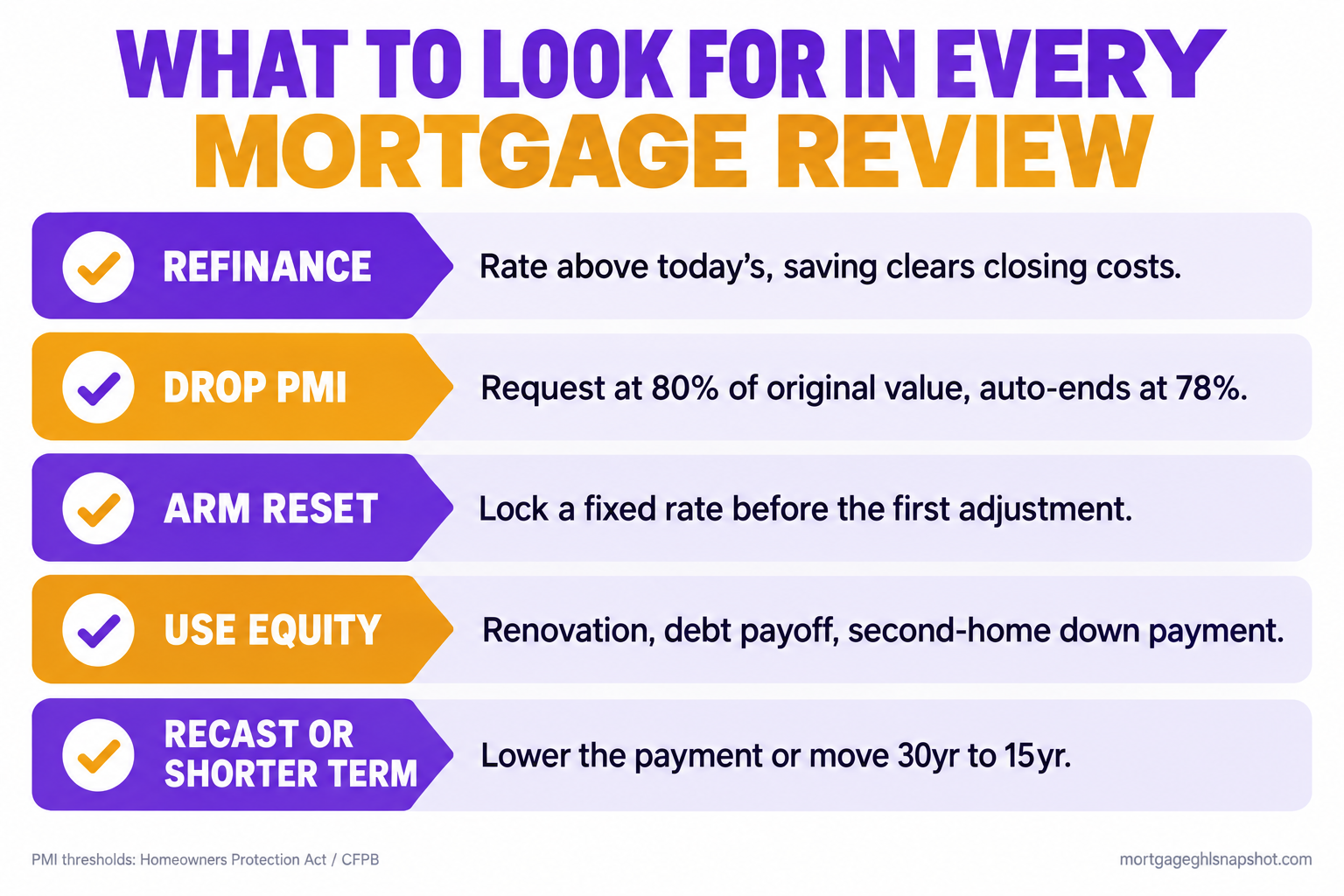
This stage pays for the whole system. A good review surfaces a specific opportunity most clients do not know they have:
- A refinance. If their rate sits above today’s and the saving clears closing costs inside a reasonable break-even, it is a conversation. Pair it with your rate-drop callback scripts so the follow-up is ready.
- PMI or mortgage-insurance removal. On a conventional loan, a borrower can request private mortgage insurance be cancelled once the balance reaches 80% of the original value, and the servicer must automatically terminate it at 78% (CFPB). Clients almost never track this. Flag it and you are a hero for saving them a premium, even with no loan in it for you.
- An ARM about to reset. A borrower approaching their first adjustment is the most time-sensitive review you will do; a fixed refinance before the reset heads off a payment shock.
- Equity for a real purpose. A renovation, debt consolidation, or a down payment on a second home: you are not pushing a cash-out, you are answering the life question with the cheapest money they have.
- A recast or a shorter term. A client who came into money may want to recast; one who got a raise may want to move from 30 years to 15.
You walk in with a hypothesis and leave with a number. “I’ll keep an eye on your rate” is weak. “You’re $40 a month from dropping mortgage insurance, let me start that” is a client for life.
Stage 5: The referral ask
You already asked at the end of the meeting; Stage 5 makes it land. The written follow-up that delivers their numbers is the natural place to repeat the ask, because you have just done something useful and the goodwill is at its peak.
The follow-up email with the referral ask built in:
Hi [First name], great talking today. Here are your numbers:
- Current rate: about [old rate]% · Today’s estimate: about [estimate]%
- Estimated monthly change: around $[estimate]
- Mortgage insurance: [on track to drop at X / already eligible / not yet]
These are estimates, not an offer. Reply and I’ll run the real file.
One more thing: if a friend or coworker is buying or refinancing, send them my way. A quick text intro is all it takes, and I’ll take great care of them like I did you.
[Your name], [Title] · [Company] · NMLS #[your number]
Specific beats vague. “Send anyone my way” gets nothing. “If a coworker is buying this spring, a quick text intro is all it takes” gives them an exact action. If you also run realtor partnerships, keep those rules separate; the RESPA-safe co-marketing playbook covers what you can and cannot do with an agent, a different world from asking a past client.
Stage 6: Log it and set next year’s trigger
The review is worthless if it happens once. Stage 6 is boring, and the whole reason the system compounds. After every review, write three things into the file: what you discussed, the life details they shared, and the outcome. Then set the next anniversary trigger so this client resurfaces in twelve months without you remembering.
That log makes next year’s call feel like a relationship instead of a cold pitch. You open with last year’s details and you are a trusted advisor, not a vendor. The same discipline that makes pre-approval follow-up convert applies: the first touch rarely closes, the system that never forgets does.
Run it solo, as a team, or as a brokerage
The six stages do not change with your size. Who runs them, and how much is automated, does.
The solo loan officer. Your enemy is time and memory. Let the anniversary trigger build the monthly list, automate the three booking touches, and reserve yourself for the reviews. Do not call three hundred people in December; call twenty-five a month, forever.
The small team, 2 to 15 LOs. Your enemy is routing. Every review must land with the loan officer who closed that client, or two people call the same borrower and nobody calls the rest. Route the list by originating LO, run a shared “annual review” pipeline so you can see who booked and who skipped, and standardize the scripts.
The brokerage or high-volume shop. Your enemy is scale and reporting. At volume the review is a measured program: booking rates, show rates, and loans sourced per hundred reviews, by segment, so you can prioritize the segments that convert. Your LOs never see an unsorted database, only a clean weekly queue with the opportunity flagged.
Keep every review compliant
This is not legal advice, but these are the lines I build every review program to respect.
Asking a past client for a referral is fine. Paying for referrals is not. You can and should ask your own clients to refer friends. What you cannot do is pay a real estate agent, or anyone else, for sending you business. RESPA Section 8 bars giving or accepting a fee for the referral of settlement business, and any marketing arrangement must pay for the fair value of actual services, not scale to the leads it produces (CFPB, 12 CFR 1024.14). The 2015 guidance on marketing services agreements was rescinded in 2020, but the statute has not moved (ALTA, 2020).
Texting a past client needs consent and an opt-out. A closed loan is not blanket permission to send automated marketing texts. Capture consent at intake, keep a working STOP on every message, and keep your text-message compliance basics current.
Never quote a live rate, and keep your NMLS ID on everything. Every number in a review is an estimate until the file is run, so say so. Your NMLS unique identifier belongs on messages that advertise your services, as the SAFE Act and state advertising rules require. Put it in your templates and signature.
The objections I hear every week
“Won’t clients feel like I’m just fishing for a refinance?” Only if you make the call about you. When it genuinely checks their rate, their mortgage insurance, and their plans, and you flag a saving with nothing in it for you, clients feel looked after, not sold. The referral ask lands because the call earned it.
“I don’t have time to review three hundred past clients.” Not all at once. The anniversary trigger spreads them across twelve months, so you call twenty to thirty a month. That is a scheduled half-day, and it replaces time you would spend buying cold leads.
“My CRM is a mess and I don’t know who consented.” Fix that first. Clean the list, confirm consent, and start with live manual calls to the clients you are sure about. A smaller consented list beats a giant one that earns you a complaint.
“What if there’s no opportunity in the file this year?” Then you made a fifteen-minute call that reminded a client you exist, asked for a referral, and logged it for next year. That is the touch that keeps them from refinancing with the call center that dials them in six months.
Frequently asked questions
How often should a loan officer do a mortgage review with past clients?
Once a year per client, triggered by the loan anniversary, with a lighter rate-watch touch in between if the market moves. Annual is frequent enough to catch refinance and mortgage-insurance opportunities and stay top of mind for referrals, without feeling like constant selling. Spreading reviews across the twelve months by closing date keeps the workload steady.
What should an annual mortgage review actually cover?
Three things: whether today's rates could lower their payment, whether they can drop private mortgage insurance yet (a request at 80% of original value, automatic termination at 78%), and whether their current loan still fits their life. The life question, about renovations, second homes, or college, is where most of the next loans hide.
Is it legal to ask past mortgage clients for referrals?
Yes. Asking your own past clients to refer friends and family is allowed and is the backbone of most loan officers' businesses. What RESPA Section 8 prohibits is paying a third party, such as a real estate agent, a fee for referring settlement business to you. Asking a client for an introduction is not the same as paying for a referral.
Can I automate the annual review, or does it have to be manual?
Automate the parts that do not need you: the loan-anniversary trigger that builds each month's list, the three-touch booking sequence, and the logging. The twenty-minute review itself stays human. Automation makes the review happen on schedule; you make it a real conversation.
How many reviews actually turn into loans?
It varies by how cold your database has gone and where rates sit, so treat any single number with caution. The useful comparison: a review costs you fifteen minutes, while winning a brand-new borrower costs an independent mortgage bank over $12,500 per loan. Even a low conversion rate on past clients beats that math by a wide margin.
It is the first week of next quarter. You open your CRM and twenty-six clients are queued for their annual review this month, each tagged with their rate, their balance, and the opportunity already flagged. You book eight reviews by noon. Three are refinances. One is a mortgage-insurance removal that makes a client’s year, and she texts you her sister’s number before you hang up. None of it was a new lead. All of it was already yours.