
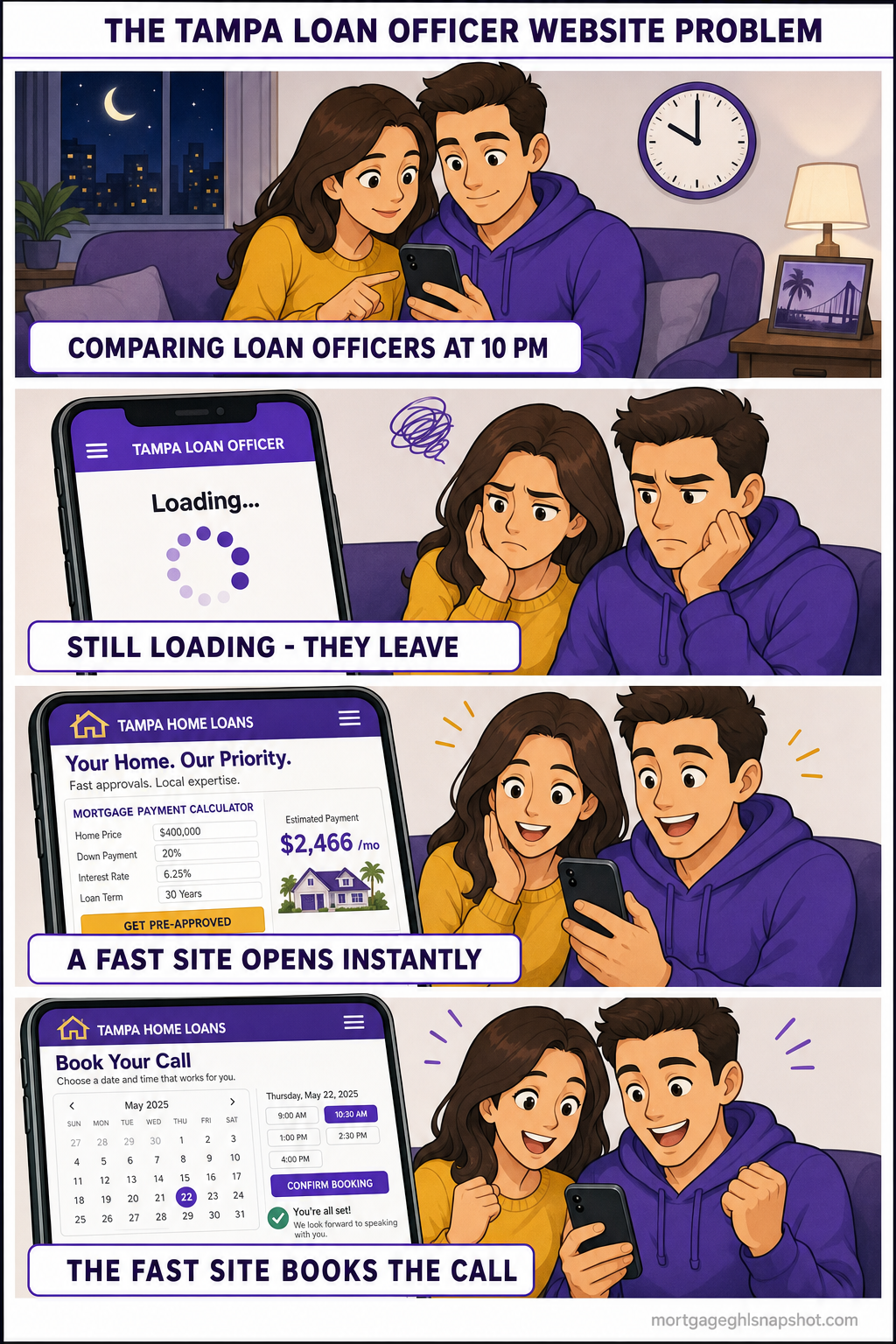
A Tampa buyer finds your name on a Zillow listing at 10:15 p.m., opens your website to see if you look like someone they’d trust with their pay stubs, and waits. The page is still painting — a spinner, a hero image half-loaded, a cookie banner jumping the layout — so they tap back to the search results and open the next loan officer. You never got a form, a call, or a notification. As far as your pipeline is concerned, that borrower never existed.
A Tampa loan officer’s website is the one part of the pitch that works while you sleep — and for most originators it’s the weakest link: too slow to hold a borrower comparing three names at night, too generic to rank in local search, and too dated to earn the trust of someone about to hand over the biggest financial decision of their life. This is the plain-English breakdown of what a slow, generic site actually costs you in Tampa, why speed and structure decide who gets the call, and what a fast, purpose-built site fixes — with real, sourced numbers.
The short answer: your website is quietly losing borrowers
A borrower choosing a loan officer in Tampa almost never phones the first name they see. They open two or three sites in tabs, glance at each, and give their attention to whichever one loads fast, looks credible, and answers the question in their head right now. The site that stalls, looks like an eight-year-old template, or has nothing local to say gets closed before it’s finished loading — and you never find out you were in the running.
That’s the whole problem in one sentence: your website is the only salesperson you have working at 10 p.m., and if it’s slow, generic, or invisible in search, it’s losing the comparison before you ever get a chance to compete on rate or service. The rest of this guide breaks down exactly how that happens, what it costs, and what a site built the right way does instead.
The four ways a slow, generic site bleeds Tampa borrowers
Most originator websites fail in the same four places. None of them show up as an error — they show up as enquiries that quietly never arrive.
1. A slow page loses the borrower before they read a word
The majority of US web traffic is now mobile — StatCounter puts it at roughly 54% (StatCounter, 2026) — which is exactly where a page bogged down by plugins, page-builder overhead, and heavy scripts feels slowest. A borrower on their phone, comparing you against two other loan officers, does not wait for a page to paint. They go back and open the next name, and you never know the enquiry existed.
2. You’re invisible in your own market
No dedicated city or county pages, no schema, no clean meta structure — so Google and the AI answer engines never surface you when a Tampa buyer searches “first-time buyer loan officer near me” or asks ChatGPT who handles FHA files in Hillsborough County. Your pipeline ends up entirely referral-fed, which feels fine right up until a referral partner retires or moves their business.
3. A dated site undercuts your credibility
This is the quiet one. 75% of users say they judge a company’s credibility based on its website design (Stanford Web Credibility research); in Stanford’s underlying study, “design look” was the single most-mentioned factor in whether people trusted a site. A borrower is about to hand you the largest financial decision of their life and a stack of bank statements. An outdated template tells them, before they read a line of copy, that you might not be the operator they want holding that file.
4. You’re billed for every small edit
Hosting invoices, SSL renewals, plugin licenses, and a quote-and-wait for a one-line change to your fee schedule. Because updating the site is a hassle, it slowly falls out of date — so the loan officer on the phone ends up explaining why the site says something the team no longer offers.
The real cost of slow: bounce and conversion math
Every one of those four failures compounds one number: how long a borrower is willing to wait before they give up on your page. And the research on that number is brutal.
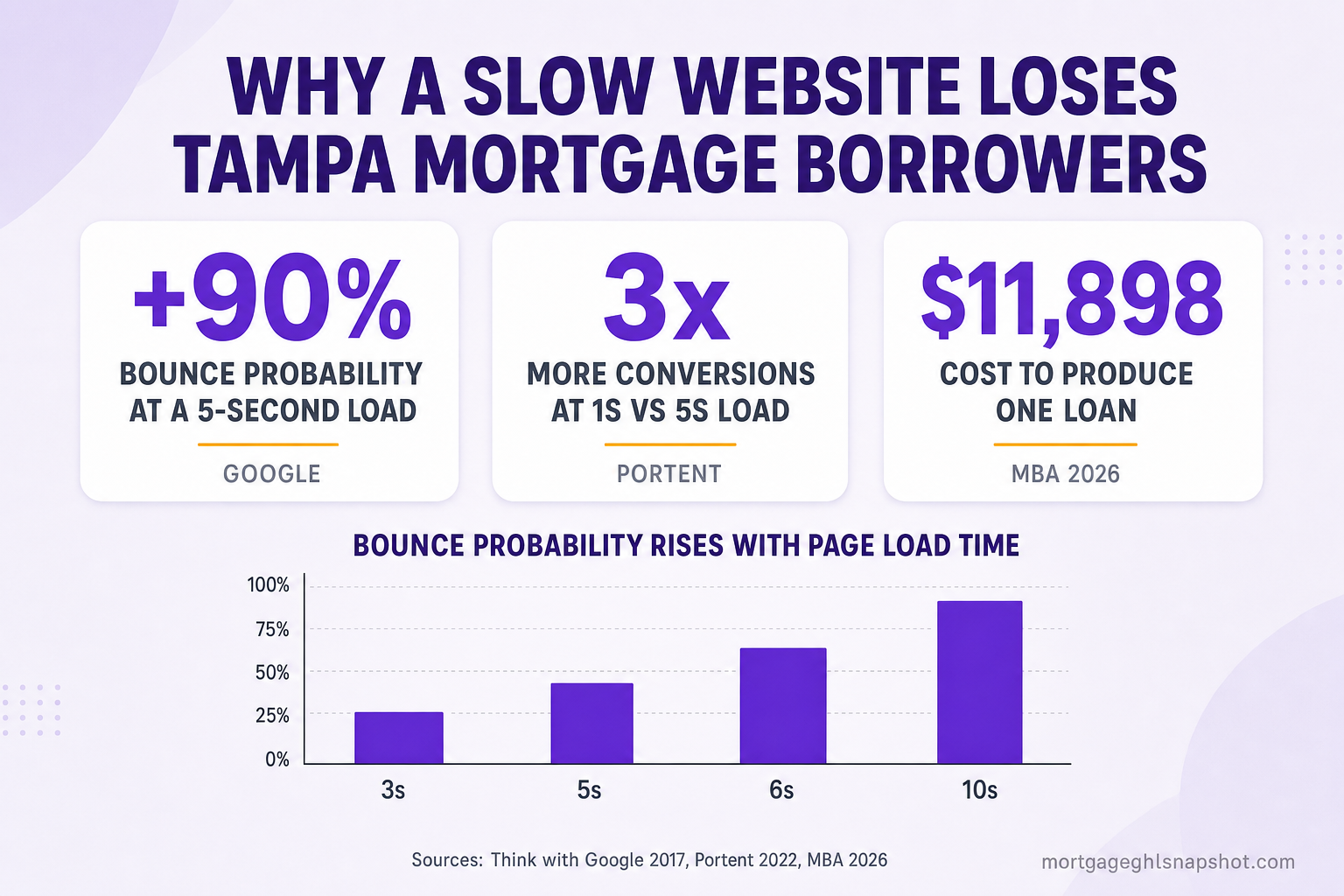
Google’s mobile-speed study, built on data from millions of pages, found that as a page’s load time climbs from 1 second to 3 seconds, the probability of a bounce rises 32%; by 5 seconds it’s up 90%; and by 10 seconds it’s up 123% (Think with Google, 2017). “Bounce” here means the visitor left without doing anything — the digital version of a borrower opening your door, seeing a waiting room that isn’t ready for them, and walking back out.
Increase in mobile bounce probability as page-load time rises, relative to a 1-second load. Source: Think with Google, 2017.
Bounces are just the visible half. The invisible half is the borrowers who stay but convert at a lower rate because the experience is sluggish. Portent’s analysis of over 100 million page views found that a website loading in 1 second converts roughly 3× better than one loading in 5 seconds, with the highest conversion rates landing in the first few seconds of load time (Portent, 2022). Deloitte and Google put a dollar sign on it: in a study spanning 37 brands and more than 30 million sessions, a mere 0.1-second improvement in mobile speed increased retail conversions by 8.4% (and travel by 10.1%) (Deloitte + Google, 2020).
Relative conversion rate by page-load time, indexed to a 5-second load = 1.0 (a 1-second page converts ~3× as well). Source: Portent, 2022.
None of this is about vanity. It’s the same principle as speed-to-lead: the borrower who gets a fast, frictionless experience is the one who stays, submits, and books — and the seconds you shave off a page load are the cheapest conversion improvement available to most originators.
What “fast” actually means (and why Astro)
“Fast” isn’t a feeling; Google measures it. Core Web Vitals — how quickly the main content paints, how fast the page responds to a tap, and how much the layout jumps around while loading — are part of Google’s page-experience signals (Google Search Central). And most sites fail them: fewer than half of mobile sites pass Google’s “good” Core Web Vitals threshold (HTTP Archive Web Almanac, 2024). A slow site isn’t just annoying borrowers; it’s telling Google you don’t deserve the position.
The reason so many originator sites are slow is architectural. WordPress, Wix, and website builders inside all-in-one CRMs load a heavy runtime, page-builder overhead, and a stack of plugins before a borrower sees anything. The modern fix is to ship almost no JavaScript and serve static-first pages from a global edge network — which is exactly what the Astro framework does. A page that’s already rendered opens in a blink, even on a phone on a Tampa parking-lot connection.
That’s why our website service builds on Astro and guarantees a 90+ Google PageSpeed score — frequently a perfect 100 — on both mobile and desktop. We benchmarked this platform against the usual options in a head-to-head speed comparison, and the gap is not subtle. Fast pages keep the borrower reading, and they tell the search engine you’re worth ranking.
Getting found in Tampa: local SEO and AI answers
Speed keeps the borrower once they arrive. Getting them to arrive at all is the other half — and it’s where “generic” hurts most. A five-page brochure site with a home, about, and contact page gives Google almost nothing to rank you for. A borrower searching a specific, local, high-intent phrase needs a page that actually answers it.
That means real, individually written pages for the places you lend and the programs you originate: a Tampa page, a St. Petersburg page, a Hillsborough and Pinellas County page, an FHA page, a first-time-buyer page. Each one carries correct titles, meta, heading structure, and schema so a search engine can crawl and place it — the same discipline we cover in our guide to local SEO for loan officers.
It also increasingly means being readable by AI. When a Tampa buyer asks ChatGPT, Perplexity, or Google’s AI Overviews “who handles VA loans in Tampa,” those systems answer from pages that are structured, fast, and machine-readable — with schema, a clean sitemap, robots.txt, and an llms.txt that lets AI crawlers index you cleanly. That’s the whole idea behind showing up in AI search, and it’s becoming a real referral channel, not a novelty. A local originator with genuine city pages is the single hardest thing for a national call center to outrank — but only if the pages exist.
The finishing touch is capture. A fast, well-ranked page still needs to turn the visitor into a lead: branded calculators that let a borrower work out their own monthly payment, an AI chat widget that answers questions and books the appointment after hours, and review collection that keeps your reputation current. The site isn’t the destination; the booked call is.
The math: what one Tampa borrower is worth
Loan officers under-invest in their website because the payoff feels fuzzy. It isn’t. Tampa’s median home sale price sat around $418,000 in late 2025 (Redfin, 2025) — a single purchase loan at that price point is a meaningful commission. And the cost of acquiring a borrower is very real: independent mortgage banks spent $11,898 to produce a single loan in Q1 2026 and netted just $727 of profit per loan (Mortgage Bankers Association, 2026).
Put those together. When it costs nearly twelve thousand dollars to originate a loan and margins are razor-thin, a website that turns away a borrower who was ready to enquire is one of the most expensive mistakes in the business — and unlike an ad budget, a fast, well-ranked site keeps producing month after month for the same fixed cost. If a rebuilt site captures even one extra Tampa borrower a month who would otherwise have bounced, the return dwarfs what it costs to run.
Your website, today vs. once it's built right
A borrower comparing three names at 10 p.m. gives up on your page before it loads, you're found only by people already given your name, your fee schedule has been wrong since last year, and every small edit means an email, a quote, and a two-week wait.
Your page is already on screen with the enquiry form in view, you appear in Tampa search results and AI answers for the counties you're licensed in, your published figures are refreshed weekly, and changes are done in a couple of days — with hosting, SSL, and the domain all inside one monthly figure.
DIY vs. done-for-you: who actually builds and runs it
Everything above is technically doable yourself. The problem is that “build a fast, schema-correct, multi-page local site, keep it updated weekly, and manage hosting” is a specialist job — and you already have one: originating loans. Most loan officers either limp along on a slow template they’re embarrassed by, or start a rebuild that stalls at 40% because the next rate lock swallowed the weekend.
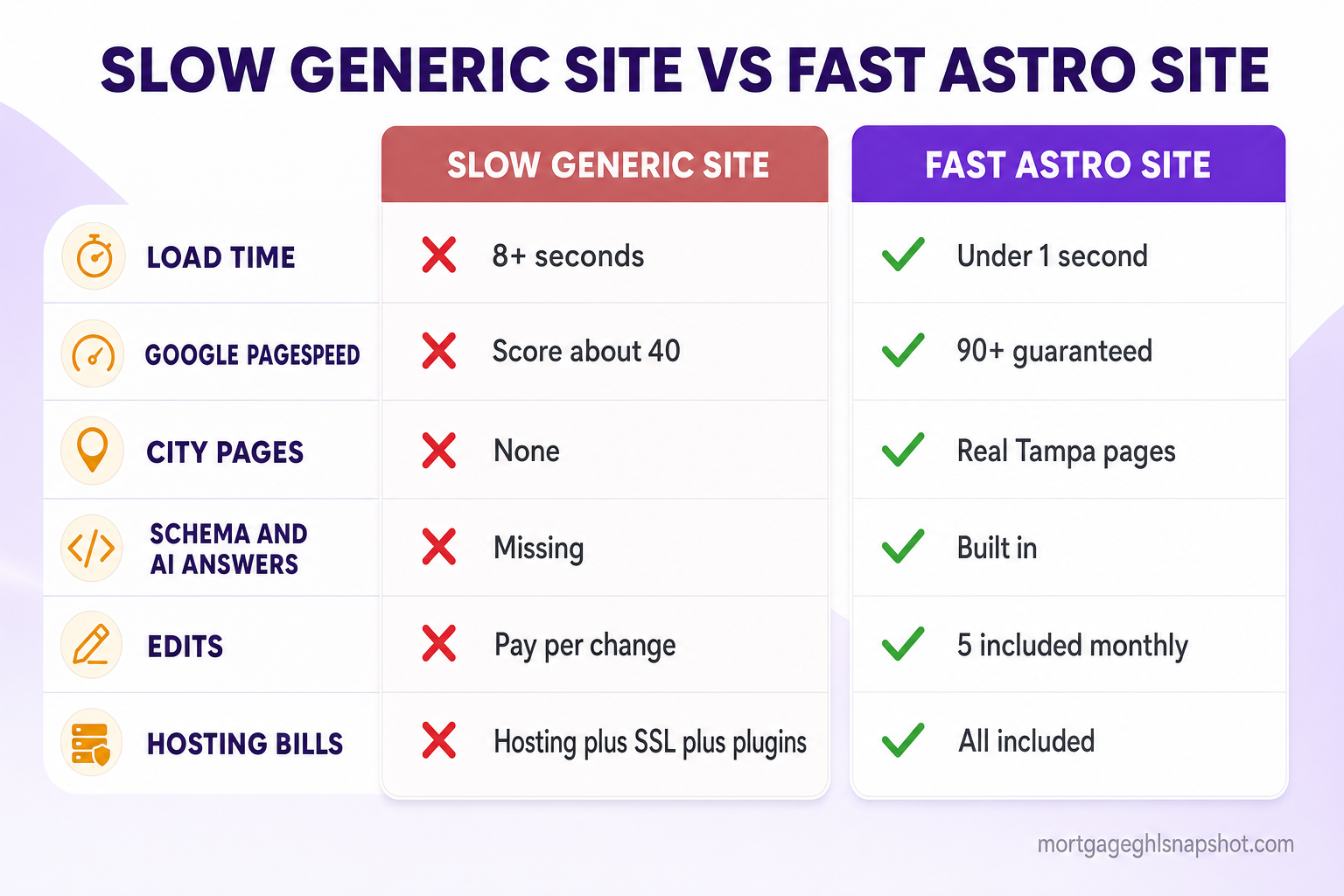
That’s the gap our done-for-you website service closes. You get a site built on Astro with a guaranteed 90+ PageSpeed score, up to 60 pages (home, programs, city and county pages, team, contact, appointment), a free domain, fully managed Cloudflare hosting with no separate hosting, SSL, or CDN bills, a built-in payment-and-affordability estimator, an AI chat widget, and review collection that runs itself. It starts at $97/month plus a one-time build fee, includes five revisions a month at no extra cost, and goes live in 7 days — and you don’t pay the build fee until the site is live and you’re happy with it. What we won’t do is post a live interest rate, for the compliance reasons below.
A compliance note on rates
A fast marketing site should never carry a live interest rate. A posted rate is stale by the afternoon and turns an ordinary web page into a compliance exposure. What a good originator site does keep current is the set of figures you control — your fee schedule, which programs you’re accepting applications for, the promotions actually running, and the turn times you publish — updated weekly, so a borrower is never reading a number your team then has to walk back on the phone. Calculators and any AI responses should be clearly labeled as estimates, never a quote, an approval, or a guarantee, and your NMLS ID and required disclosures belong where your process calls for them. Speed and structure are marketing; rate conversations stay in your compliant process with a licensed human.
Frequently asked questions
Tampa mortgage loan officer websites — FAQ
Why does website speed matter so much for a Tampa loan officer?
Because borrowers comparing loan officers open several sites at once and give their attention to whichever loads fastest. Google found the probability of a mobile bounce rises 90% as load time goes from 1 to 5 seconds, and Portent found a 1-second site converts about 3x better than a 5-second one. Most of your borrowers are on a phone, where slow sites feel slowest, so page speed is often the cheapest conversion improvement you can make.
Isn't my Zillow profile or GoHighLevel funnel enough?
They help, but they aren't a substitute for a fast website you own and rank. A directory profile puts you next to every competitor and a single funnel page gives Google almost nothing to rank locally. A real multi-page site with Tampa city and county pages, program pages, schema, and clean sitemap/robots/llms files is what lets you appear in local search and AI answers on your own terms — and what a national call center can't easily copy.
What makes an Astro website faster than WordPress, Wix, or a CRM builder?
Astro ships almost no JavaScript and serves static-first pages from a global edge network, so there's no plugin bloat or page-builder runtime to load before a borrower sees the page. That's why we guarantee a 90+ Google PageSpeed score, often a perfect 100, on both mobile and desktop. We put the platforms head-to-head in our website speed comparison post.
How much does a done-for-you mortgage website cost, and how fast is it live?
Our website service starts at $97/month plus a one-time build fee, and the first stage goes live in 7 days after the onboarding call. It includes up to 60 pages, a free domain, fully managed Cloudflare hosting, an AI chat widget, review collection, and five revisions a month at no extra cost. You don't pay the one-time build fee until the site is live and you're happy with it.
Will a new website help me rank in Tampa, and how long does that take?
Yes, if it's built for it: fast pages, real city and county pages, correct schema, and clean sitemap, robots, and llms files are what let Google and AI answer engines surface you. Ranking is not instant — with those foundations in place, expect to start showing up in your area within roughly 3 to 5 months. Anyone promising day-one rankings isn't being straight with you.
Related reading: Astro vs. WordPress vs. GoHighLevel: mortgage website speed compared · Why speed-to-lead decides who wins the borrower · Local SEO for mortgage loan officers · How to show up in AI search · Putting mortgage calculators on your site