
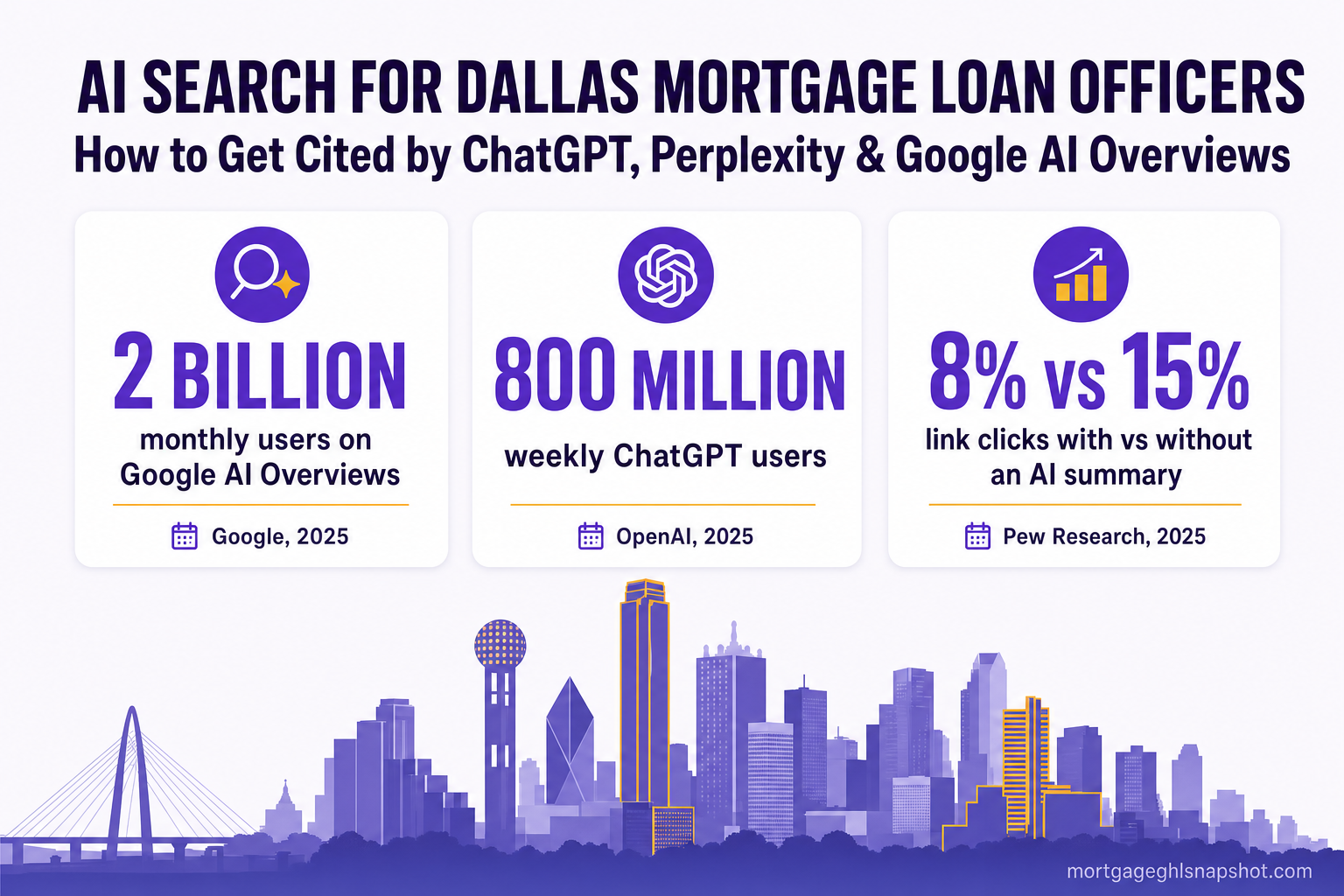
A first-time buyer in Frisco opens ChatGPT and types, “Who’s a good mortgage lender in Dallas for a first-time buyer with 5% down?” They don’t open ten blue links and compare. They read one answer, note the two or three names the AI mentions, and reach out. If your firm isn’t one of the names in that answer, you were never in the running — and you’ll never see the lead in your analytics, because there was no click to track.
For a Dallas loan officer in 2026, getting found means getting cited — showing up inside the answers that ChatGPT, Perplexity, and Google’s AI Overviews generate, not just ranking on page one. That practice is called Answer Engine Optimization (AEO) and its local cousin, Generative Engine Optimization (GEO). This is the step-by-step playbook to make your mortgage business the one the AI recommends — with real, sourced numbers on how fast this shift is happening and exactly what to change on your site.
The short answer: what AEO and GEO mean for a Dallas LO
Answer Engine Optimization (AEO) is structuring your website and content so AI answer engines — ChatGPT, Perplexity, Google’s AI Overviews and AI Mode, Bing Copilot — can extract a clean, quotable answer and attribute it to you. Generative Engine Optimization (GEO) is the same discipline aimed at generative results, with an emphasis on being the trusted local source for a specific place — for you, “mortgage lender in Dallas,” “FHA loan officer in Plano,” “first-time buyer programs in Fort Worth.”
Traditional SEO asked: does my page rank in the ten blue links? AEO asks a different question: when a borrower asks the AI a real question, does the AI name me in the answer, and does it link me as the source? Those are related but not identical. A page can rank #4 organically and still never get pulled into the AI summary — and a well-structured page can get cited even when it’s not the top classic result. This playbook is about winning the second game without losing the first.
It matters most for local, high-intent questions, which is exactly what mortgage is. Borrowers ask AI things like “what credit score do I need for an FHA loan in Texas,” “how much house can I afford on $95k in Dallas,” and “who does VA loans near me.” Each is a question your site can answer better than a national aggregator — if it’s built to be read.
Why AI search is the new referral funnel
This isn’t a someday trend. The behavior has already shifted, and the numbers are stark.
Google’s AI Overviews — the AI summary that sits above the classic results — reached 2 billion monthly users by mid-2025, up 500 million in a single quarter, and Google’s AI Mode passed 100 million monthly users in the US and India (Alphabet Q2 2025 earnings). Meanwhile ChatGPT crossed 800 million weekly active users in October 2025, doubling from 400 million in February (OpenAI via TechCrunch), and Perplexity reported roughly 780 million queries in a single month (Perplexity CEO, Bloomberg Tech, June 2025).
ChatGPT weekly active users, in millions. Source: OpenAI / Sam Altman, reported by TechCrunch, 2025.
Here’s the part that should get every loan officer’s attention: as AI answers grow, the click is disappearing. Pew Research tracked the browsing of 900 US adults across nearly 69,000 Google searches in March 2025 and found that when an AI summary appeared, users clicked a traditional search link just 8% of the time, compared with 15% on searches without one — and they clicked a source cited inside the AI summary only 1% of the time (Pew Research, 2025). Zoom out and 58.5% of US Google searches already end without any click at all (SparkToro, 2024).
Share of searches where a user clicked a traditional result link, with vs without an AI summary. Source: Pew Research Center, 2025.
Now connect it to how people actually choose a lender. NAR’s 2025 data shows 46% of buyers start their home search online and 43% find their real estate professional through a referral from someone they trust (NAR, 2025). AI search sits precisely at the intersection: it’s the online starting point and it functions like a referral — an authoritative third party telling the borrower who to call. Gartner even predicted traditional search volume would fall 25% by 2026 as users shift to AI assistants (Gartner, 2024). That specific figure is a directional forecast, not a settled fact — Google still dominates raw volume — but the direction is not in doubt.
What AI engines actually pull into an answer
AI answer engines don’t “rank” pages so much as retrieve and synthesize passages. To be the passage they quote, your content has to be easy to extract and easy to trust. In practice, AI engines favor content that is:
- Answer-first. The direct answer appears in the first sentence or two under a clear, question-shaped heading — not buried after 400 words of throat-clearing.
- Self-contained. Each section makes sense on its own, because the AI lifts passages out of context. A paragraph that only works if you read the three before it is hard to cite.
- Specific and sourced. Concrete numbers, named programs (FHA, VA, USDA, conventional), and real figures with citations read as authoritative. Vague copy reads as filler.
- Entity-clear. The AI needs to know who you are, what you do, and where — a consistent business name, service list, and location, repeated cleanly across your site and the wider web.
- Crawlable and fast. If a page is slow, JavaScript-locked, or blocked to AI crawlers, it can’t be retrieved in the first place.
None of that is exotic. It’s disciplined information architecture — which is exactly the thing a purpose-built site gets right and a bloated template gets wrong.
The 6-step playbook to get cited
Here’s the workflow we run to make a Dallas mortgage site citable by AI engines. Each step is concrete and, done together, they compound.
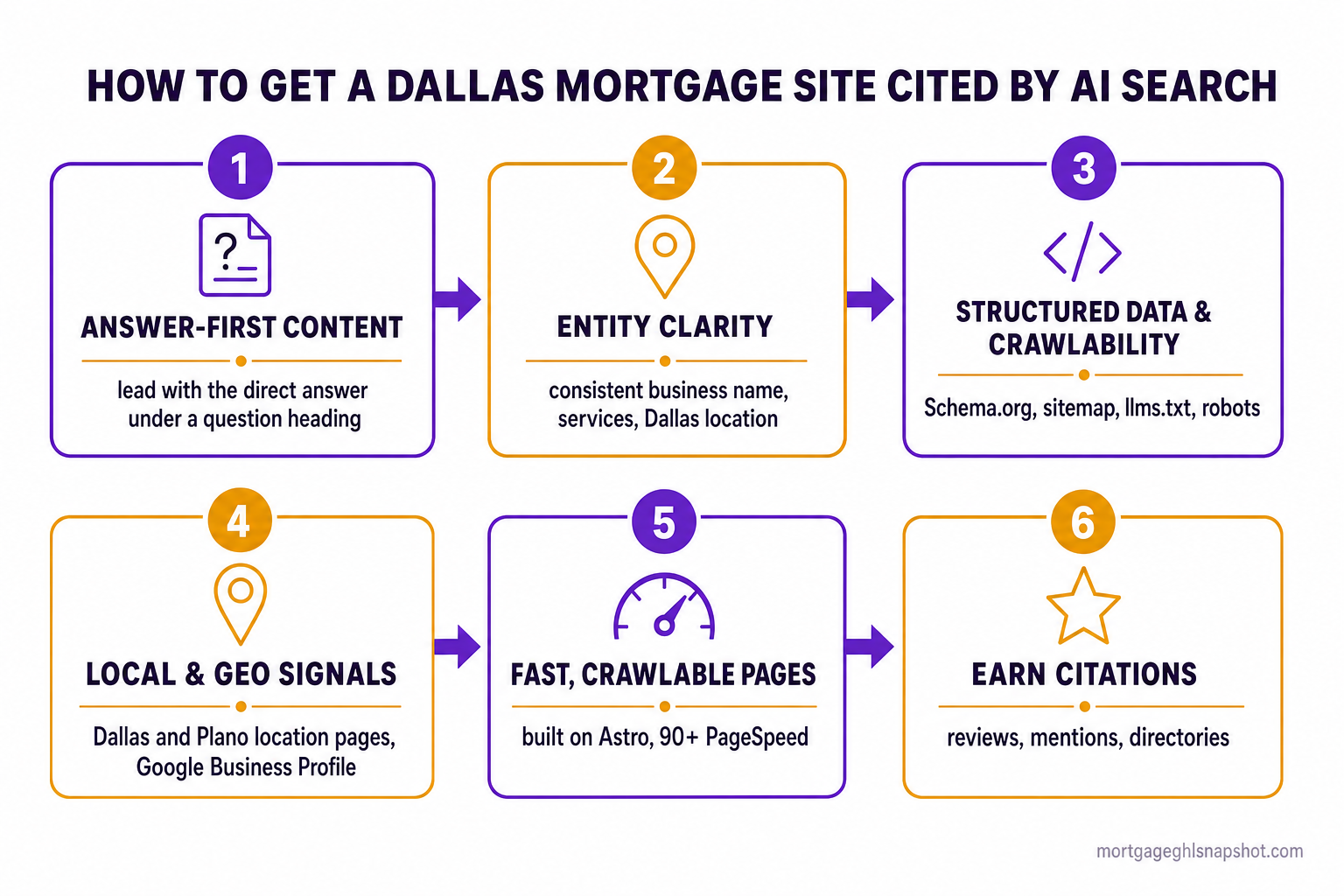
1. Write answer-first content around the questions borrowers actually ask. Build a page or section for each real question — “How much do I need for a down payment on an FHA loan in Texas?”, “What’s the difference between pre-qualification and pre-approval?”, “Can I get a mortgage in Dallas with a 620 credit score?” Put the one- or two-sentence answer at the very top, then expand. This is the single highest-leverage change, and it’s the same answer-first discipline that wins classic featured snippets too.
2. Establish entity clarity. Decide on one exact business name and use it everywhere — your site, your Google Business Profile, directories, your social profiles. Add a real “About” section that states plainly what you do, the loan types you handle, and the Dallas-area cities you serve. AI engines build a model of who you are from these repeated, consistent signals; inconsistency (three variations of your name, a mismatched address) makes you harder to cite with confidence.
3. Ship clean structured data and crawlability. Add Schema.org markup (LocalBusiness/FinancialService, Service, FAQPage), a correct XML sitemap, a sensible robots.txt, and an llms.txt file that tells AI crawlers what your site is and where the important content lives. As we’ll cover below, schema isn’t a magic citation button — but it makes your pages machine-legible and eligible for rich results, and it costs nothing to get right.
4. Win local and GEO signals. AI answers to “mortgage lender in Dallas” lean heavily on local authority. Build genuine location pages for the areas you serve — Dallas, Plano, Frisco, Irving, Arlington, Fort Worth — each with unique, useful content (not doorway pages), and keep your Google Business Profile complete and active. This is the AEO-era extension of classic local SEO for loan officers.
5. Be fast and technically crawlable. If AI (and Google) can’t render or reach your content quickly, none of the above matters. This is where the framework choice bites: a heavy WordPress or page-builder site ships megabytes of JavaScript and slow pages, while a static-first Astro site loads almost instantly and serves clean HTML that crawlers read effortlessly.
6. Earn citations and mentions across the web. AI engines cross-reference. Consistent listings, real reviews, and mentions on reputable local and industry sites raise the odds the AI trusts and repeats your name. Automated review harvesting and active Realtor partnerships both feed this — they build the off-site reputation the AI reads back to borrowers.
The schema truth: what structured data does and doesn’t do
You’ll read a lot of confident marketing that says “add schema and the AI will cite you.” Be skeptical. The most rigorous causal test to date — Ahrefs tracked 1,885 pages that added JSON-LD schema against roughly 4,000 control pages from August 2025 to March 2026 — found that adding schema produced no measurable lift in citations within Google’s AI Mode or ChatGPT, and a slightly negative move for AI Overviews (Ahrefs, 2026).
So why is structured data still step 3 of our playbook? Because it does other real jobs: it makes your pages unambiguous to machines, it’s still how you earn classic rich results (star ratings, FAQs, breadcrumbs) in Google, and both Google and Bing have said structured data helps their systems understand a page even when it doesn’t directly boost AI visibility. The honest framing is: schema is table stakes for being legible, not a lever you crank for citations. What actually moves AI citations is the harder stuff — genuinely useful, answer-first, well-structured, fast, trusted content. We build the schema in because it’s correct and free, and we spend the real effort where it pays.
The Dallas ROI: why one cited answer is worth it
Dallas is a large, competitive purchase market — Zillow puts the typical Dallas home value around $312,000 as of mid-2026, down roughly 2% year over year (Zillow, 2026). That’s a steady flow of buyers actively researching lenders, and a lot of them are starting inside an AI answer. Every borrower the AI hands to a competitor is one you never got the chance to compete for.
Line that up against what it costs to originate. Independent mortgage banks spent $11,109 in total production expense to produce a single loan in Q3 2025 (Mortgage Bankers Association, 2025). When each loan costs that much to produce and margins are thin, being absent from the answer where the borrower is deciding is one of the most expensive gaps you can have — and it’s fixable with a build, not an ad budget.
And AI-referred visitors tend to arrive with higher intent. Adobe found that US retail traffic from generative-AI sources grew more than 4,700% year over year by mid-2025, and that those visitors browse longer and bounce far less than other traffic (Adobe Analytics, 2025). Semrush’s clickstream analysis similarly clocked ChatGPT referral traffic to websites up 206% year over year (Semrush, 2026). A borrower who arrives because the AI vouched for you is closer to ready than a cold click — which is exactly the kind of lead a mortgage pipeline wants.
DIY vs done-for-you
You can absolutely do this yourself. The question is whether the pieces will actually come together — because AEO fails quietly when one link in the chain is missing (a slow page, an inconsistent business name, a template you can’t add schema to). Here’s the honest comparison.
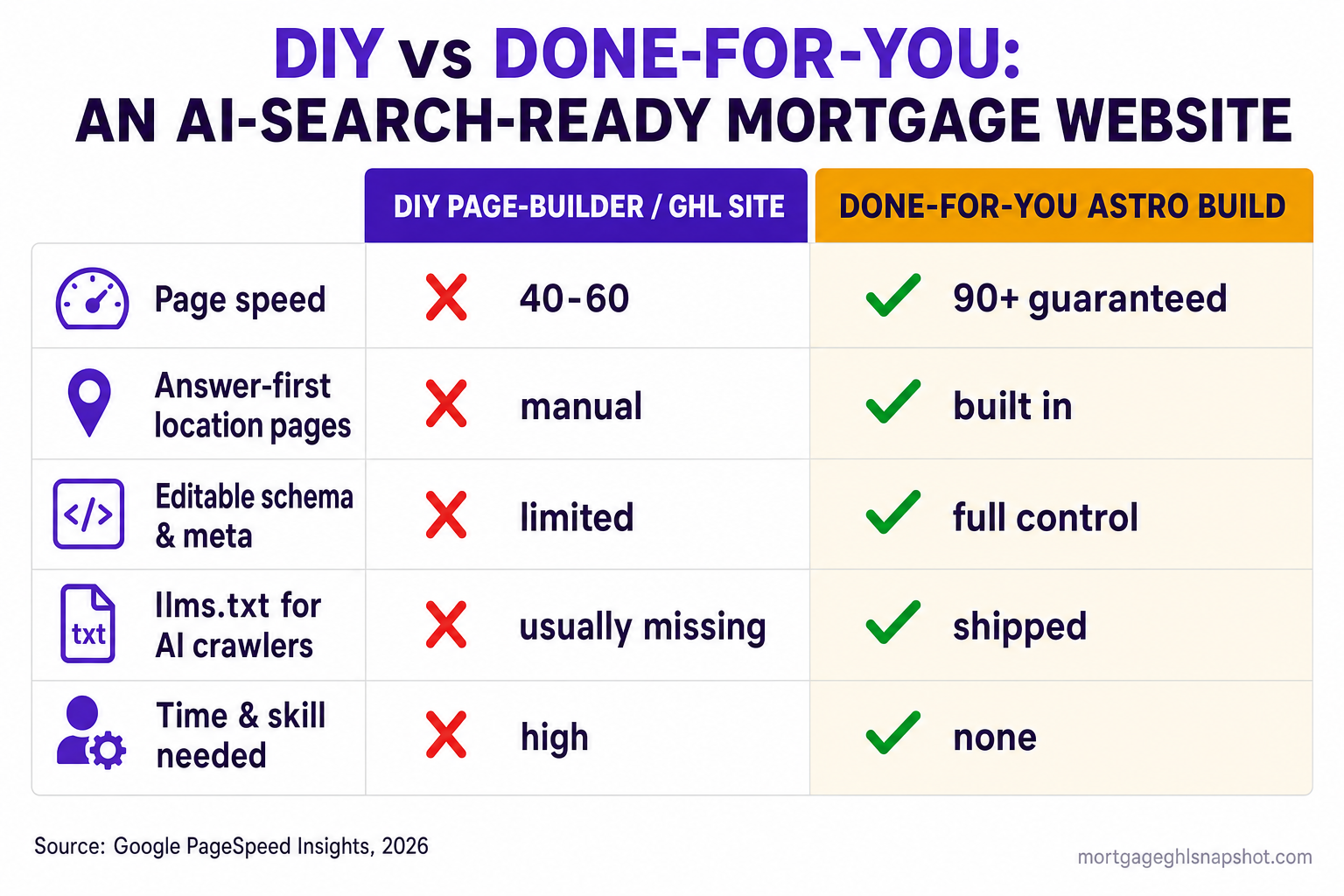
| What AEO needs | DIY on a page-builder / GHL-only site | Done-for-you Astro build |
|---|---|---|
| Fast, crawlable pages | Often 40–60 PageSpeed, JS-heavy | 90+ guaranteed, static-first |
| Answer-first location pages | Manual, easy to get wrong | Built for Dallas & suburbs |
| Editable schema & meta | Limited by the template | Full control, done for you |
| Sitemap, robots & llms.txt | Usually missing llms.txt | All shipped correctly |
| Time & skill required | High — it’s a second job | None — you originate, we build |
| Cost | “Free” but leaks leads & hours | $497 + $97/mo, managed |
Our Get-a-Website service builds the whole stack on Astro — answer-first pages, location pages, schema, sitemap, robots, and llms.txt, with a guaranteed 90+ PageSpeed score — for $497 one-time plus $97/month (you pay only the monthly up front; the build fee is charged after the site is live and you’re happy). Add automatic blog posting for $197/month total if you want the content engine running for you. If you want the AI answering borrowers on the site too, pair it with an AI chat widget from our GHL development team.
Frequently asked questions
AI search for Dallas mortgage loan officers — quick answers
What is AEO, and how is it different from SEO?
SEO optimizes your pages to rank in Google's classic blue links. AEO (Answer Engine Optimization) optimizes them so AI answer engines — ChatGPT, Perplexity, Google AI Overviews and AI Mode — extract a clean answer and cite you as the source. They overlap, but a page can rank well and still never be pulled into an AI answer. GEO (Generative Engine Optimization) is the same idea with a local focus, like 'mortgage lender in Dallas.' Our Get-a-Website service builds for both.
How do I actually get ChatGPT or Google's AI to mention my mortgage business?
Publish answer-first content around the real questions borrowers ask, keep your business name and location consistent everywhere (entity clarity), build genuine Dallas-area location pages, add correct Schema.org markup, a sitemap and an llms.txt file, keep the site fast and crawlable, and earn reviews and mentions across the web. No single trick does it — it's the combination, which is why a purpose-built site outperforms a bolted-together one.
Does adding schema markup guarantee AI citations?
No. The best causal study to date (Ahrefs, 2026) found adding schema had no measurable lift on AI citations by itself. Schema is still worth doing — it makes your pages machine-readable and earns classic rich results — but the real drivers of AI citations are useful, answer-first, well-structured, fast, and trusted content. Anyone promising citations from schema alone is overselling it.
Is AI search really big enough to matter for a Dallas loan officer?
Can I do this on my existing WordPress or GoHighLevel site?
Partly. You can add answer-first content and fix your Google Business Profile anywhere. The friction is technical: many page-builder and GHL-only sites are slow and hard to add custom schema or an llms.txt to, which caps how citable they can be. A static-first Astro build makes the fast, crawlable, fully-editable foundation the rest depends on — see our speed comparison.
How do I get an AI-search-ready mortgage website built?
Our Get-a-Website service builds a blazing-fast Astro site engineered for AEO and GEO — answer-first location pages, schema, sitemap, robots, llms.txt, and a guaranteed 90+ PageSpeed — for $497 one-time plus $97/month. Book a strategy call and we'll map your Dallas keyword and location plan with you.
About the author
Meera Sundaram is a Mortgage Marketing Strategist based in Austin, TX. She helps mortgage teams and the agencies that serve them turn content, calculators, and search visibility into a steady flow of pre-qualified borrowers, with a focus on the handful of touchpoints between a borrower’s question and a signed application. Meera is a fictional editorial persona for Mortgage Snapshot; nothing here is individualized legal, financial, or investment advice. We are not a lender and do not quote rates or pre-approve borrowers. Calculator and estimate outputs are educational only, and all figures cited are drawn from the sources linked.
Related reading
- Local SEO for mortgage loan officers: the 2026 Google Business Profile playbook — the local foundation AEO builds on.
- Astro vs WordPress vs GoHighLevel websites: page speed & conversion compared — why the framework decides how crawlable you are.
- Mortgage calculators on your site — the interactive tools AI engines love to cite.
- AI chat widget for mortgage websites — answer borrowers on the page, not just in search.
- Mortgage speed-to-lead: why the first 5 minutes decide the deal — what to do the moment an AI-referred borrower reaches out.