
It is 4:15pm on a Tuesday and your phone buzzes for the fifth time. Same borrower, same question: “Any update on my loan?” The appraisal came back two days ago, you meant to tell them, then three other files blew up and it slipped. Nothing is wrong with the loan. The only thing wrong is that the borrower has no idea where it stands, so they fill the silence by calling you, calling their agent, and quietly wondering if they picked the right lender.
Here is the fix, stated up front. An automated loan status update system sends the borrower and their real estate agent a plain-language message at every milestone, application taken, appraisal back, conditional approval, clear to close, on its own, the moment the file moves. You stop being the human relay between your loan origination system and two anxious people. The calls drop, the agent trusts you with the next deal, and you get your afternoons back. This guide walks the whole system: the stages, the messages you can steal, how it breaks, and the compliance rules.
What the status-call problem actually costs you
Status calls do not show up on a P&L, so most originators treat them as a cost of doing business. They are not. They are a tax on your time and a slow leak in your reputation. Every “where are we?” call pulls you off the file you were working, and an interrupted originator is a slower one. The borrower is not being difficult. They borrowed more money than they ever have and they are listening to silence, so when they cannot reach you, they call their agent, who now has to chase you too. The money side is just as real, because margins here are thin enough that a single lost file hurts for a long time.
Sources: MBA Quarterly Mortgage Bankers Performance Report, Q3 2025; CFPB, National Survey of Mortgage Borrowers, 2015; NAR 2025 Profile of Home Buyers and Sellers.
Independent mortgage banks kept $1,201 of profit on each loan they produced in the third quarter of 2025, on $12,310 of revenue against $11,109 of cost (MBA). That cost sits well above the long-run average of $7,799 per loan since 2008.
Independent mortgage bank per-loan production economics, Q3 2025. Source: MBA Quarterly Mortgage Bankers Performance Report, Q3 2025.
When the margin on a clean closing is that slim, a borrower who walks because they felt ignored, or an agent who stops referring because you went dark on their client, is real production you have to replace.
And replacing it is harder than keeping it, because borrowers barely shop once they have picked you. The CFPB found that almost half seriously consider only one lender and 77% apply to just one (CFPB, 2015). The borrower in your pipeline is unlikely to become someone else’s unless you give them a reason, and a week of silence in the middle of their biggest financial decision is a reason.
How the system works: triggers, not memory
Your updates are inconsistent because they depend on you remembering to send them, and memory is the first thing to fail when you are busy. An automated status system removes memory from the job. Every update fires off something that already happens in your pipeline: a loan moves to a new stage, a date passes, a document gets uploaded. That event is the trigger, the message is the action. You are not adding a task, you are wiring a message to an event that already occurs.
Three pieces make it work. First, a pipeline with named stages that match a real loan timeline, so “appraisal ordered” is an actual status your system can see, not a note in your head. Second, a message layer, usually text and email, that fires when a contact enters a stage. Third, one contact record that holds the borrower, the agent, and every message, so nothing is scattered across your phone, your inbox, and your point-of-sale.
Most originators already pay for tools that could do this and never wire them together, which is exactly how a fragmented stack leaks deals in the seams. If that sounds like your setup, why your mortgage tech stack is quietly costing you deals walks every gap, and the breakdown of what mortgage CRM software actually costs in 2026 shows where a stack of separate tools gets expensive. An all-in-one platform like GoHighLevel does these jobs under one record. Here we go deep on the status update, because it is the gap borrowers feel most.
The six milestones that need an update
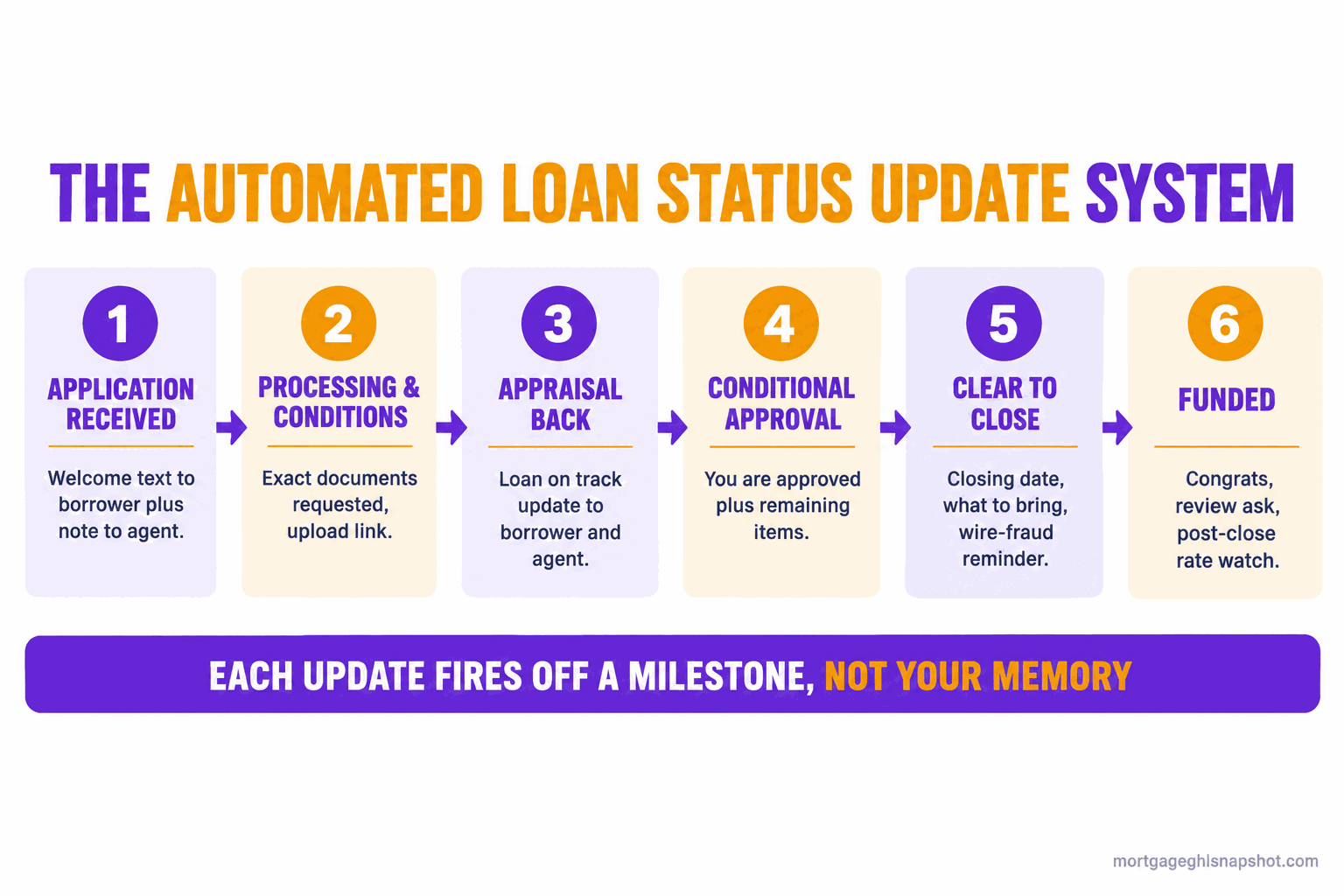
A loan does not move continuously, it moves in jumps. Each jump is a moment the borrower is wondering what just happened, and each is a trigger for a message. Here are the six that matter, what fires at each, and how each breaks by hand.
Milestone 1: Application received
The file is opened and the borrower has just handed you their life in documents. Set the tone: confirm you have it, tell them what happens next, and give a realistic timeline so they are not guessing. The agent gets a short note that their client is officially in process.
What fires: a welcome text and email the moment the contact enters the “application received” stage, plus an agent notification.
How it breaks by hand: you are heads-down taking three applications and send the welcome to one of them. The other two start in silence, which trains them to call you for everything from day one.
Milestone 2: Processing and conditions
The file is in processing and you need documents: a bank statement, a letter of explanation, a payoff. This is where loans stall, because the request is buried in your head and the borrower does not know anything is waiting on them. A clear, specific ask with a simple way to upload moves the file. A vague “we need a few things” does not.
What fires: a conditions request listing exactly what is needed and where to send it, plus a reminder if it is not back in 48 hours.
How it breaks by hand: the condition sits in your processor’s queue for two days before anyone tells the borrower, and the loan loses a week it did not have. For the full anatomy of this stall, see why pre-approvals go quiet and never close.
Milestone 3: Appraisal ordered and received
The appraisal is the most anxiety-producing step for a buyer, because it decides whether the deal holds together. Two updates earn their keep: one when it is ordered, so the borrower knows the clock started, and one when it comes back, so they are not left imagining the worst. The agent cares about this as much as the borrower does.
What fires: an “appraisal ordered” note on the order date, and an “appraisal received, loan on track” note when it lands, both to borrower and agent.
How it breaks by hand: the appraisal comes back clean, you get slammed, and nobody says anything for three days. The borrower spends them convinced something is wrong, and the agent calls to find out.
Milestone 4: Conditional approval
Underwriting issues a conditional approval, and this is genuinely good news, so say it like it is. The borrower has been bracing for a problem, and a plain “you are approved, here is what is left” message is the highest-relief moment in the file. Re-list the remaining conditions so momentum does not die at the one-yard line.
What fires: a conditional-approval message to the borrower and agent, with the remaining conditions spelled out and a date you expect to clear them.
How it breaks by hand: the approval gets lost in a day of calls and the borrower hears about it two days later, or worse, hears about it from their agent first, which makes you look like you are not driving your own file.
Milestone 5: Clear to close and closing scheduled
Clear to close is the finish line, and both the borrower and the agent have been waiting for this exact word. This update carries logistics: the closing date, what to bring, how the wire works, and a reminder never to change wire instructions over email. The agent needs the date and time to coordinate their side.
What fires: a clear-to-close message with closing details to the borrower, a date-and-time note to the agent, and a wire-fraud safety reminder.
How it breaks by hand: the CTC comes through late in the day, you plan to send details in the morning, and the borrower spends an anxious evening not knowing if they are closing on time. The agent, meanwhile, is texting you at 9pm.
Milestone 6: Funded and the post-close handoff
The loan funds and most originators consider the job done, the most expensive assumption in this business. The closing-day message congratulates the borrower and quietly does two more things: asks for a review while goodwill is at its peak, and hands the borrower into a post-close track that watches for a future refinance. The agent gets a thank-you that keeps the referral door open.
What fires: a funded-and-congratulations message with a review link, an agent thank-you, and automatic enrollment into a post-close nurture sequence.
How it breaks by hand: the loan closes, the borrower falls into a spreadsheet nobody opens, and two years later the lender who stayed in touch gets the refinance. The playbook for not leaking that is in mortgage database reactivation.
Steal this: the milestone messages
You do not need clever copy, just honest, specific messages that fire on the right trigger so no borrower or agent waits on you to remember. Adapt these to your voice, include your NMLS ID where advertising rules require it, and give a clear opt-out. These are templates, not legal or rate advice, and they never quote a number.
Wire each message to a trigger that already exists, a stage change or a date, and the updates send themselves. For the related job of answering a call you could not pick up, the missed-call text-back playbook pairs well with this system.
Solo LO, small team, high-volume shop
The six milestones are the same at every size. What changes is which gap hurts most and how you close it.
The solo loan officer. Every update competes with origination for the same scarce hours, and updates lose. Start with Milestones 1 and 6, the bookends: the welcome, so every borrower expects you to keep them informed, and the post-close review-and-referral ask, so goodwill turns into reviews and repeat business instead of evaporating. Automate the appraisal and clear-to-close notes next, the two moments a borrower is most likely to call. Keep a personal touch on top, but let the system guarantee the floor.
The small team, three to fifteen LOs. Your problem is consistency and coverage. One LO is great at updates and two are not, so borrowers get wildly different experiences and agents notice. A borrower whose LO is out sick or left the company goes dark, because the knowledge of where the file stands lived in that one person. Standardize all six milestones as one shared workflow on one record. Now the experience does not depend on which LO a borrower drew, and a file keeps talking even when its originator is on vacation.
The high-volume shop. At scale, nothing can depend on anyone remembering anything, so updates fire off real loan data: stage, loan type, closing date, agent. Segmentation becomes automatic, so a first-time FHA buyer and a jumbo refinance borrower get messages written for their situation without anyone sorting a list. An automated clear-to-close note to every agent on every file is the cheapest relationship-builder you will run, and the consent record has to be centralized, because at high volume a scattered opt-out is a guaranteed violation.
The compliance rules for automated updates
Automating messages to borrowers and agents puts a handful of rules in play. None should stop you, but all should shape how you build. This is not legal advice, just the short list to take to whoever gives you the real thing.
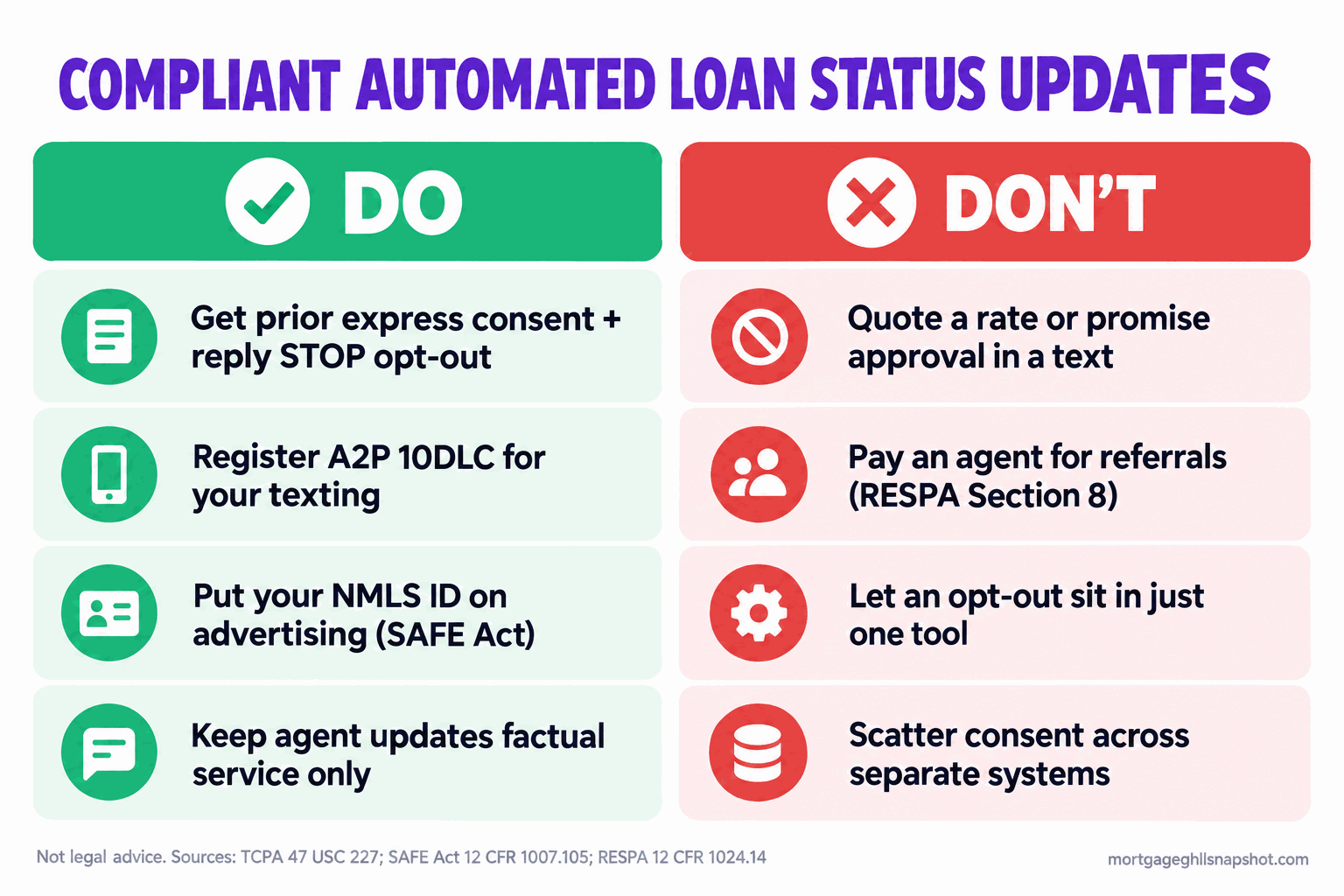
The rules reward the same architecture the status system already needs: one record, clear consent, factual messages. Build it right for communication and you have built it right for compliance. The deeper breakdown is in mortgage text message compliance in 2026.
The objections I hear every week
“Won’t borrowers find automated texts annoying?” Only when the texts are empty. A borrower does not want a “just checking in” message, they want to know their appraisal came back clean and their loan is on track. Those updates read as service, not spam, and opt-out rates stay near zero when every message actually tells them something. What annoys people is silence, then a form letter.
“I already send updates. Why automate it?” Because you send them when you remember, and you remember when you are not busy, which is never during a rush. Automation does not replace your judgment, it guarantees the floor. The personal call you make on a tricky file still happens. What changes is that the routine “appraisal is in” note goes out every time, on every file, even the week five loans close at once.
“Do I need to build a borrower portal for this?” No. A portal is a place borrowers have to log into, and most do not. The point is that the update comes to them, by text and email, where they already are. A portal can be a nice supplement, but the messages are what move the needle.
Frequently asked questions
What is an automated loan status update system?
It sends borrowers and their real estate agents a plain-language message at each loan milestone, such as application received, appraisal back, conditional approval, and clear to close. Each message fires off a stage change or date in your pipeline, so you do not have to remember to send it. The goal is to remove the silence that makes borrowers call you for updates.
Will automated status texts get me in trouble under the TCPA?
Not if you build them correctly. You need prior express consent, a reply-STOP opt-out honored across every channel, and registered A2P 10DLC messaging. Keep your NMLS ID on marketing messages per the SAFE Act, and never quote a rate or promise an approval in an automated text. This is general information, not legal advice, so confirm your setup with your compliance team.
Should I update the real estate agent too, or just the borrower?
Both. The agent is often half the reason the borrower is calling, because the agent is calling you. An automated note at appraisal and clear-to-close keeps them from chasing you and makes you the loan officer they keep referring to. Sharing status is normal service, just never attach a payment to it, which would raise a RESPA Section 8 problem.
Do I need to replace my current CRM or LOS to do this?
Usually not. Most originators already own tools that can send a message on a stage change, they just never wired them together. What matters is named pipeline stages that match a real loan timeline, a text and email layer that fires on those stages, and one contact record for the borrower, the agent, and every message. If your tools cannot do that, an all-in-one platform can.
Which milestone update should I automate first?
The appraisal-received and clear-to-close notes, the two moments a borrower is most likely to call you. Right behind them is the closing-day message with a review request, since it captures goodwill at its peak and drops the borrower into a post-close track that can recover a future refinance.
Won't this make my communication feel impersonal?
The opposite, when built well. Automating the routine 'here is where your file stands' updates frees your attention for the calls that need you, like a tricky condition or a nervous first-time buyer. Borrowers do not experience a milestone text as cold. They experience it as a lender who keeps them informed without being asked.
It is 4:15pm on a Tuesday a few months from now and your phone is quiet. The borrower whose appraisal just came back already got a text that said so, in plain language, two minutes after it landed, and so did their agent. Nobody is calling to ask where things stand, because nobody has to. You did not send one of those messages in the moment. You built the system once, wired each update to a milestone that was going to happen anyway, and handed the job to the one thing that never gets busy. The loan still closes. You just get to spend the afternoon working the next one.