
It’s the third demo this week. The rep is friendly, the slides are clean, and forty minutes in you still don’t have a price. You ask again. He says the team will “put together a custom proposal,” then asks how many loan officers you have. You say five. You can almost hear the number going up.
If you’ve shopped mortgage CRM software in the last year, you know this dance. Half the vendors refuse to publish a price, and the ones that do bury the real cost under setup fees, per-user math, annual contracts, and in one case a second software license you didn’t know you were buying. So here’s the plain answer, before the demo: a solo loan officer should expect $95 to $250 a month for a real mortgage CRM, and a small brokerage with a handful of LOs lands between $95 and $200 per user per month once you count the parts they leave off the slide. A few will cost far more once the “custom proposal” arrives.
This is the teardown: real published prices where they exist, honestly-sourced estimates where the vendor hides the number, the fees that surface in month two, and three cost scenarios for your specific shop.
Why so much mortgage CRM pricing is hidden
Start with why this is even hard. In most software categories you find the price in ten seconds. In mortgage CRM, roughly half the serious vendors treat the number like a state secret, and the reason isn’t in your favor. Demo-gating lets a sales team price you by how big your shop looks and how badly you seem to need the tool. A solo LO and a 40-person brokerage can walk out of the same demo with wildly different quotes for the same product. Public pricing ends that game.
The stakes are real because your income swings with rates, and a CRM is one of the few fixed costs you carry through a slow quarter. It’s also the tool that decides whether your past database ever turns back into loans. The math matters: 88% of buyers still purchase their home through an agent or broker, and 66% of sellers found their agent by referral or by working with someone they’d used before, per the National Association of Realtors’ 2025 Profile of Home Buyers and Sellers (NAR, 2025). Your business runs on repeat contact, and the CRM is where those relationships get worked or go quiet. Overpaying for one nobody in your shop uses is the worst of both worlds, and most of the 158,152 individuals who requested a mortgage loan originator license or renewal as of January 1, 2025 (National Mortgage News, 2025, citing CSBS) are at small shops making this call with no procurement department to lean on.
The vendors that actually publish a price
Credit where it’s due. A few vendors respect your time enough to show a number. Here’s what they charge and where each one bites.
BNTouch: the honest anchor
BNTouch is the closest thing this category has to a published starting price. The Individual plan runs about $165 a month for a solo LO, listed on their own site (BNTouch, 2026). There’s also a one-time ~$125 activation fee, and the Team plan runs about $95 per user per month with a two-user minimum, so a two-person shop starts near $190 (Capterra, 2026).
Where it bites: the activation fee is a real up-front cost the headline price hides, and per-user Team pricing means your bill grows every time you hire. It’s purpose-built for mortgage, so the fit is good, but it’s not the cheapest way to run a growing team past a few seats.
Jungo: the Salesforce tax nobody mentions
Read this one twice. Jungo (the real mortgage CRM lives at ijungo.com, not the unrelated telematics company at jungo.com) publishes about $249 one-time setup and $119 per user per month, or roughly $96 per user annually.
Here’s the catch. Jungo is built on top of Salesforce, so that $119 is only Jungo’s slice. You also pay Salesforce directly for a license Jungo doesn’t include, and the editions with the API access a bolt-on like Jungo needs list around $165 to $195 per user per month (Salesforce via G2, 2026). Stack them and your true per-seat cost isn’t $119. It’s closer to $280 to $315 per user per month before setup, a very different number from the one on the pricing page, and the most common way small shops get surprised by Jungo.
Shape Software: published, but watch the add-ons
Shape actually publishes per-user pricing, rare enough to note. It starts around $119 per user per month annually, or about $149 monthly (Shape Software, 2026), with higher tiers folding in AI tools and a block of seats.
Where it bites: calling and texting are a separate pay-as-you-go add-on, so the per-seat number is the floor, not the total. If your team lives on the phone, budget usage on top.
Velocify by ICE: a rare ICE number, with an asterisk
Velocify, now “Velocify by ICE Mortgage Technology,” is unusual for an ICE product: a pricing-editions page has historically listed LeadManager starting near $60 per user per month, advanced near $95 on annual terms (Velocify). The asterisk: ICE increasingly routes Velocify through a demo motion and the standalone Dial-IQ price isn’t clearly published. Treat $60 as a reference to confirm on a call, not a guarantee.
The demo-gated vendors and what people really pay
Now the vendors that make you work for it. For every one, the honest answer is the same: no public price, and any per-user number on a comparison blog is a third-party estimate the vendor doesn’t stand behind. I’ll give you the labeled estimates because it beats nothing, but none of it is a quote.
Total Expert
Fully demo-gated, enterprise-oriented, no price on the site. You’ll see a “$69/mo” figure on directory pages like Capterra (Capterra). Don’t trust it. It’s a stale, flat-rate placeholder that never came from Total Expert. Competitor blogs float $200 to $600 per user, all unverified. The honest statement: you’ll get a quote, and it’ll be priced for a lender, not a solo LO.
ICE Surefire
Same story, bigger brand. Surefire (formerly Top of Mind, now under ICE Mortgage Technology) is quote-only and usually bundled into an Encompass relationship. Third-party listings estimate $99 to $150 per user, with others higher, but none is vendor-published (G2). If you’re not already an Encompass shop, the negotiation starts from a place built for enterprises.
Usherpa, Whiteboard, and Aidium
The rest of the gated pack. Usherpa (formerly MyCRMDashboard) is quote-only. Whiteboard was acquired by Aidium, so its old solo price is legacy, and Aidium itself is demo-gated post-rebrand. Third-party comparisons throw around $79/mo and $139/mo plus setup, but nothing current and vendor-backed exists to cite. Assume you’ll be quoted, and assume the quote reflects how big your shop looks.
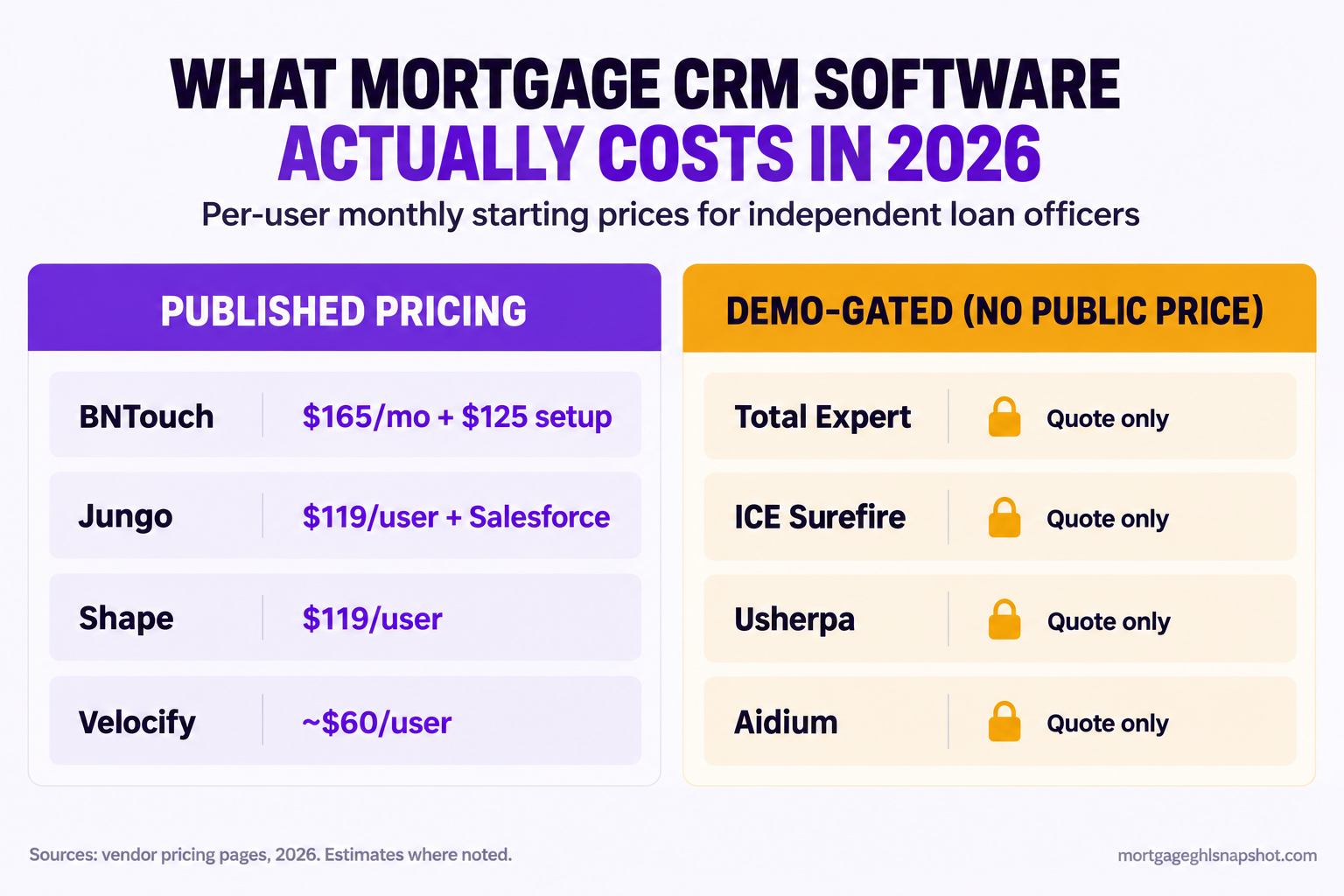
Published per-user monthly starting prices, USD. “Jungo + Salesforce” adds Jungo’s $119 to a separate Salesforce license ($165–$195/user). Demo-gated vendors publish no price and are excluded. Sources: BNTouch, Jungo, Shape, Velocify, Salesforce (G2), 2026.
Here’s the whole field on one screen.
| Vendor | Published price? | Solo starting cost | Per-user (team) | The catch |
|---|---|---|---|---|
| BNTouch | Yes | ~$165/mo + ~$125 activation | ~$95/user (2-user min) | Activation fee, per-user growth |
| Jungo (ijungo) | Partly | ~$119/user + $249 setup | ~$119/user | Separate Salesforce license on top |
| Shape | Yes | ~$119–$149/user | ~$119/user | Calls/texts billed separately |
| Velocify (ICE) | Partly | ~$60/user (verify) | ~$60–$95/user | Increasingly demo-routed |
| Total Expert | No | Quote only | Quote only | “$69/mo” directory figure is stale |
| ICE Surefire | No | Quote only | Est. $99–$150/user (unverified) | Priced for Encompass shops |
| Usherpa / Whiteboard / Aidium | No | Quote only | Quote only | Legacy figures only, nothing current |
The five fees that don’t show up until month two
The sticker price is the start of the conversation. These are the line items that turn a “$119 a month” tool into a real bill, and where small shops get burned.
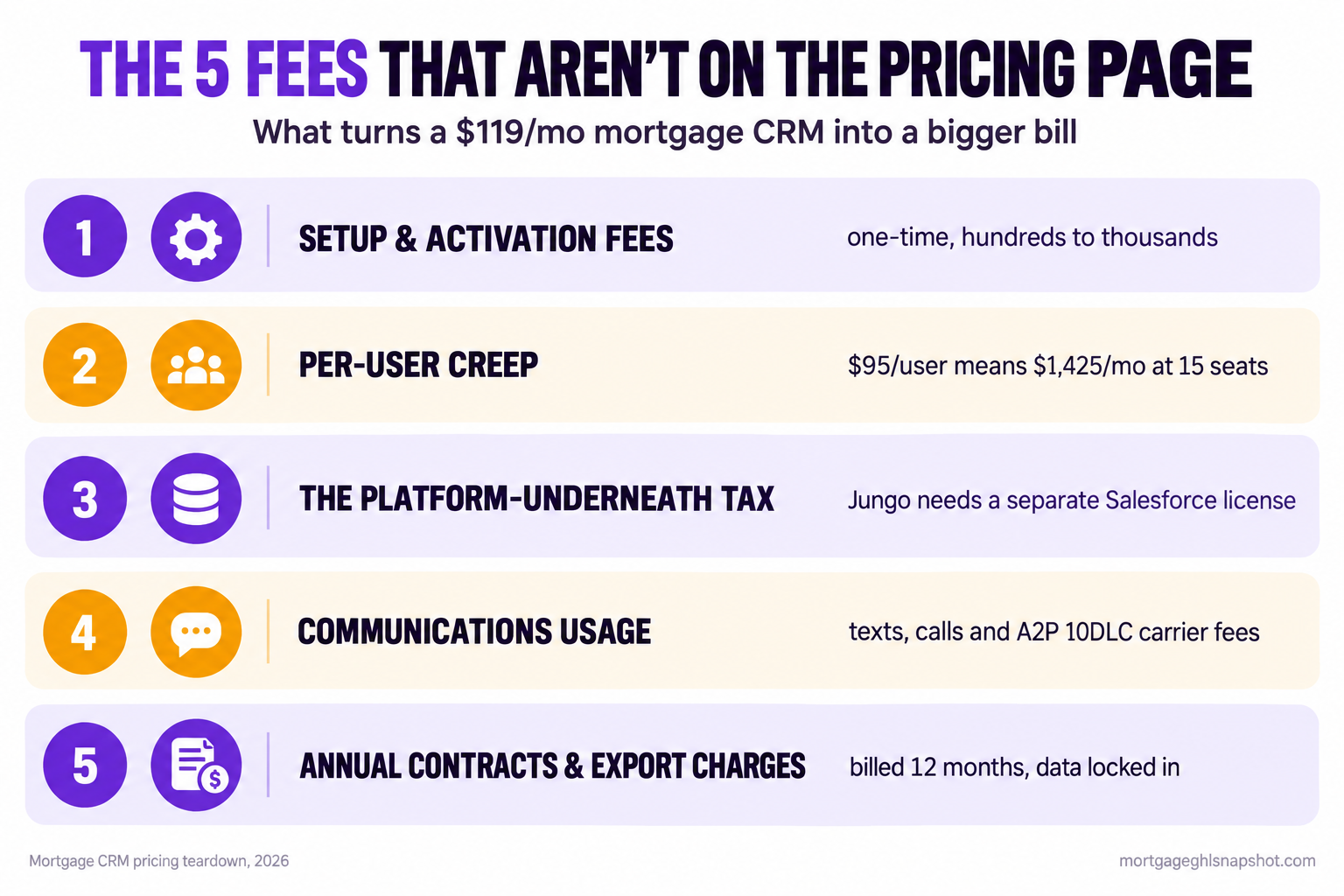
1. Setup and activation fees. BNTouch’s ~$125 activation and Jungo’s $249 setup are one-time but real on day one, and gated vendors often quote implementation fees in the thousands. Get the setup number in writing before you fall for the demo.
2. Per-user creep. The big one. A per-seat price is fine solo and punishing when you’re growing: at $95 a user, adding three LOs adds $285 a month, forever. Flat-rate pricing (pay once, add users freely) changes the whole calculation, which is why per-seat vendors don’t lead with the multiplication.
3. The platform-underneath tax. Jungo is the clearest case: two products, one price on the page. Any CRM built as a layer on a bigger platform carries this risk. Always ask, “Is there any other software I have to license separately to run this?”
4. Communications usage. Texts and calls are rarely free. Shape bills comms as a separate add-on, and everyone now pays A2P 10DLC carrier fees to send business texts at all. A heavy-outreach shop pays more than the seat price implies.
5. Annual contracts and export charges. Many tools bill annually, so “monthly price” means “times twelve, committed,” and getting your data back out isn’t always free. Ask about contract length and export fees before you sign, not after.
Three cost scenarios: solo, small team, brokerage
The right answer changes with the size of your shop. Here’s the same decision run three ways.
The solo loan officer
Per-user pricing barely stings when you’re the only user, so this is the one case where seat-priced tools are competitive. BNTouch at ~$165/mo plus ~$125 activation is a clean, mortgage-specific pick, and Shape at ~$119/user is in range. Jungo looks cheap at $119 until you add the Salesforce seat, which makes it the priciest option here for a solo. Realistic solo budget: $120 to $200 a month, plus setup and texting. Don’t waste a demo with an enterprise vendor to learn you’re too small for their price.
The small team (5 LOs)
Per-user math starts to hurt. At $95 a user, BNTouch Team is about $475/mo; Shape at $119 is about $595; Jungo plus Salesforce at a combined ~$300 a seat is roughly $1,500/mo, where the Salesforce tax becomes a real budget line. This is the size where flat-rate platforms and done-for-you systems get genuinely cheaper, because your cost stops multiplying by headcount.
The brokerage (15 LOs)
At fifteen seats, per-user pricing is the whole story. BNTouch Team is about $1,425/mo, Shape roughly $1,785, and Jungo plus Salesforce a $4,500-a-month decision, with an enterprise tool likely more. At this scale the gap between per-seat and flat pricing is tens of thousands a year, worth engineering your stack to avoid.
Steal this: how to force a real quote out of a demo
If a vendor won’t publish a price, you have to extract it. The mistake is letting the rep run the demo for forty minutes and then getting a vague “we’ll send a proposal.” Take control. Paste this into your notes and read it out, in order, before they share their screen.
Two rules make these work. Ask for dollars, not adjectives (“affordable” and “custom” aren’t numbers), and always ask the all-in question (number 7) with your real headcount, because the “starting at” price and the price for your shop are rarely the same. If a rep dodges all of these, that’s your answer: the price is high enough that they’d rather show features first.
For what a mortgage CRM should actually do for that money, our mortgage CRM buyer’s guide covers the feature side of the same decision.
The cost no vendor prices: compliance
Here’s the part that isn’t on anyone’s pricing page and can cost you the most. No CRM makes you compliant. The logo on the login screen doesn’t change the law, and mortgage marketing is the most regulated corner of this business. Three rules ride along with every tool you buy:
RESPA Section 8. Paying for referrals is banned outright. If you co-market with realtors, a lawful marketing services agreement requires payments “reasonably related to the value of services actually performed” (12 CFR 1024.14(g)). No per-referral payments, no cost-splits scaled to lead volume. The CFPB rescinded its 2015 MSA guidance in 2020, but the statute never moved, so the exposure is exactly as real. A CRM that makes it easy to split costs with an agent by lead count is handing you a RESPA problem, not a feature.
The SAFE Act’s NMLS-ID rule. Your NMLS ID has to appear on your advertising. Your CRM will happily blast a text campaign without it if you let it, so that guardrail is on you.
TCPA and A2P 10DLC. Every business text runs through 10DLC registration, needs proper consent, and needs a working opt-out. This one has a hard dollar cost: carrier fees per message on top of your seat price, plus statutory damages if you get consent wrong. We break the rules down in our mortgage text-message compliance guide.
The takeaway for a pricing decision: the cheap CRM that makes compliance easy to get wrong is more expensive than the pricier one that builds the guardrails in.
Common objections, answered
“I already pay for Total Expert (or Surefire). Isn’t switching a hassle?” Switching is real work, so the question is whether you’re paying enterprise money for features you don’t use. Most small shops use a fraction of what these platforms do while paying for all of it. Run the 8 questions on your current renewal and compare the all-in number to a purpose-built or flat-rate option. If the gap is a few hundred a month per seat, the migration pays for itself inside a year.
“Isn’t cheaper just worse?” Not automatically. Price in this category tracks who the vendor sells to more than product quality. Enterprise tools cost more because they’re negotiated with big lenders, not because a solo LO gets more value. The right question isn’t “what’s the best CRM,” it’s “what’s the best CRM for a shop my size,” and that’s usually not the most expensive one.
“Do I need to be technical to run a cheaper tool?” Less than you’d think, and it’s the wrong thing to optimize for. What you want is a system where the follow-up, the rate-drop alerts, and the database reactivation run without you touching a keyboard. “Technical” isn’t the bar. “Does it run itself” is.
“What about migration cost?” Ask both directions before you sign: what the new vendor charges to import your contacts, and what your current one charges to export. Export charges are a deliberately annoying line item designed to make leaving painful, so knowing the number up front keeps you from being trapped by it.
The bottom line before your next demo
Back to that rep and his custom proposal. You don’t have to play on his terms. You know the published prices, you know Total Expert’s $69 figure is fiction, you know Jungo’s real cost includes a Salesforce license, and you know a per-user tool that looks cheap solo becomes your biggest fixed cost at fifteen seats. Walk into the demo with the 8 questions and your real headcount, get the all-in number in writing, and compare it against a flat-priced alternative before you sign. The vendors betting on you not doing the math are betting wrong.
If you’d rather skip the per-seat treadmill, the Mortgage Snapshot is a one-time build on GoHighLevel, a platform whose own plans (Starter $97, Unlimited $297) don’t tax you per loan officer. Disclosure: that GoHighLevel link is our affiliate link, and we earn a commission if you sign up, at no extra cost to you.
Frequently asked questions
What is the cheapest real mortgage CRM in 2026?
Among vendors that publish a price, BNTouch starts around $165/mo for a solo LO and Shape around $119/user/mo annually. Velocify has listed a LeadManager tier near $60/user, though ICE increasingly routes it through a demo. For a growing team, a flat-priced platform usually beats all of them because the cost stops multiplying by headcount.
How much does Total Expert cost?
Total Expert doesn't publish pricing; it's demo-gated and quote-only, priced for enterprise lenders. The '$69/mo' figure on directory sites like Capterra is stale and never came from Total Expert, so ignore it. To get a real number you have to request a proposal and give them your headcount.
Why is Jungo more expensive than its price page suggests?
Jungo runs on top of Salesforce, so its published ~$119/user/mo covers only Jungo. You also pay Salesforce directly for a license, and the editions with the API access an integration needs list around $165 to $195 per user. True all-in cost is roughly $280 to $315 per seat, not $119.
Is per-user or flat pricing better for a small brokerage?
Flat pricing almost always wins past a few seats. At $95 per user, five LOs is about $475/mo and fifteen is about $1,425/mo, climbing with every hire. A flat-rate platform charges once and lets you add users without the multiplier, a large difference at scale.
Does a mortgage CRM keep me compliant with RESPA and TCPA?
No. RESPA Section 8 bans paying for referrals and limits marketing-services agreements to payments reasonably related to services performed. The SAFE Act requires your NMLS ID on advertising, and TCPA plus A2P 10DLC govern every text. The software can help you build guardrails, but the legal responsibility and the 10DLC carrier fees are yours.