
A Seattle homebuyer sitting in a Ballard coffee shop types “how much do I need to buy a $800K house in Seattle” into the search bar. A three-minute video from a local loan officer comes up. They watch the whole thing, click through two more of your videos, then hit the booking link in the description and grab a Tuesday slot. You didn’t run an ad, you didn’t chase them, and that video will keep pulling in borrowers next month too — because unlike a Reel that vanishes down the feed by dinnertime, a well-titled YouTube video keeps getting found for years.
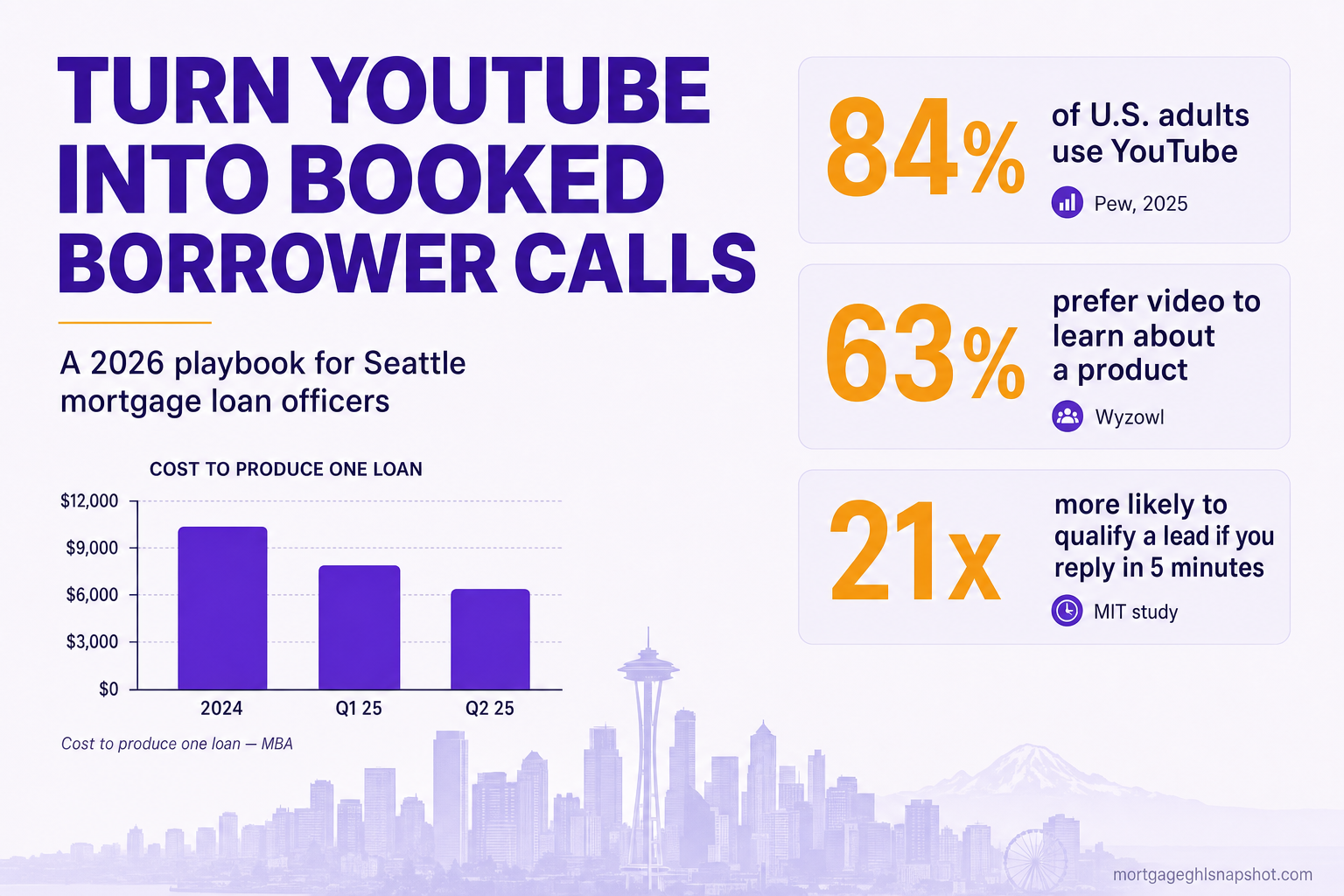
For a Seattle loan officer, YouTube turns into booked borrower calls through one repeatable loop: film short, search-shaped answers to the questions borrowers actually type; title and describe them so Google and YouTube surface them; put a booking link on every video; and answer the comments and DMs fast enough to convert the interest into a call. YouTube’s reach is the biggest of any platform — 84% of U.S. adults use it (Pew Research Center, 2025) — but the booking comes from the follow-up system behind the video. This playbook walks the exact steps, with real 2026 numbers, and shows where a done-for-you engine takes it off your plate.
The short answer: how YouTube becomes booked borrower calls
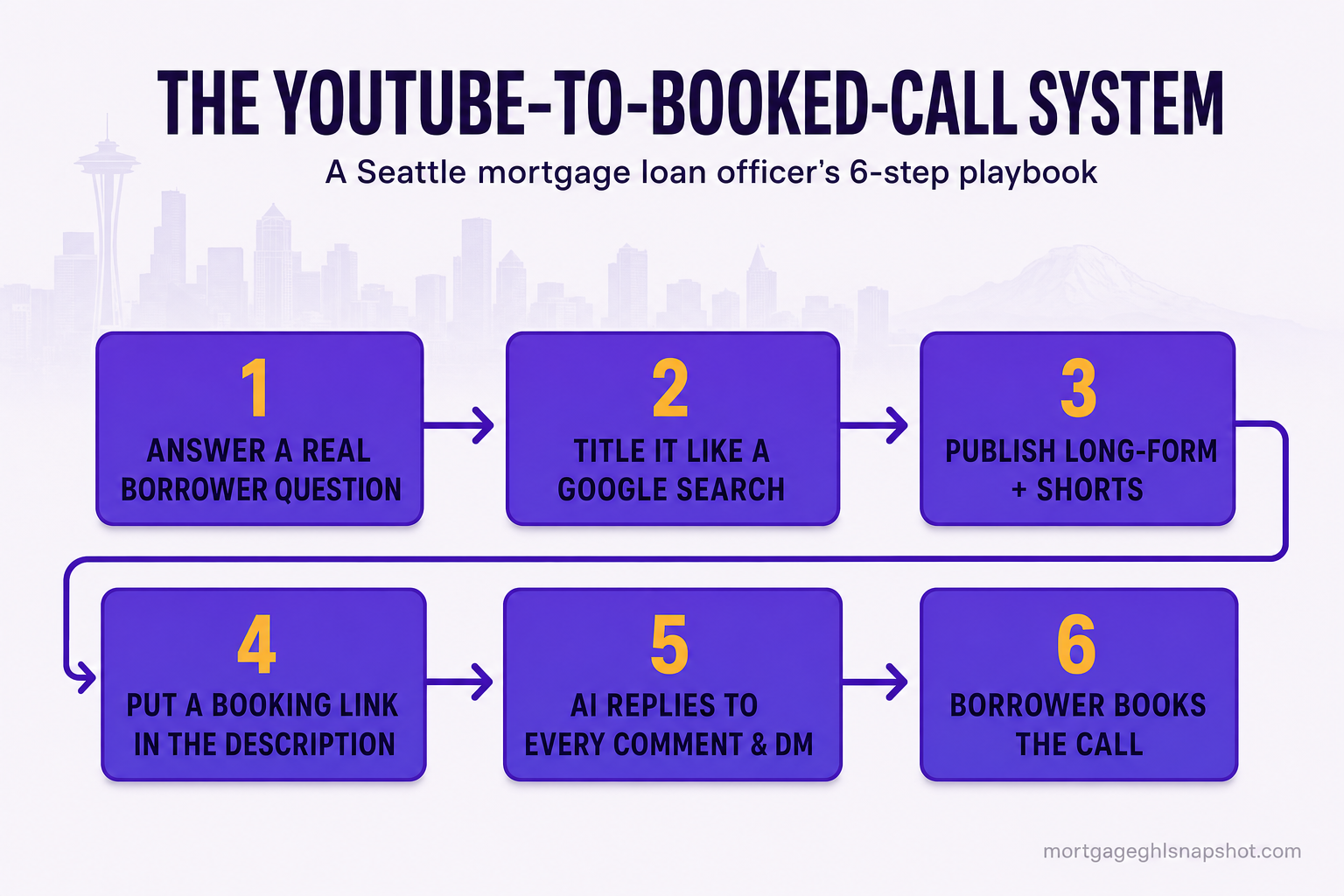
YouTube videos don’t book appointments. Systems book appointments — and a video is the top of the system. The loop looks like this:
- A short, search-shaped video answers a real question a Seattle borrower is typing into Google or YouTube.
- A keyword-first title and description get that video surfaced in search — so it works for months, not for one scroll.
- A booking link and a clear ask on every video move the interested viewer toward your calendar.
- Instant replies to every comment and DM turn a curious viewer into a booked call before a competitor answers.
Miss any one of those and the whole thing stalls. A great video with no booking link is a billboard with no phone number; a well-titled library with an unwatched inbox is demand you paid to create and then let go cold. This playbook builds all four steps so a Seattle borrower who searches a mortgage question ends up on your calendar — not someone else’s.
Why YouTube works for Seattle loan officers
Start with reach, because nothing else matters if the audience isn’t there. YouTube is the single most widely used online platform in the country: 84% of U.S. adults use it, ahead of Facebook at 71% and Instagram at 50% (Pew Research Center, 2025). And critically for mortgage, that reach doesn’t drop off with age. Roughly 92% of adults aged 30–49 and 86% of those 50–64 use YouTube (Pew Research Center, 2025) — the exact bands where move-up buyers, refinancers, and reverse-mortgage prospects live.
Share of U.S. adults who use YouTube, overall and by borrower-age band. Source: Pew Research Center, 2025.
Next, intent. When a borrower wants to understand a mortgage, they don’t want a brochure — they want to watch someone explain it. 63% of people say they’d most like to learn about a product or service through a short video, versus 12% who prefer a text article and just 5% who want a sales call (Wyzowl, 2025). That preference is why video does more than build a brand: 88% of video marketers say video has helped them generate leads, and 99% say it increased their audience’s understanding of the product (Wyzowl, 2025). For an LO whose entire job is explaining confusing things — PMI, points, rate locks, DTI — that comprehension lift is the sales pitch.
Finally, the home search itself has moved fully online. In NAR’s latest buyer study, 100% of buyers used the internet during their home search and 76% used a mobile device or tablet (NAR, 2024). A Seattle buyer researching neighborhoods, payments, and loan programs on their phone is exactly the person a well-titled YouTube video meets at the moment of the question. Be the local expert who answers it, and you’re on the shortlist before the first call — the same reason a strong local SEO foundation pays off.
YouTube vs. Instagram Reels: two different jobs
If you already read our Instagram Reels playbook, don’t file YouTube under “more of the same.” They do different jobs, and the smartest Seattle LOs run both.
Reels are a discovery engine: short, punchy videos the algorithm pushes to people who aren’t looking for you yet. They’re built for reach and the occasional viral spike, and they disappear down the feed within days. YouTube is a search-and-library engine: a borrower who is actively researching finds your video through a query, and that video keeps ranking and getting watched long after you publish it. One creates demand from strangers; the other captures demand from people already asking.
The practical move is to make them feed each other. Film one solid, search-titled YouTube video answering a real question, then cut the best 30 seconds into a Shorts/Reel to ride the discovery algorithms. That’s why our team ships both from a single filming session — Shorts for reach, long-form for the evergreen library. YouTube itself is one of the 9 channels the social media service publishes to.
The 7-step YouTube-to-booked-call playbook
Here’s the exact sequence. Every step is doable by a solo loan officer with a phone — and every step is a place a done-for-you team can take over.
Step 1 — Mine 10 real borrower questions
Your best videos aren’t clever; they’re answers. Open your text threads, your email, and your last ten discovery calls and pull the questions borrowers actually ask: “How much do I need down for an $800K house in Seattle?” “Can I buy with a 640 score?” “Is it worth refinancing if I closed at 7%?” Each question is one video. Ten questions is a month of content. Prioritize Seattle-specific angles — King County conforming limits, jumbo pricing above the limit, ADU/DADU rental income, Washington’s down-payment-assistance programs — because local specificity is what separates you from national finfluencers a borrower will never actually work with.
Step 2 — Title and script it like a search
This is the step that makes YouTube different from Reels, so don’t skip it. Write the title the way a borrower would type the question: “How Much Do You Need to Buy an $800K Home in Seattle? (2026)” beats “Seattle Mortgage Tips.” The title and the first line of your script should both contain the phrase people search. Then keep the video to one idea: a 3–5 second hook, 2–3 minutes of one clear answer, and a spoken call to action. Trying to teach the whole loan process in one video isn’t one video — it’s ten.
Step 3 — Film long-form, then cut a Short
Shoot in decent light with clean audio (a $30 lav mic beats any camera upgrade). Record the horizontal long-form answer first, then grab a vertical 9:16 slice for a YouTube Short and an Instagram Reel. Burn in captions — most people watch on mute — and keep your framing consistent so your videos are recognizable. Good-enough-and-consistent beats cinematic-and-rare every single time.
Step 4 — Write a description that ranks and routes
The description is doing two jobs: helping the video get found, and sending the viewer somewhere. Put a two-sentence summary with your keyword up top, then a booking link on the very first line (“Book a 15-minute Seattle mortgage strategy call: [link]”). Add timestamps, your NMLS ID, and links to two related videos. This is also where you point people to a mortgage calculator on your site so they self-qualify before they even reach you.
Step 5 — Publish consistently and build playlists
Reach compounds with reps and with structure. A steady cadence — even one solid video a week plus a couple of Shorts — gives YouTube enough signal to learn who your borrowers are. Group videos into playlists (“First-Time Buyers in Seattle,” “Refinance Math,” “VA Loans in Washington”) so one view turns into three. This weekly production is exactly the deliverable our social media service runs for you, published across 9 channels including YouTube.
Step 6 — Answer every comment and DM in minutes
This is where most loan officers leak the borrowers their videos worked so hard to attract. The data is blunt: a lead contacted within 5 minutes is 21× more likely to qualify than one contacted at 30 minutes (the landmark MIT / InsideSales study). Every “what would my payment be?” comment and every DM is a speed-to-lead moment. If you can’t watch your inbox all day — because you’re actually closing loans — this is exactly what an AI agent handles: it replies instantly, qualifies the borrower, and captures their info 24/7. See our deeper dive on speed-to-lead for mortgage teams and the missed-call text-back safety net for the calls you miss while filming.
Step 7 — Route the conversation to a booked call
The goal isn’t a view — it’s a slot on your calendar. Once a comment or DM establishes budget and timeline, hand over a booking link and confirm the appointment, then let automation send reminders so the borrower actually shows. An AI web-chat agent does the same for visitors who click from your video to your site. The result: a borrower goes from searching a question to booked on your calendar without you touching a keyboard in between.
What to film: Seattle mortgage video ideas that convert
Ideas are the bottleneck, so here’s a starter bank tuned for a Seattle audience. Each line is one video:
- “How much do you actually need down for an $800K Seattle home?” — bust the 20% myth; show FHA at 3.5% and conventional at 3–5%.
- “Jumbo vs. conforming in King County: where the line is in 2026.” — hyper-local, and exactly what a move-up buyer searches.
- “Can you count ADU or DADU rent to qualify in Seattle?” — a genuinely local question few national channels answer.
- “Bought at 7%? Here’s the break-even math on a refinance.” — refi education for your past-client database. (Pair it with automated rate-drop refi alerts.)
- “Washington down-payment assistance programs, explained.” — high-intent for first-time buyers, whose share just hit a historic low of 24% (NAR, 2024), which makes every one you capture more valuable.
- “Client win: keys to a first-time buyer in Tacoma.” — social proof beats claims. (Then ask for the review — see Google reviews for loan officers.)
Rotate education, local market takes, and client wins. The mix keeps you from sounding like a walking rate sheet — and gives YouTube variety to test.
The math: what a YouTube library is worth in an $890K market
Loan officers under-invest in video because the payoff feels fuzzy. It isn’t. Seattle’s median sale price sits around $890,000 in 2026 (Redfin, 2026) — a single purchase loan at that price point is a meaningful commission. And the cost side is just as concrete: independent mortgage banks spent an average of $11,076 to produce one loan in 2024, spiking to $12,579 in Q1 2025 before easing back to about $10,979 in Q2 2025 (Mortgage Bankers Association, 2025).
Total cost to produce a single loan, independent mortgage banks (USD). Sources: MBA 2024 and MBA Q2 2025.
Now put the numbers together. YouTube is organic — the production cost is time, not ad spend. If a consistent video habit produces even one extra booked-and-closed Seattle borrower a month, the return dwarfs the cost of creating the content, especially compared to paying roughly $11,000 to originate a loan you sourced through ads. And because a titled, search-indexed library keeps getting found, month six is dramatically better than month one — the videos keep working while you sleep. That’s the whole thesis of the brand: stop losing borrowers while you sleep.
DIY vs. done-for-you: who actually runs the engine
Everything above is doable solo. The problem is that “publish a titled video every week, cut Shorts, write ranking descriptions, and answer every comment and DM in five minutes” is a full-time content-and-community job — and you already have one: originating loans. Most loan officers start strong, film for three weeks, get buried in a rate lock, and go quiet. The channel stalls, and the comments pile up unanswered.
That’s the gap our done-for-you social media service closes. For $397/month (one brand), you get the full weekly content engine — written in your firm’s voice, mortgage-compliant, and published 5 days a week across 9 channels including YouTube. Just as important, it deploys three AI agents: a comment agent that replies under your videos, a DM agent that qualifies borrowers and books consults, and a web-chat agent for your site. In other words, it runs steps 5, 6, and 7 of this playbook automatically — the exact steps solo LOs drop first. Prefer to keep it in-house but need hands on the keyboard? A dedicated GHL virtual assistant can run the publishing and inbox for you.
Whichever route you take, the framework is the same: search-shaped videos, ranking titles and descriptions, instant replies, and a clean path to the calendar. Do that, and YouTube stops being a vanity channel and becomes the top of your Seattle borrower pipeline. To capture the demand it creates, pair it with a fast mortgage CRM and workflow and a strong pre-qualification follow-up sequence so every view has somewhere to land.
Frequently asked questions
YouTube for Seattle loan officers — FAQ
How often should a loan officer post on YouTube?
Consistency matters more than volume, but YouTube rewards a steady signal. A practical target is one solid, search-titled long-form video per week plus two or three Shorts cut from it. That gives the algorithm enough to learn who your borrowers are and builds a library that keeps getting found. One video a quarter won't build momentum — the compounding comes from reps published on a schedule.
What should Seattle mortgage YouTube videos be about?
Answer the real questions borrowers type into search: down-payment amounts for local price points, jumbo vs. conforming limits in King County, ADU rental income, Washington down-payment-assistance programs, VA funding fees, and refinance break-even math. Mix education, local market takes, and client wins. Keep each video to one idea, title it the way a borrower would phrase the question, and put a booking link in the first line of the description.
Is YouTube better than Instagram Reels for mortgage lead generation?
They do different jobs, so run both. Reels are a discovery engine that pushes short videos to people who aren't searching for you yet, built for reach and the occasional viral spike. YouTube is a search-and-library engine: borrowers who are actively researching find your video through a query, and it keeps ranking for months. Film one search-titled YouTube video, then cut a Short from it so the two feed each other.
Do YouTube videos actually generate mortgage leads?
Video generates reach and qualified interest; your follow-up generates booked calls. YouTube reaches 84% of U.S. adults (Pew, 2025), 63% of people prefer video to learn about a product (Wyzowl), and 88% of video marketers say video helped them generate leads (Wyzowl). The conversion depends on answering comments and DMs fast — a lead contacted within 5 minutes is 21x more likely to qualify (MIT study) — and routing interested borrowers to a booking link.
Is it compliant for a loan officer to talk about rates on YouTube?
Keep videos educational and estimates-only. Don't quote a specific locked rate or APR on camera, don't imply a guaranteed approval, and include your NMLS ID and any disclosures your firm requires in the description. 'Here's how the down-payment math works' is fine; 'You're approved for $800K at 6%' is not. When in doubt, clear the script with your compliance team, and keep SMS and AI follow-up inside TCPA and 10DLC rules.
How much does done-for-you mortgage YouTube and social media cost?
Our done-for-you social media service starts at $397/month for one brand and includes weekly content published 5 days a week across 9 channels including YouTube, plus three AI agents that reply to comments and DMs and book consultations. Up to 4 brands is $997/month. It's 100% white-label and requires no account passwords, so you can keep originating while the channel runs itself.
Written by Meera Sundaram, Mortgage Marketing Strategist (Austin, TX). Meera helps mortgage teams and the agencies that serve them turn calculators, content, and nurture sequences into a steady stream of pre-qualified borrowers. Estimates and educational content only — not a lender, and not financial or legal advice. Confirm program details and current figures with your own compliance team before publishing.
Related posts: Instagram Reels for San Diego loan officers · Social media for NYC loan officers · Speed-to-lead for mortgage teams · Google reviews for loan officers · Local SEO for loan officers