
It is the second week of January. Your phone has not rung with a real lead in three days, and the pipeline that looked healthy in September is now a column of “funded” with almost nothing behind it. You are not doing anything wrong today. The problem started in August, when you were too busy to plant anything for winter.
Here is the honest answer up front: your income swings because your marketing is seasonal, not because the market is. Purchase demand has a calendar and rates have a cycle, both outside your control. What you control is whether you are still talking to borrowers, past clients, and referral partners when the market goes quiet. This is the loan officer’s year as a system, season by season: the moves, the copy, and the ways each season breaks.
What the income swing actually costs you
Every loan officer knows the feast-and-famine rhythm, and most treat it as a law of nature. It is not. It is the predictable result of a pipeline that only works when borrowers come to you. The calendar is tight: median home prices climb from January through June almost every year, with gains of roughly 11% to 21% from 2018 through 2024, then give most of it back in the second half (Calculated Risk). The busiest selling months are May through August. You know in July that December will be slow. The question is whether you used the busy months to build anything that pays you in the slow ones.
The rate cycle makes the swing sharper. When rates fall, refinance demand jumps. In 2025 the refinance share of applications was 36.4% in May, climbed to 46.5% in August when the 30-year dipped to 6.67% (the strongest refi week since April), and hit 60.2% by the week of September 19 as rates fell to 6.34%, with refi volume 42% above a year earlier (Calculated Risk; HousingWire). The LOs who made money on that wave already had past clients and a message ready the week rates moved. Everyone else read about it afterward.
Sources: MBA, NAR 2025, Calculated Risk.
Refinance share of total mortgage applications in 2025 as the 30-year fixed rate fell. MBA Weekly Survey, via Calculated Risk and HousingWire. Seasonally adjusted.
The cost is not just a thin January. It is spending every slow season starting from zero and competing on rate because you have no relationship to compete on instead. A loan officer with a year-round system spends the slow months harvesting a database they already own.
The mortgage year: the calendar and the rate cycle
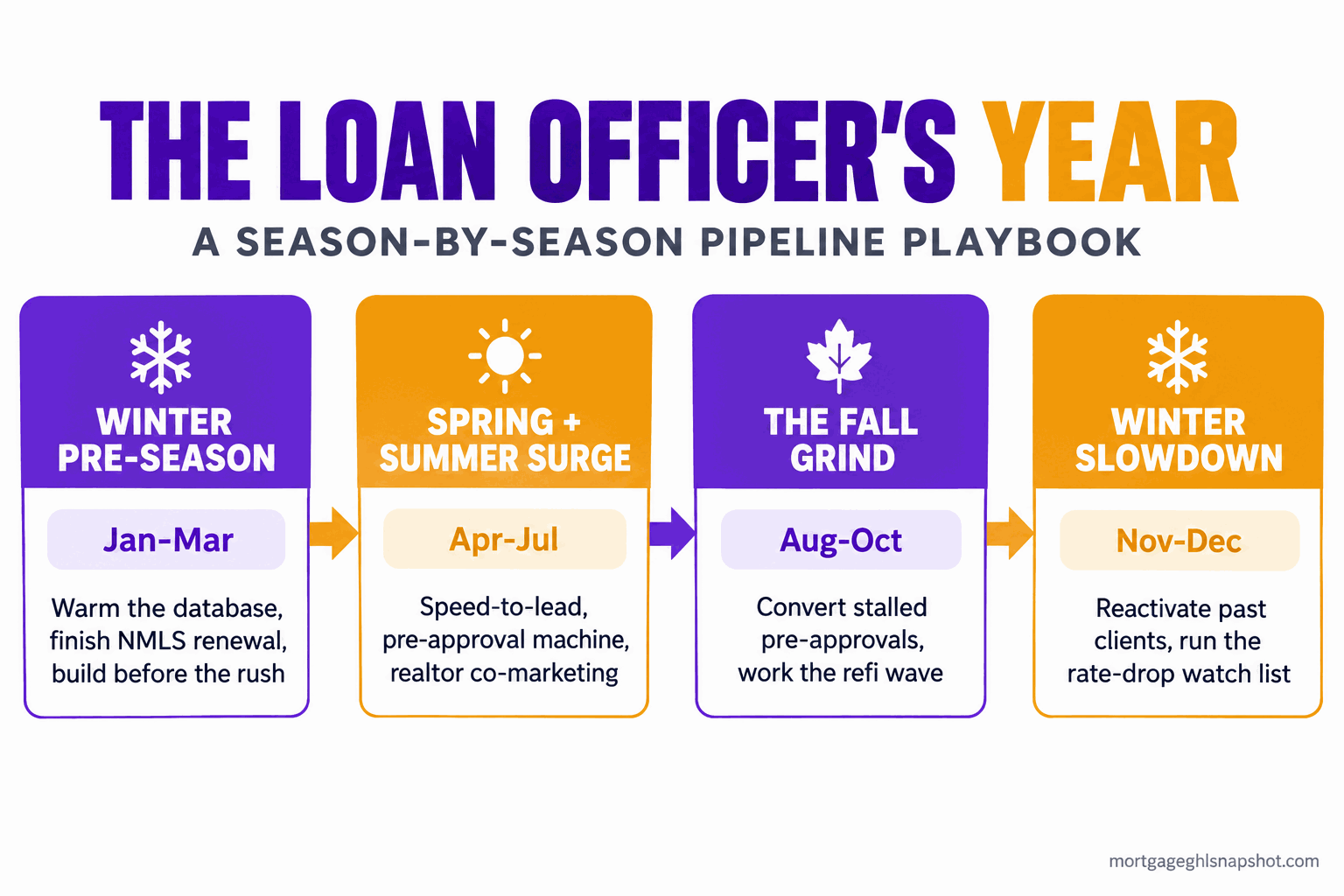
Two cycles run at once. The purchase calendar is steady and dependable. The rate cycle is unpredictable in timing but predictable in effect: when rates drop, your past clients and your stalled pre-approvals both come back to life. Build for the calendar and stay ready for the rate cycle. Here is the shape of the year.
- •Jan–Mar
Pre-season prep
Warm the database, lock realtor plans, finish NMLS renewal, and build your intake and follow-up before the rush.
- •Apr–Jul
The purchase surge
Speed-to-lead on every inquiry, the pre-approval machine running, realtor co-marketing live. Most of the year's volume closes here.
- •Aug–Oct
The grind
Purchase demand cools. Convert the pre-approvals in your pipeline, clean up stalled files, and work any refi wave a rate dip hands you.
- •Nov–Dec
The slowdown
Reactivate past clients, run the rate-drop watch list hard, send year-end check-ins, and plan next year while competitors go dark.
Notice that pre-season is in winter. The surge leaves no room to set up systems, so you build them now and they are running when the leads arrive.
The four seasons, move by move
Each season has a job, a money move, and a way it breaks when you skip it. Build it in whatever you already pay for; most of my installs run on GoHighLevel because the texts, emails, and triggers live in one place, though the rhythm matters more than the tool.
Winter pre-season (January to March): build before the rush
The market is quiet, which is exactly why it is the most valuable season: you have time, and nobody else is using theirs.
Three moves. Warm the database: pull your past-client and old-lead list and start a light monthly touch so people remember your name before they need you. Lock your realtor relationships for the year and get the co-marketing plan in writing, compliantly (more below). Finish the housekeeping the surge will not allow: your NMLS renewal and continuing education, intake forms, and follow-up sequences, all tested.
Money move: warm the database you ignored last year, the cheapest lead source you will ever have, already sitting in your CRM.
Failure mode: you treat winter as a break and coast. Then spring arrives and you are scrambling to build intake forms and chase realtors while trying to close loans, and do both badly. The LO who built in January is taking applications while you are still wiring up forms.
Spring and summer surge (April to July): capture everything
This is when the market rewards speed and punishes everything else. Applications pick up as the spring season opens; in 2025 the jump started the first week of March, which the MBA called the start of the spring homebuying season (MPA), and volume builds through summer.
Three moves. Speed-to-lead on every inquiry, because in a busy market the first to respond usually wins the application. Run the pre-approval machine: fast 1003-lite intake, soft-pull triggers, and a letter out while the borrower is still excited. Make your realtor co-marketing visible now, when agents decide who to send the next deal to.
Money move: convert the flood. The leads arrive whether you are ready or not, so the game is capturing them faster than the shop down the street.
Failure mode: you let speed slip because you are overwhelmed. A lead that sits for two hours in July is a lead a faster LO already called. Volume hides the leak, but the ones you drop in the surge are the borrowers you will wish you had come January.
Late summer and fall grind (August to October): convert what you have
The faucet slows. Purchase demand cools as families settle into the school year. This season separates LOs with a system from those who just ride the market.
Three moves. Work your existing pipeline hard: every spring pre-approval that has gone quiet is a borrower who may still buy, and pre-approvals go quiet for reasons you can fix. Run pipeline hygiene so stalled files get a real next step instead of sitting as “someday.” Watch rates, because fall is often when a dip arrives, a refi wave for anyone ready.
Money move: squeeze conversion out of the pipeline you already built, not pay for new leads into a slower market.
Failure mode: you let fall feel like the off-season and stop following up. Your spring pre-approvals go cold, and when a borrower finally buys in October, they do it with the LO who kept calling. The market did not take that deal from you; your silence did.
Late fall and winter slowdown (November to December): harvest and plan
Everyone else goes dark: holidays, year-end, the purchase calendar at its lowest. This is your window to be the one loan officer still showing up and to set up next year.
Three moves. Reactivate past clients, because a warm database worked in the slow season is a refi pipeline and a referral engine (run reactivation without buying new leads). Run the rate-drop watch list hard, because a year-end dip finds your competitors asleep. Send genuine year-end check-ins and set your calendar for the January build.
Money move: mine the database. The refis and referrals hiding in your past clients do not care that it is December, and you are the only one asking.
Failure mode: you join everyone else in going quiet and write off November and December. Then the rate dip you could have cashed in on goes to the LO who sent one text, and you start January from a standstill instead of a running start.
The always-on rate-drop watch list
This one ignores the calendar. Rates can fall in any month, and the borrowers who care most are the ones you already closed; a single week of lower rates in August 2025 drove the strongest refinance activity since spring (Calculated Risk). Tag every funded borrower with their rate and loan type, so when the market moves the people who benefit get a message the same week and the LO who sends it first gets the refi. Our rate-drop refi alert system runs it on autopilot. The rule that keeps it safe: flag that it may be worth a conversation, never quote a rate.
Solo LO, small team, and a brokerage
The four seasons apply to everyone. How you build for them depends on your size.
The solo loan officer. You are the whole operation, which is why your pipeline swings hardest: slammed in spring, the winter prep never gets done, and the cycle repeats. Start with two automated sequences that protect you from yourself, the winter database warm-up and the rate-drop watch list, and keep the human touch for the spring applications and the past-client calls that close.
The small team (2 to 5 LOs). Your problem is consistency. One LO works the off-season like a pro, another vanishes every November, and the team’s revenue is the average. Standardize the seasonal calendar as shared workflows so every LO’s database gets warmed, and so whoever runs the shop can spot cold follow-up before a dry quarter.
The brokerage (6 to 15 LOs). At this size the seasonal system is a retention and recruiting asset. LOs stay where the slow season does not threaten their income, and keeping everyone’s database warm across the whole book smooths the revenue line for the shop. The risk at scale is generic outreach, so invest in copy that sounds like a person. The staffing math often looks like an in-house assistant versus a GHL-driven setup.
Steal this: the message copy for each season
Copy these, keep every text short, sign with your name and NMLS ID, and include an opt-out where required. These are templates, not legal or rate advice, and nothing here should promise a rate or an approval.
Five messages cover the whole year, almost all automatic, each with your name on it. The rate-drop message is deliberately careful: it opens a conversation, it does not advertise a rate.
The compliance lines that do not take a season off
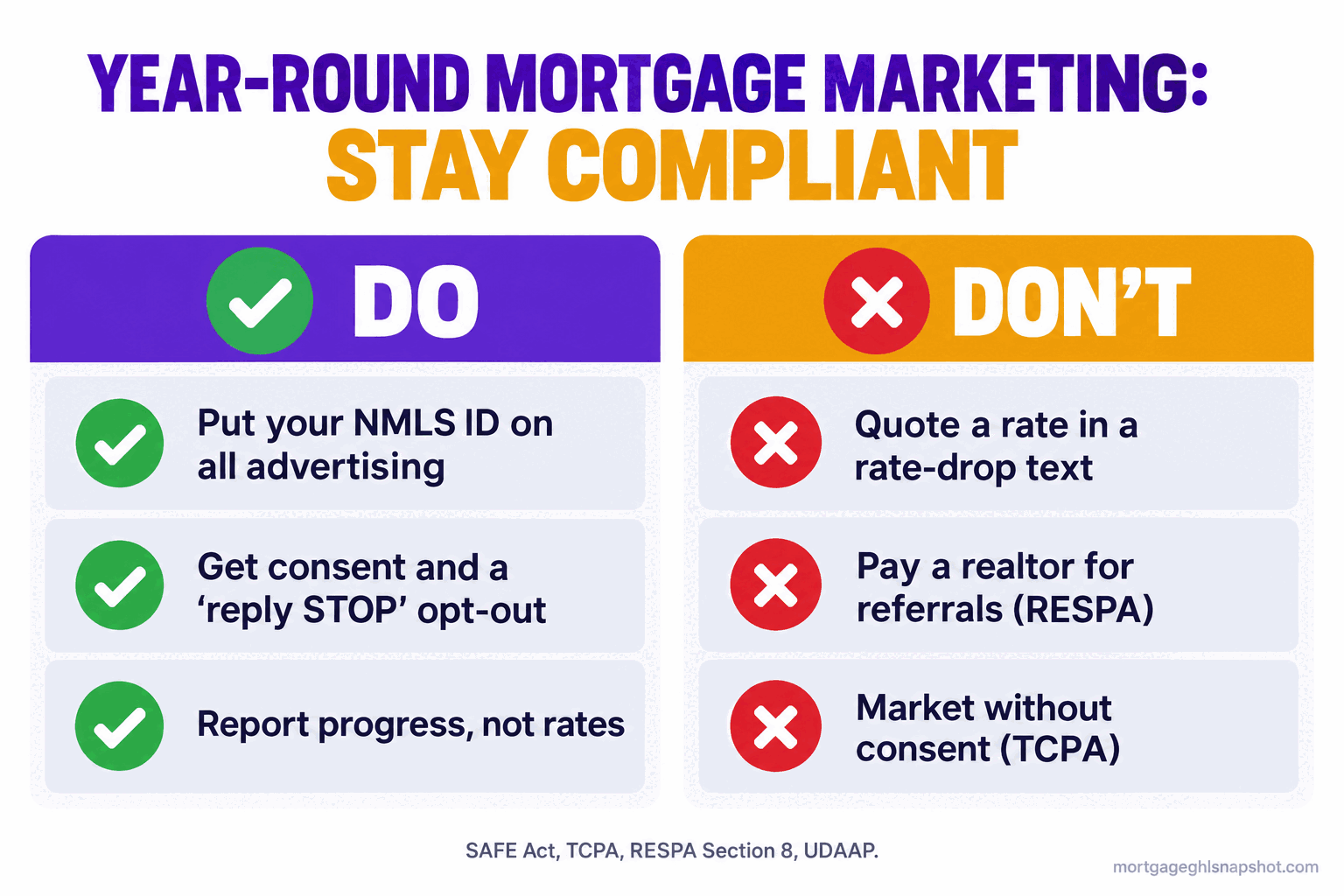
A seasonal system that lands you in front of a regulator is a liability, not a system, and automated year-round outreach makes the guardrails matter more. Four lines hold in every season.
The objections I hear every January
“Income swings are just part of this job.” Partly true, partly a story LOs tell to avoid building a system. The market’s swing is real; yours does not have to match it. LOs with steadier income are harvesting a database while everyone else waits for the phone. You cannot flatten the market, but you can flatten your own line.
“I don’t have time for off-season marketing.” The off-season is the time. Winter is slow precisely because there is less loan volume, which is the whole reason it is the right moment to build and work your database. Too busy in spring and unwilling in winter leaves no month left.
“Automated seasonal texts feel fake.” They feel fake when they are empty. A generic “happy holidays” blast is noise. A rate-drop heads-up they can use, or a year-end note referencing when you closed their loan, reads as attention. The system handles the timing; the message sounds like you because you wrote it once, carefully.
“I already pay for a CRM I barely use.” Then you own the asset and are leaving it idle, the most expensive way to own software. The seasonal calendar turns a CRM from a contact graveyard into a pipeline. If yours cannot run these sequences, that is worth knowing before another slow season.
Frequently asked questions
What is the slowest season for a loan officer, and what should I do during it?
The slowest stretch is typically November through January, as the purchase calendar bottoms out and prices hit their seasonal low. Use it to reactivate past clients, run your rate-drop watch list, and build the systems you will need for spring. It is build-and-harvest time, not downtime.
When does the mortgage purchase season actually start?
Purchase demand begins climbing in early spring. In 2025 the MBA called the first week of March the start of the spring homebuying season, and volume builds through summer. Median home prices typically peak in June, reflecting contracts signed in April and May.
How do I make money when rates are high and nobody is refinancing?
Focus on purchase business and your database. High rates slow refinancing but people still buy, and 88% of them use an agent, so realtor relationships and past-client referrals carry you. Keep a rate-drop watch list ready so the moment rates dip, your refi pipeline is already warm.
Is it worth marketing to past clients if they are not buying right now?
Yes. Repeat and referral business is the backbone of this job, and 91% of buyers say they would use their agent again or recommend them. A past client who hears from you twice a year is the one who refers a coworker and comes back for the refi.
Can I automate seasonal and rate-drop texts to borrowers legally?
With consent and an opt-out, yes: prior express consent, a working opt-out such as reply STOP on every message, registered A2P 10DLC messaging, your NMLS ID on advertising, and clean records. The rate-drop message in particular must flag a possible conversation, never quote a rate or promise savings, to avoid UDAAP exposure.
It is the second week of January again, next year. Your phone is quiet too, but your pipeline is not. The database warm-up went out on the second, three past clients already replied, and your rate-drop list is tagged and waiting for the next dip. You built it last winter while everyone else coasted, and now the slow season is just the season you harvest. The market still has a calendar; your income no longer has to follow it.