
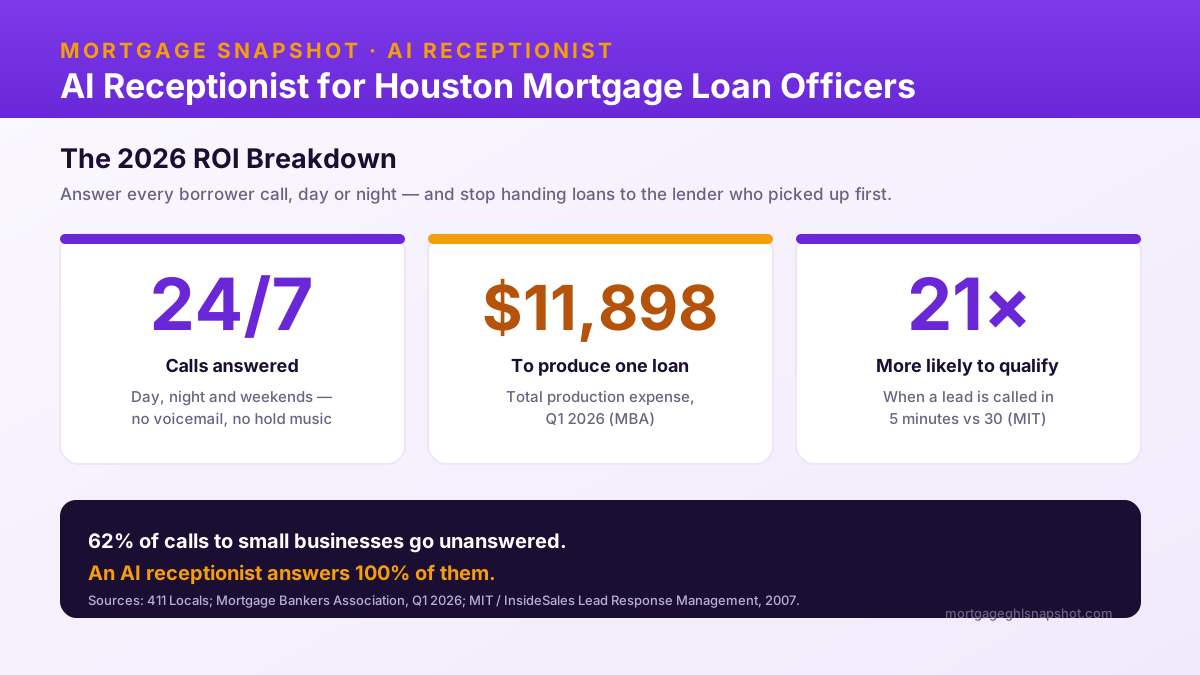
A Houston buyer is scrolling Zillow at 9:15 p.m., finds a townhouse in the Heights, and calls the loan officer whose name was on the listing. It rings four times and drops to voicemail. They don’t leave a message — they just tap the next name on the search results. By the time you see the missed-call notification at breakfast, that borrower is already pre-qualified with someone else.
For a Houston loan officer, an AI receptionist is a voice agent that answers 100% of your inbound calls — day, night, and weekends — qualifies the borrower on purchase-vs-refi and timeline, and books the consultation onto your calendar before the caller can dial a competitor. It pays for itself the moment it catches one loan you would otherwise have lost, and in a market where it costs nearly $12,000 to produce a single loan, that math is not close. This is the 2026 ROI breakdown: what it does, what it’s worth, and how it stays compliant.
The short answer: what an AI receptionist is and does
An AI receptionist is a natural-sounding voice agent that picks up your phone. For a mortgage loan officer, it answers every inbound call instantly — no hold music, no voicemail — has a real conversation with the borrower, figures out whether they’re a purchase or a refi, captures the essentials (rough timeline, ballpark loan amount, how to reach them), and drops a booked appointment onto your calendar. When you’re on another call, at a closing, or asleep, it’s the version of you that always picks up.
It is not a robocall, and it is not a phone tree. The modern version — built on production voice platforms like VAPI or Retell — holds a two-way conversation, understands interruptions, and hands off cleanly to a human when the caller asks. The point isn’t to replace you; it’s to make sure the first touch happens in the first ring, because in mortgage the loan officer who responds first usually wins the file.
Here’s the loop it runs, every time, automatically:
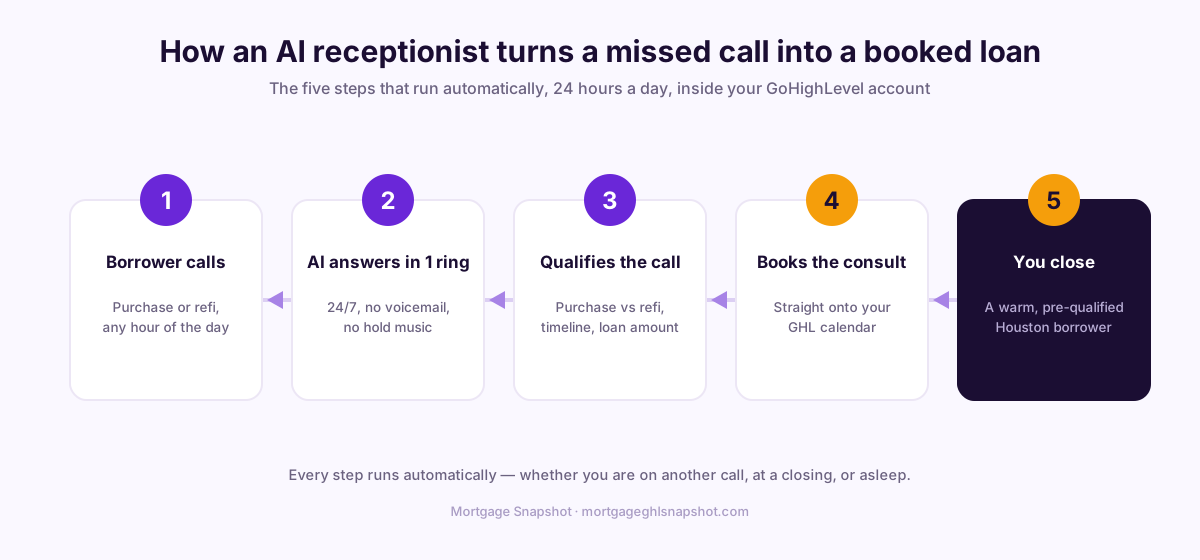
Miss any one of those steps and the whole thing stalls. A phone that rings out is a lead-generation budget feeding a broken funnel. The AI receptionist closes the gap between “borrower calls” and “borrower is on your calendar” — which is exactly where most Houston loan officers are losing deals right now.
Why Houston loan officers leak borrowers on the phone
Houston is one of the busiest purchase markets in the country — the only major Texas metro still posting year-over-year price growth in 2026, with a typical home value around $264,789 (Zillow, 2026). That means a steady flow of buyers, a lot of comparison-shopping, and a phone that rings at inconvenient times. The problem is what happens to those calls.
The uncomfortable truth is that most calls to small businesses simply don’t get answered. A secret-shopper study by 411 Locals found that 62% of calls to small businesses went unanswered — only about 38% were picked up by a live person (411 Locals). A producing loan officer is a perfect example of why: you’re on the phone with an underwriter, in a signing, or driving to a Realtor meeting when the next borrower calls. You physically can’t answer, and the borrower won’t wait.
Share of calls to small businesses answered by a live person, secret-shopper study. Source: 411 Locals.
And borrowers today expect the opposite of a voicemail. HubSpot’s research found that 82% of consumers rate an immediate response as important or very important when they have a sales question (HubSpot). Mortgage is the sharpest version of this: a rate quote is time-sensitive, the purchase is emotional, and the borrower is actively dialing more than one lender. The one who answers becomes the trusted human on the biggest debt of that borrower’s life. The one who sends them to voicemail becomes the number they never call back.
The speed-to-lead advantage an AI answer captures
The reason instant pickup matters so much isn’t a hunch — it’s one of the most replicated findings in sales research. The Lead Response Management study led by Prof. James Oldroyd (MIT Sloan) with InsideSales analyzed more than 15,000 leads and 100,000 call attempts. It found that a lead contacted within 5 minutes is 21× more likely to qualify than one contacted at 30 minutes, and that you’re 100× more likely to even reach the lead when you respond in the first five minutes (Lead Response Management, 2007).
Read that again in mortgage terms. The difference between answering a Houston borrower’s call now versus calling back after your 10 a.m. is not a small conversion tweak — it’s an order-of-magnitude difference in whether that borrower becomes a file at all. A human loan officer cannot be available for the 5-minute window on every call, on every night, on every weekend. An AI receptionist can, because it never sleeps, never double-books, and never sends a caller to voicemail.
This is where the “answer engine” framing helps: the AI receptionist isn’t there to close the loan — you do that. It’s there to win the first five minutes so the loan is still yours to close. It captures the borrower, books the consult, and hands you a warm, pre-qualified conversation instead of a cold callback. Pair it with an instant missed-call text-back and even the rare call it can’t complete still gets a text in seconds, so nothing leaks.
The ROI math in a $265K Houston market
Here’s where the “is it worth it?” question actually gets answered. The Mortgage Bankers Association reports that independent mortgage banks spent $11,898 in total production expense to produce a single loan in Q1 2026, up from $11,102 the prior quarter — while net production profit was just $727 per loan (MBA, 2026). Production costs have hovered near or above $11,000 per loan for three straight years.
Total loan production expense per loan (independent mortgage banks), in dollars. Sources: MBA 2024 annual report; MBA Q1 2026 report.
Now line those numbers up against what an AI receptionist costs. Whatever a Houston loan officer earns on a single funded mortgage on a ~$265K home, it dwarfs the flat monthly cost of a voice agent by a wide margin — and the industry is spending nearly $12,000 just to produce each one. That reframes the whole decision:
The cheapest loan you will ever close is the one already trying to reach you. When margins are this thin and each loan is this expensive to originate, letting a warm Houston borrower hit voicemail is one of the most expensive mistakes an LO can make — and it’s entirely preventable. An AI receptionist doesn’t need to catch many extra loans to pay for a year of itself; in most Houston pipelines, it needs to catch one. Everything after that is upside. This is the same logic behind reactivating your existing database: recovering a borrower you already have is far cheaper than buying a new one.
What a mortgage AI receptionist actually does
“Answers the phone” undersells it. A properly built mortgage AI receptionist runs a full front-desk workflow:
- Answers 100% of inbound calls instantly, 24/7 — no hold music, no voicemail, day or night. Houston borrowers who call at 9 p.m. get a real conversation, not a callback promise.
- Qualifies the caller — purchase vs refi, target timeline, rough loan amount, and basic eligibility signals like employment type and ballpark credit band, so you know what you’re walking into.
- Books the consultation directly onto your GHL calendar — the borrower leaves the call with a scheduled rate-review or pre-qual appointment, not a “we’ll get back to you.”
- Places outbound follow-ups — it can call new web leads in that critical 5-minute window and re-attempt no-shows, so speed-to-lead isn’t dependent on you being free.
- Logs everything into GoHighLevel — the call is transcribed, the contact is tagged by loan type and source, and the right nurture automation fires automatically.
Because it’s wired into GoHighLevel, the receptionist isn’t a standalone gadget — it’s the front door to your whole pipeline. A captured call becomes a tagged contact, which triggers a pre-qualification follow-up sequence, which feeds your mortgage CRM. The AI Caller module that ships in Mortgage Snapshot does exactly this, and pairs with the AI chatbot so the borrower who prefers to type gets the same instant, qualifying response.
AI receptionist vs voicemail vs answering service
Loan officers usually weigh three ways to handle calls they can’t answer: let it go to voicemail, hire a human answering service, or deploy an AI receptionist. Here’s how they actually compare for a mortgage workflow.
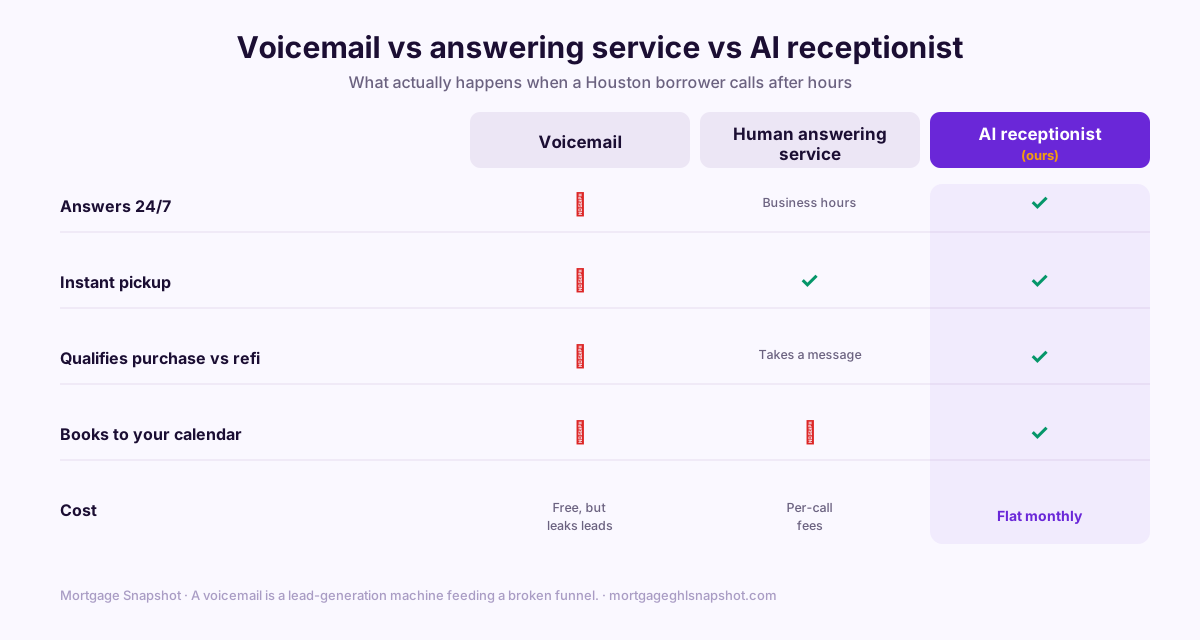
| Capability | Voicemail | Human answering service | AI receptionist |
|---|---|---|---|
| Answers 24/7 | No — goes to a greeting | Usually business hours only | Yes, always on |
| Instant, live pickup | No | Yes, if staffed | Yes, first ring |
| Qualifies purchase vs refi | No | Rarely — just takes a message | Yes — mortgage-trained |
| Books to your calendar | No | Usually not | Yes — auto-books into GHL |
| Logs to your CRM | No | Manual, if at all | Yes — transcribed & tagged |
| Cost | Free — but leaks leads | Per-call or per-minute fees | Flat monthly, unlimited calls |
Voicemail is free in dollars and expensive in lost loans. A human answering service solves the “someone picks up” problem but usually just takes a message — it doesn’t qualify a borrower, doesn’t book a pre-qual call, and doesn’t log anything into your pipeline, so you still do the real work on a cold callback. The AI receptionist is the only option that does all three at a flat, predictable cost.
Is it compliant? Consent, disclosure, and TCPA
This is the question a careful loan officer asks second, and it’s the right one. An AI voice agent touches two things regulators care about: how you contact people, and how you disclose that they’re talking to AI. Handled correctly, an AI receptionist is more defensible than a rushed manual process, because every interaction is logged and consistent. Handled carelessly, it’s a liability. The difference is setup.
A few guardrails we build in from day one:
- Inbound is the safe starting point. When a borrower calls you, they’ve initiated contact — that’s the cleanest consent posture. The AI receptionist’s core job is answering inbound calls, which sidesteps the thorniest outbound-consent questions entirely.
- Outbound follow-up respects consent and TCPA. For AI-placed outbound calls and texts, we wire consent capture, calling-time windows, and STOP/opt-out handling into the workflow before anything goes live — the same discipline covered in our mortgage text-message compliance guide.
- Disclosure is built into the script. The agent identifies itself appropriately and hands off to a human whenever the caller asks — no pretending to be something it isn’t.
- Estimates stay estimates. The receptionist qualifies and books; it does not quote live rates, pre-approve, or give individualized advice. Those conversations belong to a licensed human, and the script is written to route them there.
How we build and install it
You don’t need to learn VAPI, Retell, or GoHighLevel automation to get this running. Our GHL development service builds the whole thing and installs it in your account. Here’s the process:
- Map your call flow. We start with how borrowers actually reach you today, where calls drop, and what a qualified Houston borrower looks like — so the agent asks the right questions for purchase, refi, FHA, VA, and jumbo callers.
- Build the voice agent. We tune a production voice AI (VAPI/Retell) with a mortgage-specific script, connect it to your number, and set the qualification logic and handoff rules.
- Wire it into GoHighLevel. Calls get transcribed, contacts get tagged by loan type and source, appointments book onto your calendar, and the right nurture and speed-to-lead automations fire automatically.
- Lock in compliance. Consent capture, A2P/10DLC for any SMS, opt-out handling, and AI disclosure are configured before launch.
- Test, launch, and monitor. We run live test calls, refine the script, and hand you a receptionist that runs 24/7 — with the option for a dedicated GHL VA to monitor and optimize it day to day.
If you’d rather own the entire system at once, the Mortgage Snapshot ships the AI Caller as one module inside a complete GoHighLevel install — 13 pipelines, 50+ workflows, seven white-label calculators, and the borrower-capture automation already wired together, live in your account in 24 hours.
Frequently asked questions
AI receptionists for Houston loan officers — quick answers
What is an AI receptionist for a mortgage loan officer?
It's a natural-sounding AI voice agent that answers your inbound calls 24/7, has a real conversation with the borrower, qualifies them on purchase vs refi and timeline, and books a consultation onto your calendar — then logs everything into GoHighLevel. It handles the first touch so no borrower hits voicemail. Our AI Caller module is exactly this, and our GHL development team can build a custom one for your firm.
Does an AI receptionist really pay for itself?
In most Houston pipelines it needs to catch just one loan a year to more than cover its flat monthly cost. Consider that independent mortgage banks spent $11,898 to produce a single loan in Q1 2026 (MBA, 2026), and that 62% of calls to small businesses go unanswered (411 Locals). Recovering even a handful of otherwise-lost calls a month makes the ROI lopsided in your favor.
Is using an AI voice agent TCPA-compliant?
It can be, when it's set up correctly. Answering inbound calls — where the borrower initiated contact — is the cleanest posture. For any AI-placed outbound calls or texts, consent capture, calling-time windows, A2P/10DLC registration, and STOP/opt-out handling are configured before launch, and the agent discloses that it's AI and hands off to a human on request. See our text-message compliance guide for the current rules.
Will borrowers know they're talking to AI, and will they hate it?
Modern voice agents sound natural and hold real two-way conversations, and the agent discloses appropriately and hands off to a human whenever asked. Most borrowers care far more that someone picked up instantly at 9 p.m. than that the first voice was AI — 82% of consumers rate an immediate response as important (HubSpot). Instant beats perfect.
How is this different from a human answering service?
An answering service picks up and takes a message, usually only during business hours, and rarely qualifies a mortgage borrower or books to your calendar. An AI receptionist answers 24/7, qualifies purchase vs refi, books the consult directly into GoHighLevel, and logs everything — at a flat monthly cost instead of per-call fees. It does the front-desk work, not just the message-taking.
How do I get one set up for my Houston firm?
Two paths. Buy the Mortgage Snapshot and get the AI Caller as part of a complete GoHighLevel install in 24 hours, or have our GHL development team build a custom voice receptionist tuned to your call flow and wired into your account. Book a walkthrough and we'll scope it with you.
About the author
Terrence Ndiaye is a Compliance & Operations Advisor for the mortgage niche, based in Columbus, OH. He writes about TCPA consent, opt-out handling, audit trails, and the operational guardrails that keep AI messaging and voice outreach on the right side of the rules — so originators can move fast without skipping the steps that matter. Terrence is a fictional editorial persona for Mortgage Snapshot; nothing here is individualized legal, financial, or compliance advice. We are not a lender, and any figures cited are drawn from the sources linked.
Related reading
- Mortgage speed-to-lead: why the first 5 minutes decide the deal — the window an AI receptionist is built to protect.
- Missed-call text-back for loan officers — the instant text that backs up every call.
- Pre-qualification follow-up that actually converts — where a booked call goes next.
- Mortgage text-message compliance in 2026 — the TCPA rules behind AI outreach.
- AI for mortgage loan officers — the broader playbook this fits into.