
There is a realtor in your phone who used to be worth three closings a quarter. You met at a first-time-homebuyer class, you closed a tricky FHA deal for one of her buyers, and for about eighteen months she sent you everything. Then it thinned out. A deal here, a deal there, and now nothing. You did not have a fight. You did not lose a file. She just stopped. The last thing she sent was “thanks!” after a closing you barely remember.
That silence is not random, and it is not personal. It is feedback. An agent who stops referring is telling you something specific about the last few times you worked together, and if you read the signal you can usually fix it. This is the diagnostic I run when a loan officer’s referral pipeline dries up: the six reasons agents go quiet, how to tell which one you are dealing with, and the messages that reopen the door. None of it involves paying for a referral, because that is illegal.
What a quiet realtor is actually costing you
Referrals are not a nice-to-have in this business, they are the business. In the 2025 NAR Profile of Home Buyers and Sellers, 88% of buyers bought through an agent or broker, 43% found their agent through a referral, and 66% of sellers used an agent they found by referral or had worked with before. A good agent hands you pre-qualified buyers who already trust the person who sent them.
So when an agent goes quiet, you did not lose a lead. You lost a pipe. A single agent doing normal volume can be five to ten transactions a year, and every one of those buyers needs financing. Multiply that across the two or three partners who drift off in a slow year and you have accounted for most of the gap in your production, without a single rejection you could learn from.
Share of the market that runs on agent relationships. Source: NAR 2025 Profile of Home Buyers and Sellers.
It also matters because the field is crowded. Roughly 192,793 uniquely licensed mortgage loan originators were active in late 2024 (HousingWire, 2024). Your quiet agent is not short of loan officers who want her business. Somebody is answering her buyers fast. The question is whether it is you.
The six reasons realtors stop sending deals
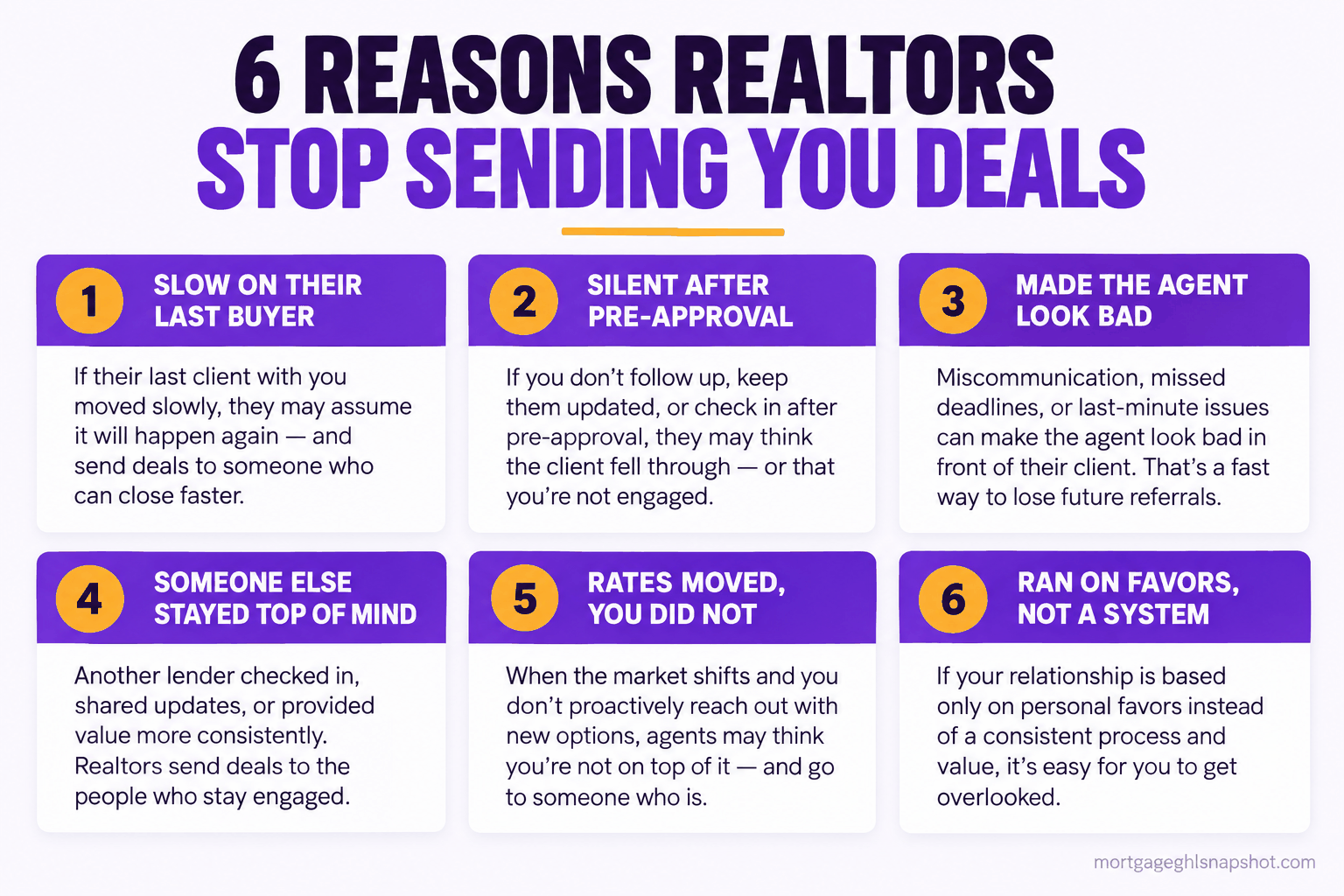
Agents rarely tell you why they stopped. They just route the next buyer elsewhere. Here are the six causes I see over and over, each with the signal that gives it away, what happened, and how to fix it. Most quiet relationships are one or two of these, not all six.
1. You were slow on their last buyer
The signal: the referrals slowed right after a deal where the buyer had to wait on you, even if the loan closed fine.
This is the most common one and the hardest to see, because the loan closed, so you filed it as a win. The agent filed it differently. Her buyer called you Saturday about a house they wanted to write on Monday, and you got back to them Sunday night. To you, a normal weekend. To the agent, a client texting “have you heard from the lender?” while a competing offer went in. The landmark speed-to-lead research found that contacting a lead within 5 minutes instead of 30 makes you 21x more likely to qualify it (Oldroyd/MIT, 2007). Agents do not read that study, they live inside it.
The fix: stop relying on yourself to be fast, because you cannot be fast at 9pm on a Sunday. Put an instant response on every inbound. A missed-call text-back that fires within seconds, plus a speed-to-lead workflow that acknowledges a new buyer and books the call, earns you the reputation of the lender who always picks up, even when you are asleep.
2. You went silent between pre-approval and clear-to-close
The signal: the agent was warm through pre-approval, then cooled during or right after a deal that felt quiet on her end.
The window between contract and closing is exactly when the agent needs information and when a lot of loan officers go dark. Nothing is technically wrong, so you say nothing. But no news reads as bad news to a realtor whose commission and reputation ride on your file. She ends up chasing you for a status while her client texts her asking what is happening, the fastest way to make an agent decide the next buyer is safer elsewhere. Poor communication is the most common complaint borrowers file about lenders (Floify), and the agent hears those complaints first.
The fix: send proactive milestone updates the agent never has to ask for. Application received, submitted to underwriting, conditions in, appraisal ordered, clear to close. Five short texts across a normal file, sent automatically, and she never wonders again. A steady drip of “here is where we are” makes an agent relax and refer.
3. You made the agent look bad in front of her client
The signal: referrals stopped cold after one deal, with no explanation, sometimes with a noticeably cooler tone.
This is the expensive one. A surprise at the closing table, a payment that moved without warning, a condition you should have caught in week one that blew up in week three. The buyer does not blame you. They blame the person who recommended you. You did not just deliver a rough file, you spent the agent’s credibility with her own client, and agents protect that harder than their commission. One deal like that can end a relationship that took two years to build.
The fix: you cannot un-ring that bell with the client, but you can be honest with the agent. Own it, tell her what broke and the step you have changed so it cannot happen again, then prove it on the next file with flawless communication. Agents forgive a mistake that gets named and fixed. They do not forgive the loan officer who pretends it went fine.
4. Someone else stayed top of mind and you did not
The signal: no bad deal, no complaint, the referrals just faded while the agent stayed friendly.
Sometimes nothing broke. You simply disappeared from her week. Another loan officer showed up with a co-branded open-house flyer, a useful market update, a quick “saw your new listing” text. You were not worse. You were absent, and referrals go to whoever is present when the buyer raises their hand.
The fix: build a light, compliant, always-on presence. A monthly value email the agent can forward, co-branded content that makes her look good to her sphere, a genuine touch on her listings. You are not paying for placement, you are staying useful and visible. Our realtor referral partnerships playbook walks through the cadence that keeps you top of mind without becoming a pest.
5. Rates moved and her business changed, but your outreach did not
The signal: the whole relationship cooled around the same time the market shifted, not around any one deal.
When rates jump, an agent’s business does not just shrink, it changes shape. Fewer move-up buyers, more first-timers stretching for affordability, more deals that need a buydown to pencil out. If your outreach still assumes the market from two years ago, she drifts to the lender speaking to the deals she is working now.
The fix: meet the market she is in. Send the FHA and first-time-buyer angles when that is what is moving, offer to run a homebuyer class for her stretched clients, and get fluent in the rate-drop refi conversation so you have a reason to reconnect with her past buyers when rates ease.
6. The relationship ran on favors, not a system
The signal: it was always sporadic, dependent on you remembering to reach out, and it faded the first busy season you got distracted.
A lot of agent relationships run on goodwill and nothing else. No cadence, no follow-up, just two people who like each other and occasionally do a deal. Goodwill is fragile. The first quarter you get slammed and forget to check in, the relationship starves. If it lived entirely in your memory, it was always going to fade, because memory is a terrible pipeline.
The fix: put the relationship on rails. A CRM workflow that tags every agent partner, schedules the next touch automatically, and never lets one go more than a few weeks without a genuine, useful contact. The point is not to automate away the relationship, it is to make sure it never dies because you had a busy month.
Relative odds of qualifying a web lead by response time, indexed to a fast reply. Source: Lead Response Management Study (Oldroyd/MIT, 2007) and Harvard Business Review (2011). Figures illustrative of the study’s findings.
Steal this: the winback scripts and cadence
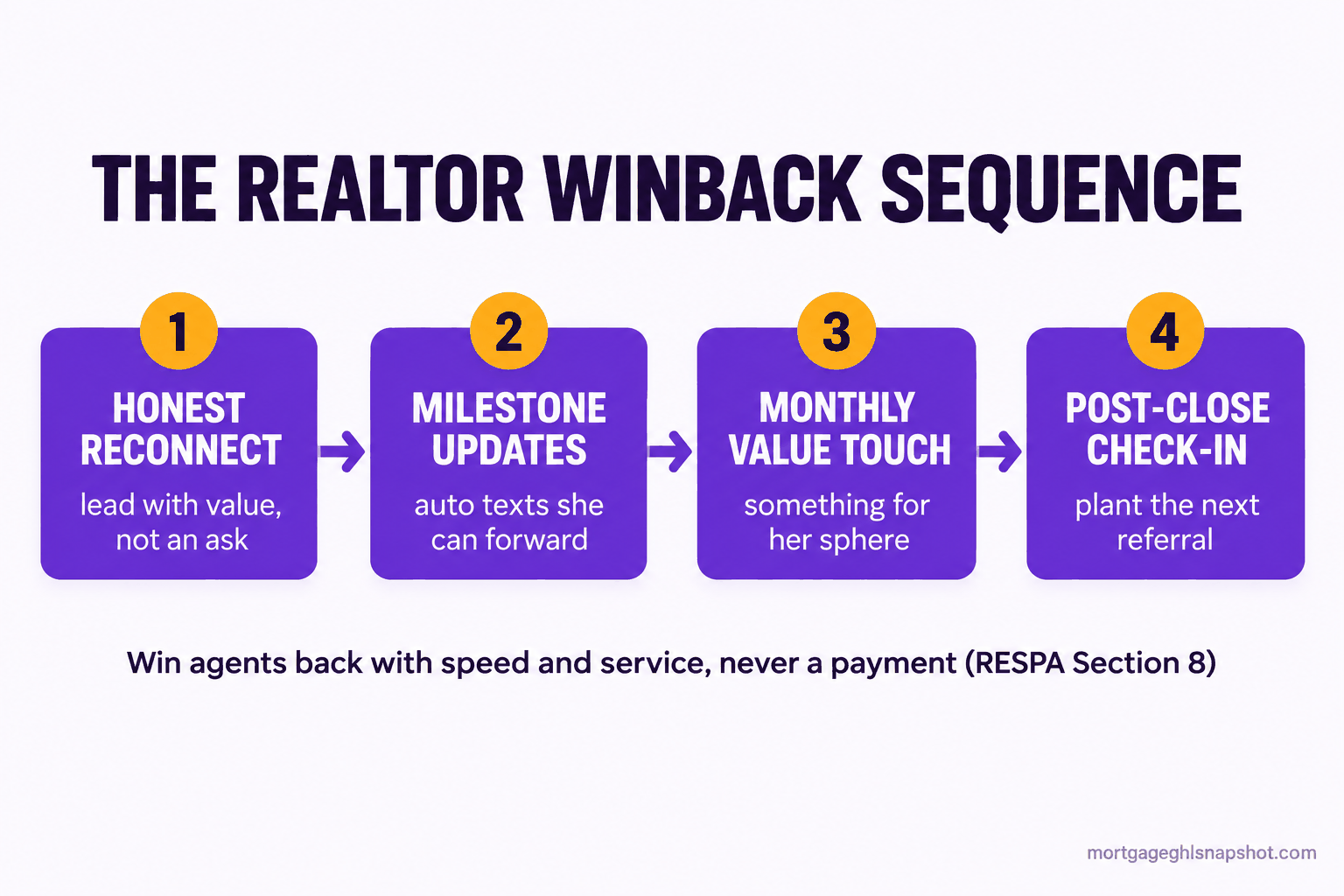
Diagnosis is half the job. Here is the copy I hand loan officers to reopen a quiet relationship. None of it costs the agent anything or offers value in exchange for referrals, keeping you clean under RESPA.
The pattern is the same across all three: lead with usefulness, prove reliability, keep the ask small. Set the milestone updates to fire automatically, and put the reconnect and monthly touches on a schedule so no partner slips through the cracks again.
Solo LO, small team, and a real partner program
The six reasons are the same at every size. What changes is how much of the winback runs on you versus on a system.
The solo loan officer. You are the bottleneck, and reasons one and two are always your risk, because you cannot answer every buyer inside five minutes while processing files. Automate the instant response and milestone updates so your reliability no longer depends on your calendar, then reconnect with your top three quiet agents by hand. You do not need fifty partners, only three good ones.
The small brokerage with 2 to 15 LOs. Here the problem is consistency across people. One LO’s slow weekend becomes the whole shop’s reputation with a shared agent. You need a standard: every partner tagged in the CRM, every live file firing the same milestone updates regardless of which LO owns it, and a rule that no partner goes a month without a touch. When the experience is identical no matter who picks up, agents default to your firm.
The team built on a realtor partner program. If agent referrals are your primary channel, treat the relationship as infrastructure, not goodwill. Score partners by production, watch for the early signal of one cooling off (referrals per quarter trending down), and trigger a reconnect before the pipe goes dry. Pair the always-on service with compliant co-marketing, and reactivate the buyers those agents sent you years ago through database reactivation.
Winning them back without breaking RESPA
The instinct that kills more loan officers than slow follow-up is the temptation to buy the relationship back with money. You cannot. RESPA Section 8 prohibits giving or accepting a fee, kickback, or thing of value for the referral of settlement-service business, with penalties up to a $10,000 fine and a year in prison per violation, plus triple damages (CFPB, 12 CFR 1024.14). Paying an agent’s marketing bill because she feeds you loans, covering her CRM seat, or sponsoring her happy hour is a thing of value for referrals, and calling it “marketing” does not save you.
What is legal is genuine co-marketing where each side pays its own fair share of a real service, and educational activity not conditioned on referrals. Run the homebuyer class, send the market update, co-brand the flyer and split the cost by the space each takes. Win the agent back with speed and reliability, never with a check. For the full rulebook and sample language that survives an audit, read our RESPA-safe realtor co-marketing guide. The good news: what actually wins agents, being fast and making them look good, is free.
The objections I hear every week
“If she wanted to work with me, she’d call. Chasing her looks desperate.” There is a difference between chasing and being useful. “Got any deals?” is chasing. “Here is a market update you can forward, and I’ve fixed the thing that slowed us down” is a value touch. Agents do not refer to the loan officer who begs, but to the one who is reliably helpful.
“I don’t have time to send updates on every file.” That is exactly why you automate them. The milestone texts fire on their own as the loan moves through your pipeline, so the agent gets a steady stream of “here is where we are” while you do zero extra work.
“My rates aren’t the sharpest, that’s why they left.” Almost never true. Agents refer on the experience their client had, not on an eighth of a point. A loan officer who answers in minutes and never surprises anyone at the table beats a cheaper lender who goes dark. Price is a comfortable story to tell yourself, but usually the wrong problem to fix.
“Isn’t it too late once they’ve gone quiet?” Rarely. A quiet agent is not an angry agent, she just found a path of less resistance. One honest reconnect backed by a better experience on the next file reopens most relationships. You already closed deals together, so you are reminding her why, not starting over.
Go back to the agent who used to send three a quarter. The right move is not a groveling text or a gift card, both of which make it worse. It is one honest message that leads with value, a system that answers her buyers in minutes and keeps her informed without her asking, and a next file so smooth she remembers why she trusted you. That is what reopens the pipe and keeps it open.
Frequently asked questions
Why do real estate agents stop referring a loan officer?
Usually because of the experience their client had on a recent deal: slow response on the agent's buyers, going silent between pre-approval and closing, surprising the client at the table, losing top-of-mind presence to a competitor, or a relationship that ran on goodwill with no follow-up. Agents rarely explain. They just route the next buyer elsewhere.
How do I win back a realtor who has gone quiet?
Lead with usefulness, not an ask. Send one honest reconnect message that offers value and names any issue you have fixed, then prove reliability on the next file with instant lead response and milestone updates she can forward to her client. Never offer anything of value in exchange for referrals, which violates RESPA.
Is it faster follow-up or lower rates that wins agent referrals?
Follow-up, in almost every case. Agents judge a lender by the experience their client receives, so responsiveness and protecting the closing date matter far more than a fraction of a point on rate. Contacting a buyer within five minutes instead of thirty makes a loan officer 21x more likely to qualify the lead (Lead Response Management Study, Oldroyd/MIT, 2007).
Can I pay a realtor to send me referrals?
No. RESPA Section 8 prohibits giving or accepting any fee, kickback, or thing of value for the referral of settlement-service business on a federally related mortgage. Penalties reach a $10,000 fine and one year in prison per violation. Covering an agent's marketing, software, or events because they feed you loans is an illegal referral payment even if you call it marketing (CFPB, 12 CFR 1024.14).
How often should I stay in touch with a referral partner?
At least monthly with a genuine, useful touch, plus automatic milestone updates on every live file the agent sent you. The monthly touch should give her something she can use with her own sphere, such as a market update, not a pitch. The relationships that fade are the ones with no cadence behind them.